

These lands once belonged to the great Novgorod, and in the Vodskaya Pyatina Census Book they were listed as Dyatlinsky Pogost of the Koporye Uyezd. The initial successes in this war allowed Peter to found Petersburg and the naval fortress of Kronstadt. Peter entrusted Menshikov with overseeing the construction of both.
The history of Oranienbaum began in October 1703, when Peter I personally determined the shortest route from Kronstadt to the coast. From this point, along the entire southern shore of the Gulf of Finland up to the under-construction Petersburg, the tsar ordered plots of land to be cut out for the suburban residences of his close associates. Peter reserved lands for building future residences in Strelna and Peterhof, and gave Menshikov the first and simultaneously the farthest plot from Petersburg. Here began the construction of Oranienbaum, conceived as part of a majestic panorama welcoming all arriving by sea to the new Russian capital. The ceremonial residence of the "first" nobleman of the state was meant to be perceived, among other things, as a symbol of Russia’s triumph in the Great Northern War.
In 1780, the city of Oranienbaum, recently elevated to the rank of uyezd town, was granted a coat of arms. Its mysterious and unusual symbolism for Russian heraldry — a bitter orange tree with exotic fruits on a silver field — dates back to the first decade of the 18th century. Most likely, this coat of arms originally belonged to Menshikov’s estate.
Regarding the origin of the unusual name Oranienbaum (translated from German as "bitter orange tree"), first recorded in 1711 as "Araninbom," there are several theories. The most famous, essentially legendary version, is that on the territory of Menshikov’s future residence there was a greenhouse with bitter orange trees, each labeled "Oranienbaum." Greenhouses with 101 bitter orange trees did exist on the estate in 1728, but historians reject the possibility of such greenhouses before 1711. Other versions proposed by scholars are not mutually exclusive. According to the second version, the name was borrowed from the German city of Oranienbaum, named after Henrietta of Nassau-Oranien and her Orange dynasty. The third version claims that when choosing a name for his estate, A. D. Menshikov sought to please Peter and used a slightly altered name Oranienburg, which Peter I gave in 1703 to Menshikov’s new estate near Voronezh. Finally, according to the latest viewpoint, Oranienbaum was named after the English King William of Orange from the same dynasty, who inspired deep sympathy in Peter the Great, bordering on worship in his youth.
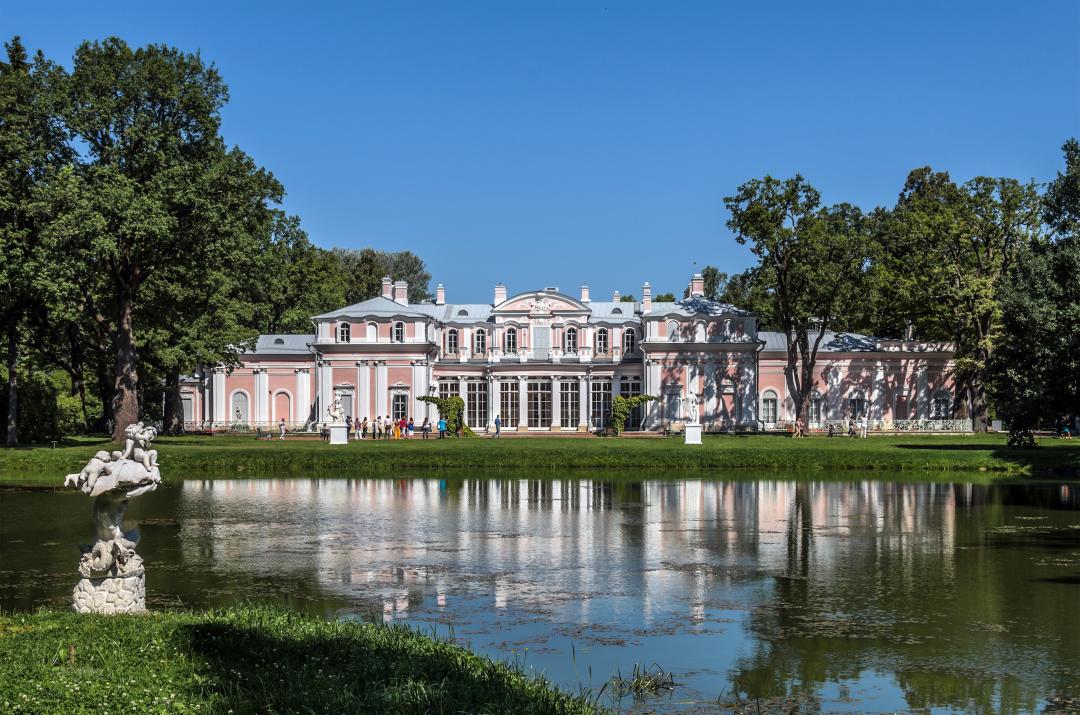
In 1711, architect Giovanni Fontana, engaged in building Menshikov’s palace in Petersburg on Vasilievsky Island, began constructing Alexander Danilovich’s suburban residence right on the shore of the Gulf of Finland. The Large Menshikov Palace, like Peterhof, stretched along the edge of a natural elevation. The length of the main facade facing the Lower Garden and the Gulf of Finland is 210 meters. The central part of the palace is two stories, flanked by one-story galleries curved in an arc and ending with the Japanese and Church pavilions. Two wings are attached perpendicularly to the galleries, so the palace’s layout resembles the letter "П" (a U-shape). The wings form the boundary of the Large Palace’s inner southern courtyard.

Contemporaries noted the unprecedented luxury of the Light Prince’s suburban residence, which at the time surpassed Peterhof in scale. The French traveler Aubry de La Motte wrote about it: "Oranienbaum is a magnificent pleasure palace… Nothing can compare to it, neither in splendor nor in other respects."
Initially, a two-story building was constructed, later extended by one-story semicircular galleries finished with two striking pavilion towers. From the pavilions, one housing a church and the other the Japanese Hall, one-story arcaded service wings extended southward, forming a huge inner courtyard.
The sense of extraordinary height and grandeur of the palace from the sea was enhanced by terraces decorating the northern slope of the natural elevation, serving as a kind of pedestal for the entire structure. Gentle ramps and picturesque, grand fan-shaped staircases adorned with balustrades, vases, niches, and sculptures led to the terraces.
This was a typical Baroque suburban mansion, whose exaggerated size, excessive magnificence, and emphasized ceremonial nature reflected the character of its owner, whose boundless ambition and vanity would not allow him to remain in the background. His Petersburg palace was considered the largest in the capital, excluding the royal chambers, and the Oranienbaum palace significantly exceeded the size of the royal Peterhof palace. Contemporaries called Menshikov’s palace on the seashore the "Pleasure Castle." Its view, with a giant crown above the roof and princely monograms on the balcony grilles, attracted the attention of sea travelers from afar. Meanwhile, the flat roofs of the galleries, enclosed by balustrades in the 18th century and used for walks, opened amazingly beautiful views of the Gulf of Finland and Kronstadt.
From 1713, architect Schedel completed the palace, working in Oranienbaum until Menshikov’s disgrace and exile. Later, at various times, project and construction work in the palace was carried out by Mikhail Zemtsov, Bartolomeo Rastrelli, and finally Antonio Rinaldi. Each brought elements of their own architectural style but managed to preserve the unity of the original artistic concept and the integrity of the spatial composition. However, the palace’s preservation was somewhat affected by the absence of permanent owners. At different times, it belonged to the Naval Hospital, the Naval Cadet Corps, heir to the throne Peter Fedorovich, and other members of the royal family. Various institutions and departments were housed there. The palace gradually fell into decline. Elements that gave the palace its grandeur and majesty disappeared. For example, the loss of the arcaded treatment of the stone terrace walls completely deprived the palace of the perception as a multi-story structure.
Simultaneously with the construction of the Large Palace, a formal Lower Garden was laid out in front of its northern facade, with a parterre square, bosquets, and sculptures. The garden’s creators intended to decorate it with more fountains than the royal Peterhof. Combined with European-style trimmed shrubs, a huge number of trees were planted in the garden, modeled after old Moscow estate gardens. According to the 1736 inventory, there were 314 apple trees and 600 old cherry trees alone.
From the main palace entrance, a wide central alley divided the garden into two equal halves. Extending beyond the garden gates, it crossed the old Koporye road and ended at the docks of a specially dug basin for ships to enter. From the basin to the gulf stretched a wide canal nearly a kilometer long, reminiscent, as in Peterhof, of Russia’s inseparable connection with the sea.
The Marine Canal (as in Peterhof) approached the gates of the Lower Garden from the Gulf of Finland and ended in a shaped harbor with a pier. There is a legend that both the original Menshikov Palace and the Marine Canal were built at the request of Catherine I. Like the "way stations" in Peterhof, Catherine, concerned about her husband’s safety during his trips to Kronstadt, believed that in stormy weather Peter would inevitably stop by his favorite’s residence on the way back. From there, he could return to Petersburg by a safer route — along the coastal road on horseback. According to legend, the canal was dug in just three days. Nine thousand of Menshikov’s serfs, taken off all construction sites, participated in the work, supervised by the Light Prince in Kronstadt and Petersburg at that time.
According to another legend, the same canal was dug for a different reason. Once Menshikov was waiting for the tsar on the road from Petersburg to Oranienbaum. But, unfortunately, Peter decided to come to him by the gulf in a light boat. However, the shallow coastal strip overgrown with reeds prevented the boat from approaching the shore. The angry tsar ordered to turn back. Then Menshikov stopped all construction work in Kronstadt for three days to dig a canal to the Lower Garden of Oranienbaum. After passing through it, Peter supposedly said: "A fine thing, though it must have cost a bit." The Duke of Izhora, notes Pylyaev, "did not skimp when the matter required expenses." As we know, the emperor himself was indifferent to luxury but encouraged passion for it in others.
The Lower Garden was separated from the Koporye road by an impressive fence, rebuilt in the mid-18th century by architect Rastrelli during his redesign of the Lower Garden. The metal links of the fence were joined by alternating small and large stone pillars, topped in the 18th century with military armaments and busts.
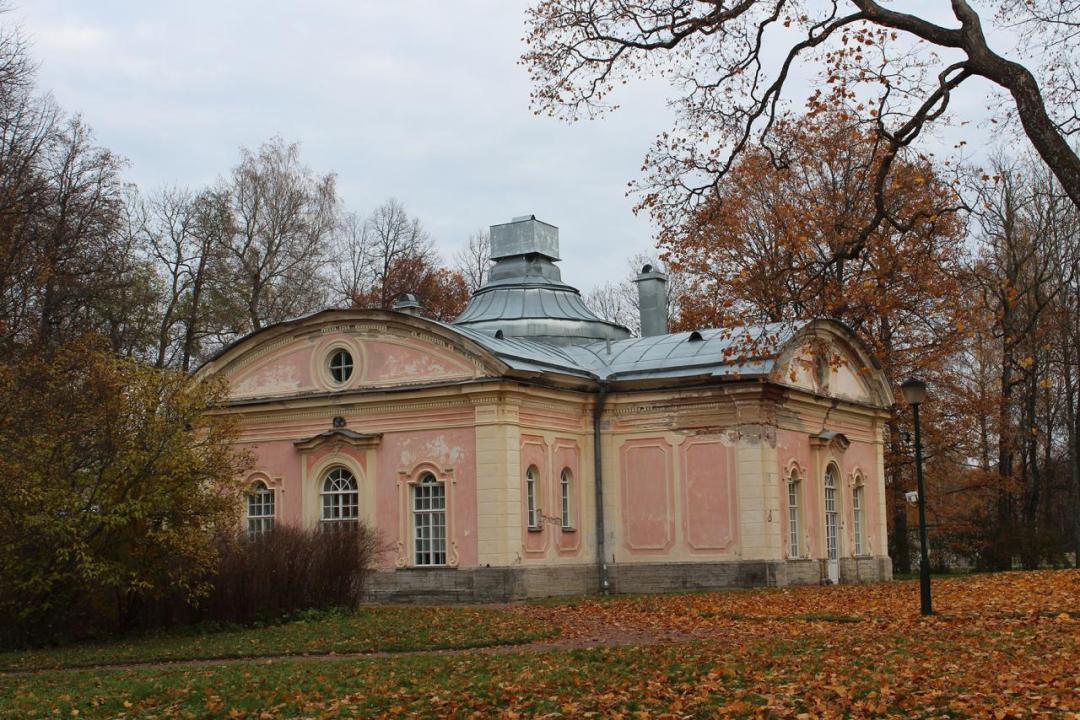
The western side of the fence adjoined a one-story house on high cellars with a mezzanine, built, according to some assumptions, by Rastrelli himself and formerly used for entertainment purposes. One half housed an opera, which is why in documentary sources this house is sometimes called the "Former Opera House," and the other half contained a library, a Kunstkamera, and rooms for hanging paintings. The "Picture House," as it was called by the first owners, became almost the first special building in Russia for housing and storing art collections. This exceptionally valuable architectural monument of the mid-18th century has preserved its original appearance despite its solid 200-year age and many different, sometimes completely random owners, including a military hospital, a real school, and a secondary school.
The eastern wing of the garden fence was once closed by the architecturally matching "Picture House" Pomeranian Orangery, which we have already mentioned. Unfortunately, it has not survived to this day. Behind the orangery, formed by a complex system of dams and weirs, lay the Lower Pond, known in the Petrine era as the "Small Pleasure Sea," used for sharp entertainments of the jaded nobility.
Contemporaries noted the unprecedented luxury of the Light Prince’s suburban residence, which at the time surpassed Peterhof in scale. The French traveler Aubry de La Motte wrote about it: "Oranienbaum is a magnificent pleasure palace… Nothing can compare to it, neither in splendor nor in other respects."
After Menshikov’s disgrace, all his estates were confiscated into the treasury. In 1743, Empress Elizabeth Petrovna granted Oranienbaum to the heir to the Russian throne, Grand Duke Peter Fedorovich, later Emperor Peter III.
It was under Peter Fedorovich that the eastern pavilion of the Large Menshikov Palace received its current name — "Japanese." By the Grand Duke’s order, a collection of expensive porcelain was placed inside. According to legend, it was in the Japanese pavilion on June 29, 1762, that the emperor, who had reigned only 186 days, signed his abdication in favor of his wife, who became Empress Catherine II and the new owner of Oranienbaum.
From 1762, architect Rinaldi worked on the palace. Having remodeled the terrace anew, he built a magnificent granite staircase with a semicircular balcony. The palace interiors were decorated with paintings, stucco, fabrics, and mirrors. In the 1770s, under Rinaldi’s project, retaining walls of the terraces and a granite porch, preserved to this day, were constructed. At the end of the 18th century, by order of Emperor Paul I, the owner of the Large Palace became his eldest son, Grand Duke Alexander Pavlovich, the future Emperor Alexander I. From 1809 to 1825, the Large Palace served as an imperial residence.

From 1827, the palace was owned by the emperor’s brothers, Grand Dukes Konstantin and Mikhail Pavlovich. A new stage of reconstruction is associated with the name of Grand Duchess Elena Pavlovna, widow of Grand Duke Mikhail Pavlovich, who owned Oranienbaum for almost half a century. The estate became her favorite summer retreat, and significant changes took place in the layout and decorative interior finishes of the palace. The new mistress sought and found other forms of self-expression, making Oranienbaum completely different and original without losing its former charm. In the mid-19th century, the palace interiors were altered according to the designs of famous architects Stakenschneider, Bosse, and others in the then-fashionable eclectic style, which allowed mixing heterogeneous stylistic elements. From Elena Pavlovna, Oranienbaum passed to her daughter, Ekaterina Mikhailovna, and then to her grandchildren — the German Dukes of Mecklenburg-Strelitz.
In 1918, the palace was transferred to the Local Council and came under the protection of the Commissariat of Property of the Republic. At various times, the Large Palace housed a hospital, an agricultural school, and a forestry technical school with a dormitory. In 1934, the palace building was handed over to the Navy — the space of the Church Pavilion was divided by intermediate floors, and the unique early 18th-century iconostasis was dismantled. Only in 1995 did the transfer of the Large Palace to the museum-reserve begin. Its doors as a museum opened to visitors in September 2011.
In the three-century history of the Large Menshikov Palace, times of prosperity were repeatedly replaced by periods of oblivion and decline. Nevertheless, the palace avoided catastrophic destruction and radical reconstructions and has survived to this day as one of the few authentic monuments of Russian architecture of the first half of the 18th century. During the Great Patriotic War, the fascists failed to occupy Oranienbaum, making it the only fully preserved imperial residence.
In October 1948, during the uncompromising struggle of Soviet power against cosmopolitanism and imitation of the West, the city of Oranienbaum was renamed Lomonosov. Hence the joke still told: "Did you know that Lomonosov was Jewish?" — "What? Him too?" — "Imagine, his real surname was Oranienbaum."
However, many curiosities occurred in the biography of the glorious city of Oranienbaum. For example, as early as 1917, one of the city’s oldest streets — Yelenskaya, named after Grand Duchess Elena Pavlovna, then owner of Oranienbaum — was turned into Leninskaya by cutting off the first letter. By the way, this cheerful pun, thought up by one of the local revolutionary sailors, became the first toponym in the new Russia dedicated to the "leader of the world proletariat."
Sources:
Naum Sindalovsky: Legends of Petersburg Gardens and Parks
https://peterhofmuseum.ru/objects/oranienbaum
https://ru.wikipedia.org/wiki/Oranienbaum_(palace-and-park_ensemble)
http://www.oranienbaum.org/oranienbaum/the-ensemble-of-the-grand-palace/great-oranenbaumskiy-palace/




Written by Jermaine
Discuss this with the author and others
No comments yet. Be the first to start the conversation.