

The history of Lomonosov’s origin is connected with the construction of the fortress city of Kronstadt. The beginning of Oranienbaum’s appearance was laid by Alexander Danilovich Menshikov, who managed the construction works in Kronstadt. The first structure in the Kronshlot fortress was built in 1704, and already in 1708 Menshikov began construction on the southern shore of the bay of the Grand Palace, which became the center of his estate. Despite the proximity to Kronstadt, the approaches to Oranienbaum from the bay side were difficult. Below, near the shore, lay a swamp, not far away was a sandy shoal, and the entire coastal shallows and the mouth of the Karosta river were overgrown with reeds, which complicated access to the shore. All this caused the necessity of building the Oranienbaum Canal.
Oranienbaum was never a military port in the full sense of the word, but throughout its history it served as a kind of transit hub for the fleet, and in this regard, the Oranienbaum Canal played an important role for many years. Built at the beginning of the 18th century, during the war with Sweden, using free labor and local building materials, it apparently did not require any full accountability from the canal builders, and what has been preserved in the archives regarding the canal’s history has not been reflected in the history of the city of Oranienbaum, which gave rise to various legends.
The canal itself, located opposite the Grand Palace, was at that time a well-thought-out and rather complex hydraulic engineering structure, and its true purpose was far from idle palace amusements. The canal existed as the only sea gate of the city approximately from 1713 to 1850, that is, until the opening of steamboat communication between Oranienbaum and Kronstadt.
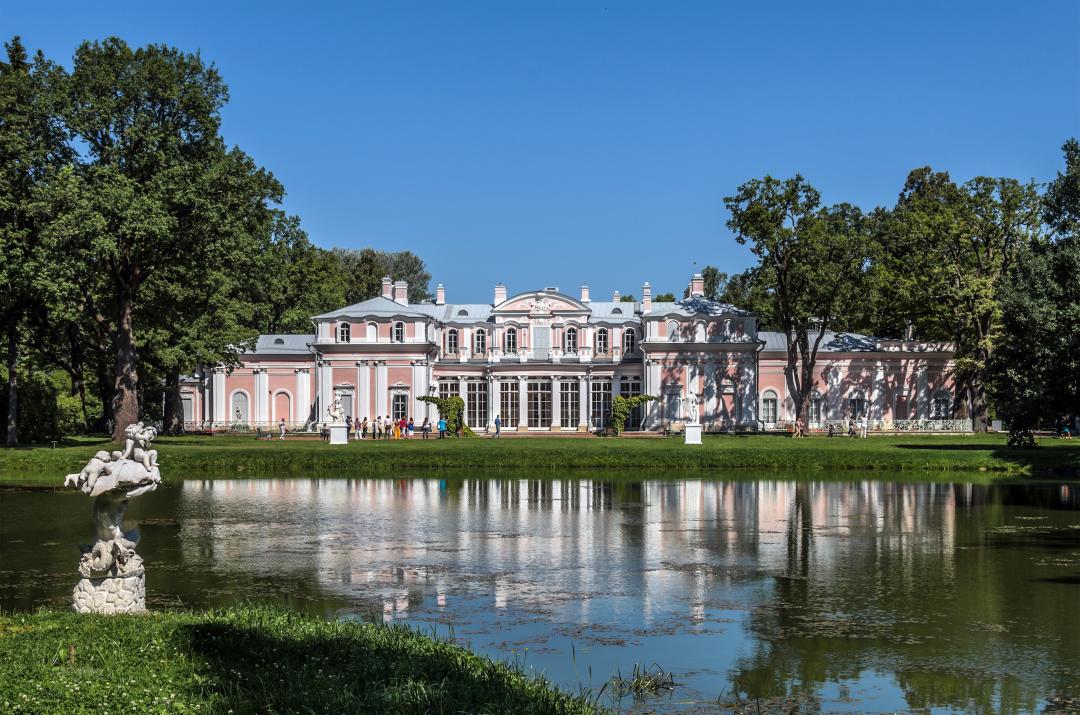
The canal was included in the unified ensemble of the Grand Palace’s structures and to this day remains a decoration of the city of Lomonosov and has its own history. The magazine "Neva" in 1882 writes: “Menshikov, Peter I’s favorite and manager of works in Kronstadt, built himself a house and planted a garden in his new estate. However, despite Oranienbaum’s proximity to Kronstadt, due to shallow waters Menshikov could not travel to Oranienbaum for rest after work. Peter himself tried in vain to approach, and Menshikov decided to surprise the sovereign. He gathered several thousand peasants, and in three days a canal 220 sazhen long was dug.” In 1889, Pylyaev in his book "The Forgotten Past of the Surroundings of Petersburg" writes: “There is a legend: both the laying of the estate and the digging of the canal were done by the prince at the request of Catherine I. According to legend, the canal was made in three days, with more than nine thousand serfs of Menshikov participating in the work.”
We will not refute all the legends about the canal but will turn to the historical documents that have been preserved. To begin with, the length of the Oranienbaum Canal is not 220 sazhen, but together with the harbor structure exceeded 700 linear sazhen. Regarding the nine thousand peasants involved in construction, it should be said that Menshikov indeed owned many thousands of serfs in Russia, but here, on the peninsulas of Bronninskaya and Soykinskaya belonging to him, even in 1789 according to the census, there were only 3,550 male peasants. If such a number of people participated in the construction, then apparently the main part were Swedish prisoners of war.
Regarding the legend of Prince Menshikov presenting the canal to Tsar Peter as a “surprise,” there are quite complete documentary data preserved in the archives about its direct purpose. It has not yet been possible to establish the exact start and end dates of the Oranienbaum Canal construction, but a letter from Prince Menshikov to Peter the Great dated May 26, 1712, has been preserved: “Most honorable and excellent Sir Admiral, my special benefactor. Upon sending this courier to Your Excellency, I have nothing notable to report... I gave instructions to Vice-Governor Korsakov to dig a canal for me in Oranienbaum, for which a bagard (Bagard — a crimson coastal fishing boat) is needed, and therefore I ask you to kindly order one to be brought from Voronezh, who in everything is, by your excellency’s hope, always your excellency’s well-wisher and most ready to serve, Menshikov.”
The letter shows that the appearance of the Oranienbaum Canal was no “surprise” by Menshikov for Tsar Peter and that it was built, judging by the letter, by his order. It was built by Yakov Nikitich Rimsky-Korsakov — the Novgorod and Petersburg vice-governor, who oversaw the supply of troops, labor, and building materials. There are no exact data on how long the canal construction lasted. But it was built hastily and in a short time. Judging by its size and construction, evidenced by the preserved original plan of the canal, it can be concluded that work on the canal was carried out both in summer and winter, that is, about a year, not just one day as the legends claimed.
The ongoing war with Sweden, which at that time had a strong military fleet dominating the Baltic, required decisive actions and constant readiness to go to sea from the emerging Russian fleet. In this regard, it is interesting to cite the content of a report from Fleet Commander Admiral Kruys to Peter the First from Kotlin Island dated June 27, 1713, that is, a year after the start of the Oranienbaum Canal construction:
“I have received and understood your most gracious letter dated the 26th of this month with attached copies, and with the ships I am ready at a moment’s notice to sail, only some provisions have been sent here... Yesterday I was informed to take bread from Oranienbaum and have already sent ships and men from the fleet there.” Therefore, from its early years, Oranienbaum became a nodal point through which fleet supplies passed. Hence the canal’s direct purpose. In all historical archival documents, it is listed not as the Palace Canal but the Oranienbaum Canal and, after Menshikov’s disgrace in 1728, like the Grand Palace, was under the management of the Office of Imperial Household Buildings and Gardens. The further fate of the canal is known as follows. In November 1736, by the personal decree of Anna Ioannovna, “The Oranienbaum estate with the mill, gardens, and other lands located in that village” was transferred to the maintenance of the Naval Hospital, that is, to the Naval Department, including the canal.
And in 1761, by decree of the Governing Senate, it was ordered “that until further notice the canal be under the supervision of the director over the Kronstadt Canal, General-Anschef Hannibal.” From that time, it has been part of the Admiralty Department, as stated in the Admiralty College’s report to Catherine II dated March 29, 1767. It follows that the Oranienbaum Canal was transferred to the Naval Department, after which no imperial government decisions changing these decrees about the canal were made until 1918. Repairs and all maintenance of the canal were carried out at the Admiralty’s expense. The site chosen for the canal and the plan itself, considering the technical means of that time, are successful.
Built at an angle of 50 degrees east of the meridian in a straight line from the Grand Palace, the canal cuts into the bay, crossing the former sandy shoal. It is 680 sazhen long, with an initial width of five sazhen and a depth of nine feet throughout. Two-thirds of the canal passed through marshy, periodically flooded swamp, and along the sea water for 180 sazhen there were artificial dams built on both sides, five sazhen wide.
The shore inside the canal along its entire length and both dams were paved with stone, and along the eastern shore, on top of the dam, ran a paved road. The canal ended with a wooden harbor structure about 100 sazhen long in the bay, and inside the harbor there was a pier called the Kronstadt Military Pier. The initial part of the canal, the so-called “bucket,” measuring twenty by fifteen sazhen, was reinforced on both banks with wooden hoops made of logs, and the front — southern side — was lined with a brick wall. Here was also the Palace Pier.
A wide staircase descended directly from the lower park to the pier, and a wooden house stood nearby. Beyond the bucket, the canal ran about two hundred sazhen over dry land, where a basin of two parts was dug, located on both sides of the canal. They were called “basenki,” each measuring thirty by twenty sazhen. They were connected to the canal by channels over which drawbridges were thrown. The “basenki” served as moorings for boats and cutters, whose bridges were raised upon their entry. Here, near the basin, stood a guardhouse where the team assigned to work on the canal and service the vessels entering the basin was stationed. There were also stables for government horses assigned to the canal, a smithy, and a shed. Between the basin and the harbor along the eastern shore of the canal, there were two recesses called “passing places” for meeting vessels of larger tonnage to pass each other. Over time, during canal repairs, the passing places were removed. The canal banks up to the harbor structure, over the sheathed planks, were covered in six rows of fascines, and the bottom was laid with natural stone. The harbor structure of the canal consisted of a row of log frames fastened to the ground with piles and filled with natural stone.

The canal occupied a land strip fifteen sazhen wide, plus an additional five sazhen on the banks where roads ran. The main road, paved with cobblestones, ran along the eastern highway and was initially called the Kronstadt Military Harbor Highway, and with the establishment of steamboat communication between Oranienbaum and Kronstadt, it was renamed Steamboat Street. In the harbor itself at the pier stood a guardhouse for the military team assigned from the fleet to ensure transportation, headed by an officer “overseer,” whose duties included monitoring cleanliness in the harbor, maintaining it in good condition, and overseeing the dispatch of boats. This is how the Oranienbaum Canal looked according to the preserved plans and regulations of the last quarter of the 18th century.
Being under the Naval Department since 1736, the Oranienbaum Canal was under the direct supervision of the Office of the Kronstadt Stone Canal, “therefore its maintenance depended on it.” Only once in 1733 was the replacement of dilapidated wooden fences carried out under the supervision of the department’s carpenter master from the Office of Imperial Household Buildings and Gardens.
The first major repairs on the canal were carried out in 1755 by General Engineer Abram Petrovich Hannibal — great-grandfather of A. S. Pushkin, and these works cost 25,318 rubles and one-quarter kopeck.
Throughout the 18th century, that is almost a hundred years, the Oranienbaum Canal was used by the Naval Department only for government transportation and regular mail, opened in 1730 between Petersburg and Kronstadt via Oranienbaum, for which a special boat was allocated. Visitors to Kronstadt and back had to travel by private boats, and only from May 19, 1803, were private persons first transported on government boats. For this, a special naval officer was appointed at the military pier in Oranienbaum, whose duties included “monitoring the transportation of people and goods, collecting tolls, and requesting the highest decree for this.”
Toll fees in old times were collected from travelers for passage along the city street. In Oranienbaum, in particular, tolls for passage along the highway to the Kronstadt Military Harbor were collected until 1850, excluding military personnel, according to the tariff: one kopeck from church officials, noble clerks, townspeople, merchants, and tavern keepers; three kopecks from horses; five kopecks from carriages; three kopecks from Cherkassk cows; two kopecks from Russian cows; one kopeck from sheep, goats, and pigs. In spring 1805, special “Passenger Boats” were established between Oranienbaum and Kronstadt for transporting people of various ranks with their carriages, and navigation times were set — summer navigation was considered until August 15, and autumn until the “closing of the water.”
By the 1806 navigation season, the departure times of vessels, the number of passengers, and the fare were already regulated. Admiral Chichagov, being the assistant to the Naval Minister, reported to the State Admiralty College that, in addition to the boats used for transporting mail, couriers, and other government needs from Kronstadt to Oranienbaum, ordinary cutters and other vessels, it was decided to allocate four cutters specifically for transporting free people and officials traveling on their own business. The departure times of the cutters were set four times a day at exact hours regardless of the full number of passengers.
The number of passengers allowed on cutters was: 12-oar boats — 16 people, 10-oar boats — 12 people, 8-oar boats — 10 people, and anyone wishing to take a boat alone paid the full fare for the number of passengers. In this regard, it is interesting to cite the content of a report on the number of people, livestock, goods transported, and money collected for transportation in 1841 at the Oranienbaum pier, which characterizes the intensity of traffic between Oranienbaum and Kronstadt and the role of the canal as the city’s Naval gate.
“Transported by boats were senior and junior officers, sailors, noblemen’s people, peasants, their wives and children — 3,637 people; merchants and their wives — 188 people; Cherkassk bulls — 4,440 heads; Russian cows — 480 heads; calves, pigs, rams — 1,050 heads; geese — 300 heads; empty horses — 189 heads; horses with carts — 99 heads; and a total of 182 rubles was collected. Toll fees were collected from passengers traveling on free vessels, such as free noble peasants, merchants, townspeople, and their children, totaling 2,054 people. Transported on cutters were military personnel and their wives — 6,417 people; clergy, civil officials, clerks, merchants — 7,019 people. For the total number of passengers sent in ordinary times, 350 times 91.3 kopecks were collected from each cutter. In total, 1,092 rubles 47 kopecks were collected. In addition, military personnel were transported free of charge on boats — 16,498, and on cutters — 6,529 people.” From this, it follows that through the Oranienbaum pier on the canal, one-way towards Kronstadt, during the 1841 navigation season, 43,120 people, 6,258 heads of various livestock, and 5,378 poods of various goods were transported. Such was the role of the Oranienbaum Canal.
However, providing transportation was expensive for the treasury and imposed certain burdens on the fleet command, so the transition to steamboat communication was a necessary measure. In January 1847, the military governor of Kronstadt, Bellingshausen, having received a proposal to establish steamboat communication, reported to the chief of the Main Naval Staff:
“Until now, communication with Oranienbaum has been carried out on government cutters and boats for a very small fee, since the maintenance of vessels and crews for this purpose is a very significant expense for the Ministry, therefore the proposed communication will relieve the treasury of these costs and complaints of burden for the residents.” Steamboat communication between Oranienbaum and Kronstadt was opened on July 10, 1850. With the opening of steamboat communication, a special pier was built in Oranienbaum. The Kronstadt port command ceased to engage in the repair and cleaning of the Oranienbaum Canal, which lost its importance for the fleet. The canal turned into a recreational facility for the palace nobility and its guests. Every summer until 1905, the fleet had to allocate two sailors specifically for the palace boat, with maintenance at the fleet’s expense.
Accustomed to free maintenance of the canal by the fleet, the palace department continued to demand its cleaning and repairs even after the opening of steamboat communication. In a petition to the chief commander of the Kronstadt port, the manager of the palace department in 1860 reported: “The canal has become inconvenient for passage due to long-term sand deposits” and therefore requested to deepen the fairway and repair the banks. The daughter of Grand Duchess Elena Pavlovna, who became the actual mistress of Oranienbaum, persistently sought ways to force the Kronstadt port command to take care of the canal. Subsequently, the family of the Dukes of Mecklenburg-Strelitz repeatedly attempted to appropriate the canal. Currently, it is part of the Grand Palace ensemble.
Sources:
https://opeterburge.ru/environs/morskoj-kanal-v-oranienbaume.html



Written by Jermaine
Discuss this with the author and others
No comments yet. Be the first to start the conversation.