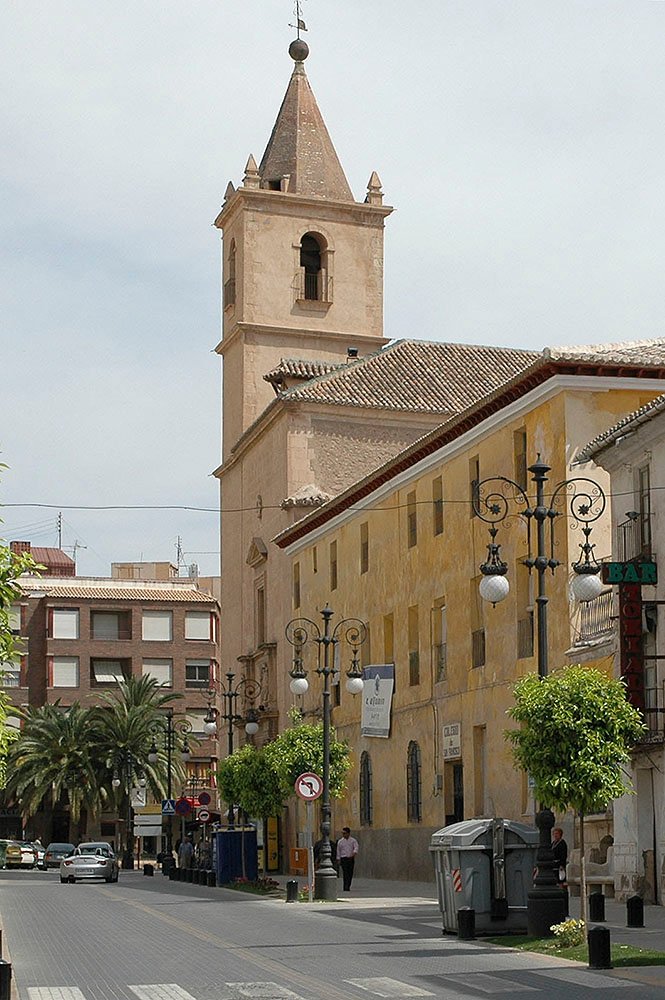

The Iglesia de San Francisco in Lorca, Region of Murcia, is a Catholic church of Baroque style with origins dating back to the 16th century. It is located at the intersection of the streets of Nogalte and cuesta de San Francisco in the city's historic center. While the current church was built as part of the Convent of San Francisco in the second half of the 16th century, subsequent reforms in the 17th and 18th centuries left little trace of its original appearance.
Inside, the church houses some of the most important Baroque altarpieces in the Region of Murcia. The Retablo Mayor (1694) is the work of Ginés López. The side altars from 1730 and 1735 are both by Jerónimo Caballero, with the right one dedicated to San Antonio and the left to the Vera Cruz and Blood of Christ. Additionally, the retablo of the Virgen de los Dolores (1691) was created by Manuel Caro. The church features a single nave covered by a barrel vault, with niches between the buttresses and a Rococo-style main chapel from the second half of the 18th century featuring mirrors.
The exterior includes a facade designed like a triumphal arch with elongated niches. The second body features a niche with a sculpture of the Virgin and Child, flanked by parapets with unfinished shields. The facade is topped with the coat of arms of Lorca. The bell tower is austere and slender, consisting of four bodies with an octagonal brick spire. The tower's clock still preserves its original machinery. The church is currently the seat of the Hermandad de Labradores (Paso Azul), one of the main brotherhoods of Lorca's Holy Week, which is declared a Festival of International Tourist Interest.
During Holy Week, the temple serves as a peak point for the festivities. It houses a significant portion of the artistic heritage of the Paso Azul, from which the blue processions depart. The collection includes the image of the Santísima Virgen de los Dolores (1942) by José Capuz and the Santísimo Cristo de la Buena Muerte (1945) by José Planes, both of which were declared Bien de Interés Cultural in 2023. The church also houses the Cristo de la Coronación de Espinas, a mystery paso created in 2001.
Sources: Wikipedia, OpenStreetMap, Wikidata, Wikimedia Commons
Written by Nicolo Ciampini
Discuss this with the author and others
No comments yet. Be the first to start the conversation.