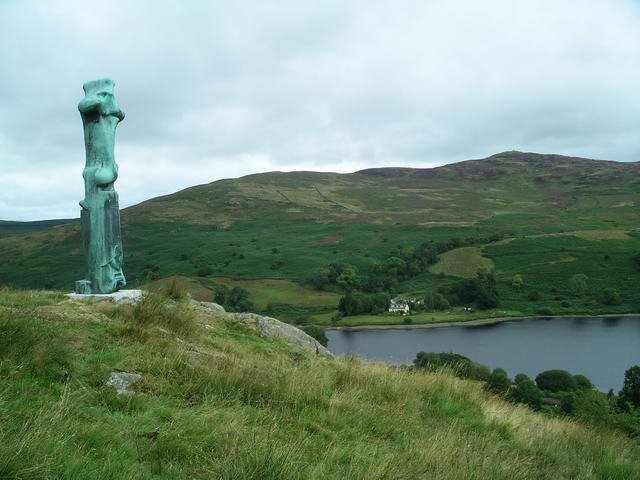
Upright Motive No. 1: Glenkiln Cross is a bronze sculpture by Henry Moore, cast in a number of copies in 1955-56. It was the first of a series of narrow vertical sculptures by Moore, who compared them to totem poles. The work takes its name from the Glenkiln Sculpture Park in Galloway, Scotland.
Moore described how the original idea came from a commission for an Olivetti building in Milan. After visiting the site, a lone Lombardy poplar growing behind the building convinced him that a vertical work would act as the correct counterfoil to the horizontal rhythm of the building. This idea ultimately grew into the 'Upright Motifs' series.
Versions of the sculpture are held in the Glenkiln Sculpture Park, the Kroller-Muller Museum in the Netherlands, the Amon Carter Museum in Fort Worth, and the Hirshhorn Museum in Washington, D.C. Some are mounted in a row with others of the series to produce a reminiscence of the three crosses in the Crucifixion of Jesus. Moore and Sir William Keswick installed the first cast of the cross on a hilltop, where Moore noted it looks rather like one of the old Celtic crosses from a distance.
Sources: Wikipedia, OpenStreetMap, Wikidata, Wikimedia Commons
Written by Friendly Jane
Discuss this with the author and others
No comments yet. Be the first to start the conversation.