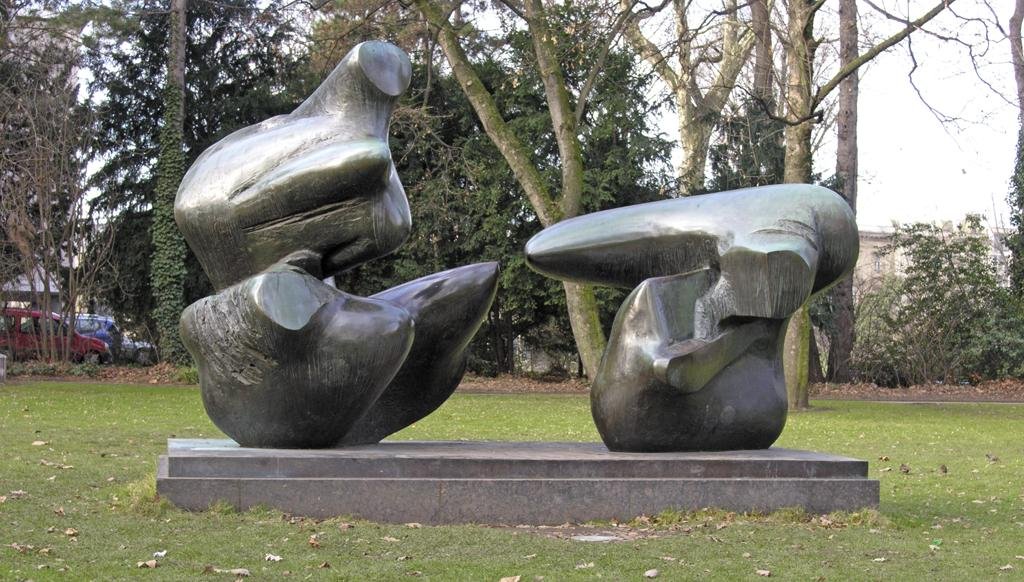
At first glance, this bronze looks like a reclining figure, but Henry Moore developed a specific logic for its form. When creating the first work in this series, Moore did so in two pieces almost without intending to, though the second one became a conscious idea. He realized that a separated two-piece composition offered an advantage in relating figures to the landscape, where knees and breasts could be seen as mountains.
Moore was interested in the way sculpture allows for multiple viewpoints, a special advantage over painting where the front view does not enable one to foresee the back. Because the parts are separated, the viewer does not expect a naturalistic figure; instead, the form can justifiably look like a landscape or a rock. As you move around the bronze, the two parts overlap or open up to leave space in between, providing more unexpected views.
Created between 1969 and 1970 and cast in 1973, this work is part of a series of post-war abstract bronzes. A bronze edition of seven was produced, including an artist's copy in London's Kew Gardens, a piece in Düsseldorf, and another at the Hirshhorn Museum and Sculpture Garden in Washington D.C. The work captures Moore's aim for form to represent primal matter.
Sources: Wikipedia, OpenStreetMap, Wikidata, Wikimedia Commons
Written by Friendly Jane
Discuss this with the author and others
No comments yet. Be the first to start the conversation.