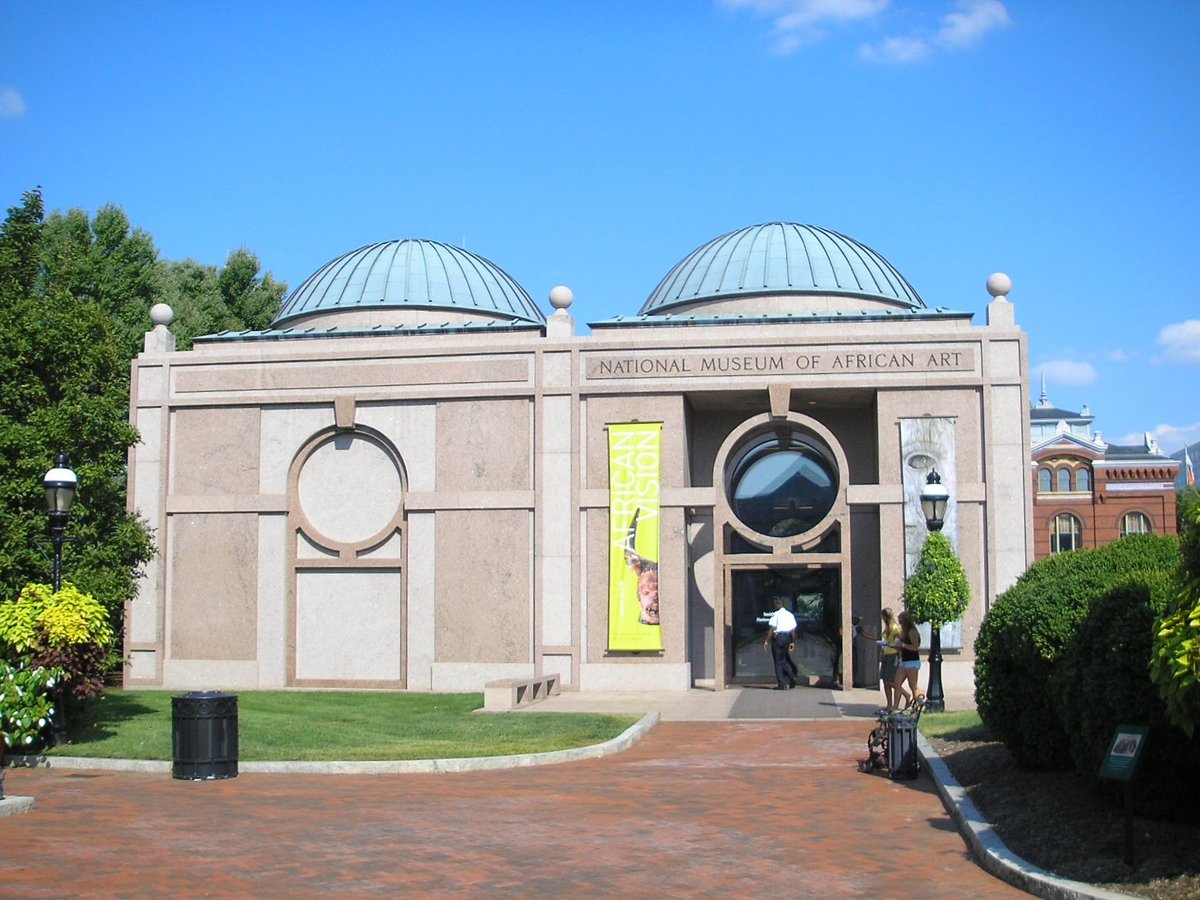
The National Museum of African Art is the Smithsonian Institution's African art museum, located on the National Mall of the United States capital. Founded by Warren M. Robbins in 1964, the institution began with an educational mission to teach black cultural heritage. The museum's collection includes 9,000 works of traditional and contemporary African art from both Sub-Saharan and North Africa, 300,000 photographs, and 50,000 library volumes.
Initially housed in the Frederick Douglass House on Capitol Hill, the museum focused on traditional African art. By 1976, the museum had a 20-person staff and a 6,000-object collection. To ensure the museum's longevity, Robbins lobbied Congress to absorb the museum into the Smithsonian Institution. The House of Representatives approved this plan in 1978, and the Smithsonian directors adopted the museum in 1979, renaming it the National Museum of African Art in 1981.
A new, primarily underground museum building was completed on the National Mall in 1987, expanding the exhibition space. Under the direction of Sylvia Williams, the museum took a scholarly, art historian approach, pursuing risky, high-cost pieces. The collection expanded to include contemporary works and works from Arab North Africa. In 1997, Roslyn Walker became director and added a dedicated contemporary art gallery and curator.
Sharon Patton served as director between 2003 and 2008, during which she introduced shows targeting children. Johnnetta Cole became director in 2009, and her tenure included a controversial 2015 exhibit featuring works from Bill Cosby's private collection. More recently, the museum returned 29 looted Benin Bronzes to Nigeria in 2022, and Yinka Shonibare's Wind Sculpture VII was put on permanent display outside the museum in late 2016.
Sources: Wikipedia, OpenStreetMap, Wikidata, Wikimedia Commons
Written by No Other
Discuss this with the author and others
No comments yet. Be the first to start the conversation.