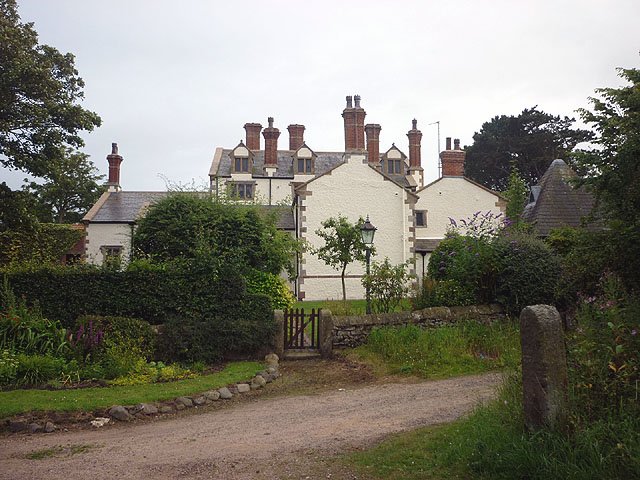

Nestled on Whinny Lane in Preesall, Lancashire, England, stands the historic Hackensall Hall Farmhouse, a Grade II listed building. Built in 1873, it is a remodelling of a 17th-century house that retains much of its earlier fabric. The house was built by Francis Fleetwood, the brother of Richard, in 1656 after their home at Rossall Hall was flooded. The farmhouse is constructed of pebbledashed brick with sandstone dressings and a slate roof, featuring two storeys with attics.
The building has an irregular plan with rear wings and outshuts. Most of the windows are mullioned and transomed, or mullioned. Other features include a single-storey gabled porch, a doorway with a moulded surround and a Tudor arched head, and a re-set inscribed plaque. Inside the house is an inglenook.
Dorothy Parkinson, who created the first example of Preesall salt, lived at the farm up until her death in 1925, where she raised nine children. In 1926, Parkinson's husband, John, found over three hundred Roman coins in the hall's grounds, estimated to date to around 273 AD.
Nearby Parrox Hall was built about the same time as the 1656 construction, and has been in the possession of the Elletson family since 1690.
Sources: Wikipedia, OpenStreetMap, Wikidata, Wikimedia Commons
Written by Nicolo Ciampini
Discuss this with the author and others
No comments yet. Be the first to start the conversation.