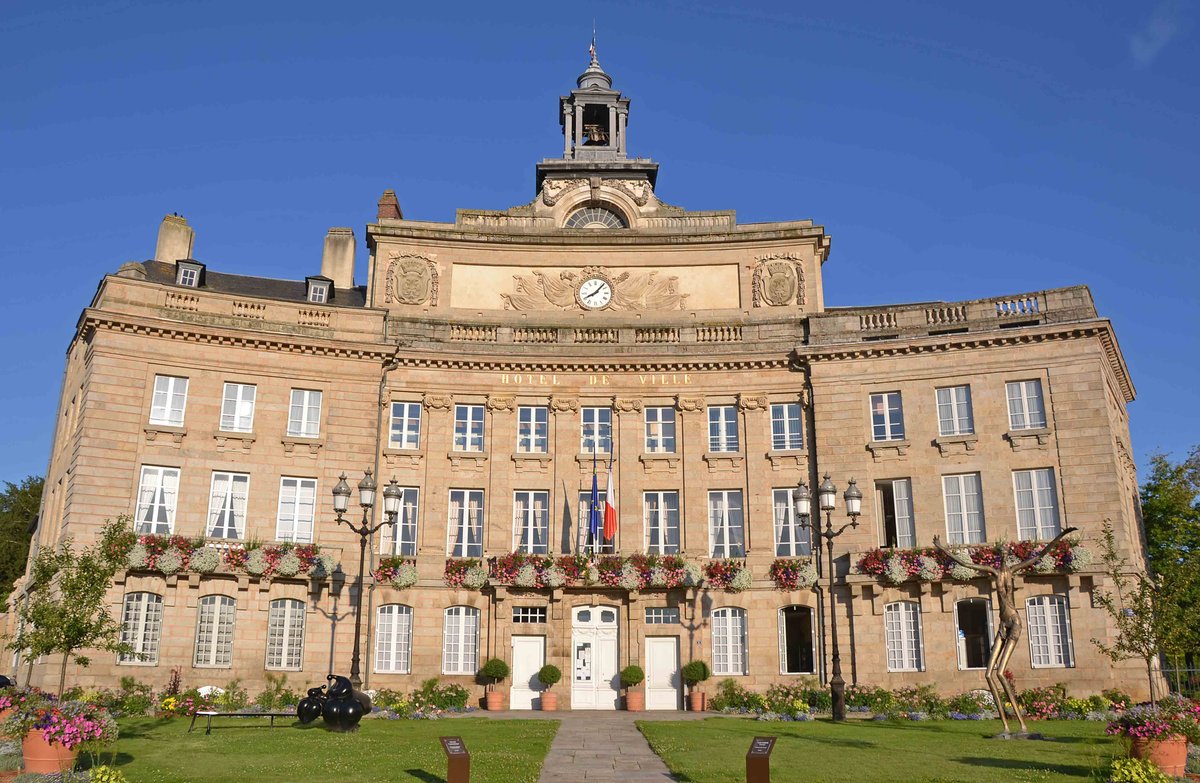

The Hôtel de Ville in Alençon stands on Place du Maréchal Foch as a building in the Louis XVI style. Finished in 1788, it is constructed of ashlar stone and features a curved main frontage of 13 bays. The design includes Ionic order pilasters, a modillioned cornice, and a central pediment housing a clock.
In the 1780s, the town needed a new seat of power because the fourth town hall was falling apart. The site selected for the new building had formed part of the grounds of the Château of the Dukes d'Alençon. The architecture features three doorways on the ground floor and three French doors with a balustraded balcony on the first floor of the central section.
During a renovation in 1966, contractors discovered a series of posters published in June 1793 by the jurist and Girondin Charles Éléonor Dufriche-Valazé. Dufriche-Valazé had been one of the Commission of the Twenty-One which presented charges against Louis XVI. He was subsequently arrested by the national guard, tried by a revolutionary court, and condemned to death. In the posters, he protested against the arbitrary measures taken against him.
Today, the building remains a monument historique. A sculpture by Louis Derbré, depicting a female figure, was installed in front of the building in 2007. The interior contains the Salle du Conseil et des Mariages, which serves as the council chamber and wedding room.
Sources: Wikipedia, OpenStreetMap, Wikidata, Wikimedia Commons
Written by Nicolo Ciampini
Discuss this with the author and others
No comments yet. Be the first to start the conversation.