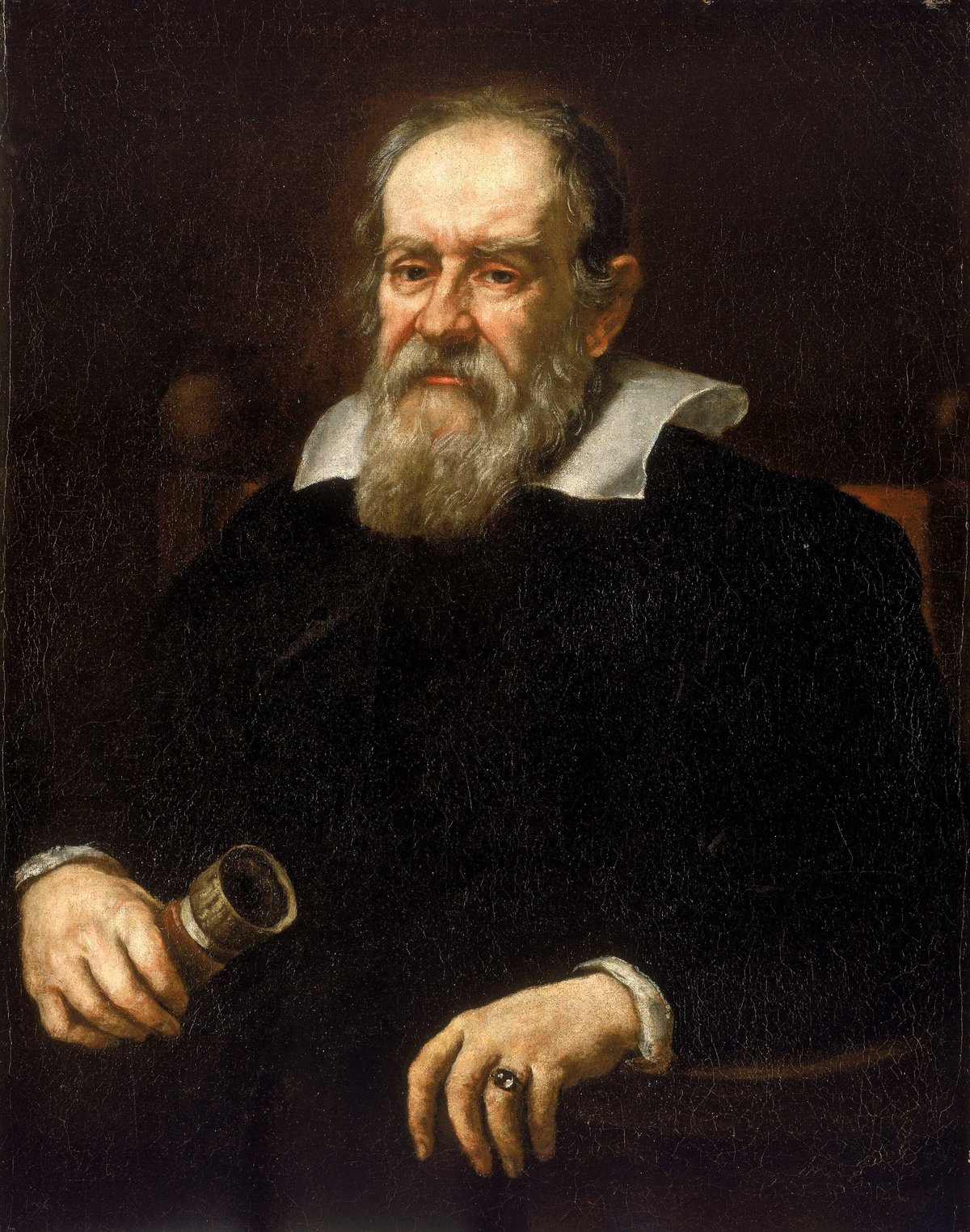

Galileo Galilei was an Italian astronomer, physicist, engineer, and polymath who is known as the father of observational astronomy and modern science. Born in Pisa in 1564 to Vincenzo Galilei and Giulia Ammannati, he grew up in a family of accomplished musicians. As a lutenist himself, Galileo faced financial pressures from his siblings, which may have influenced his desire to develop inventions for additional income.
In 1589, Galileo was appointed to the chair of mathematics in Pisa. He later moved to the University of Padua in 1592, where he taught geometry, mechanics, and astronomy. During this period, he made significant discoveries in both pure fundamental science and practical applied science, including hydraulic engineering. He obtained a patent for a horse-powered water pump and became an early developer of the thermoscope.
Galileo built an improved telescope and used it to observe the stars of the Milky Way, the phases of Venus, the four largest satellites of Jupiter, Saturn's rings, and lunar craters. He also built an early microscope. He demonstrated one of his early telescopes to Venetian lawmakers in August 1609, with a magnification of about 8x or 9x. He published his initial telescopic astronomical observations in March 1610 in a brief treatise titled Sidereus Nuncius.
Sources: Wikipedia, OpenStreetMap, Wikidata, Wikimedia Commons


Written by Nicolo Ciampini
Discuss this with the author and others
No comments yet. Be the first to start the conversation.