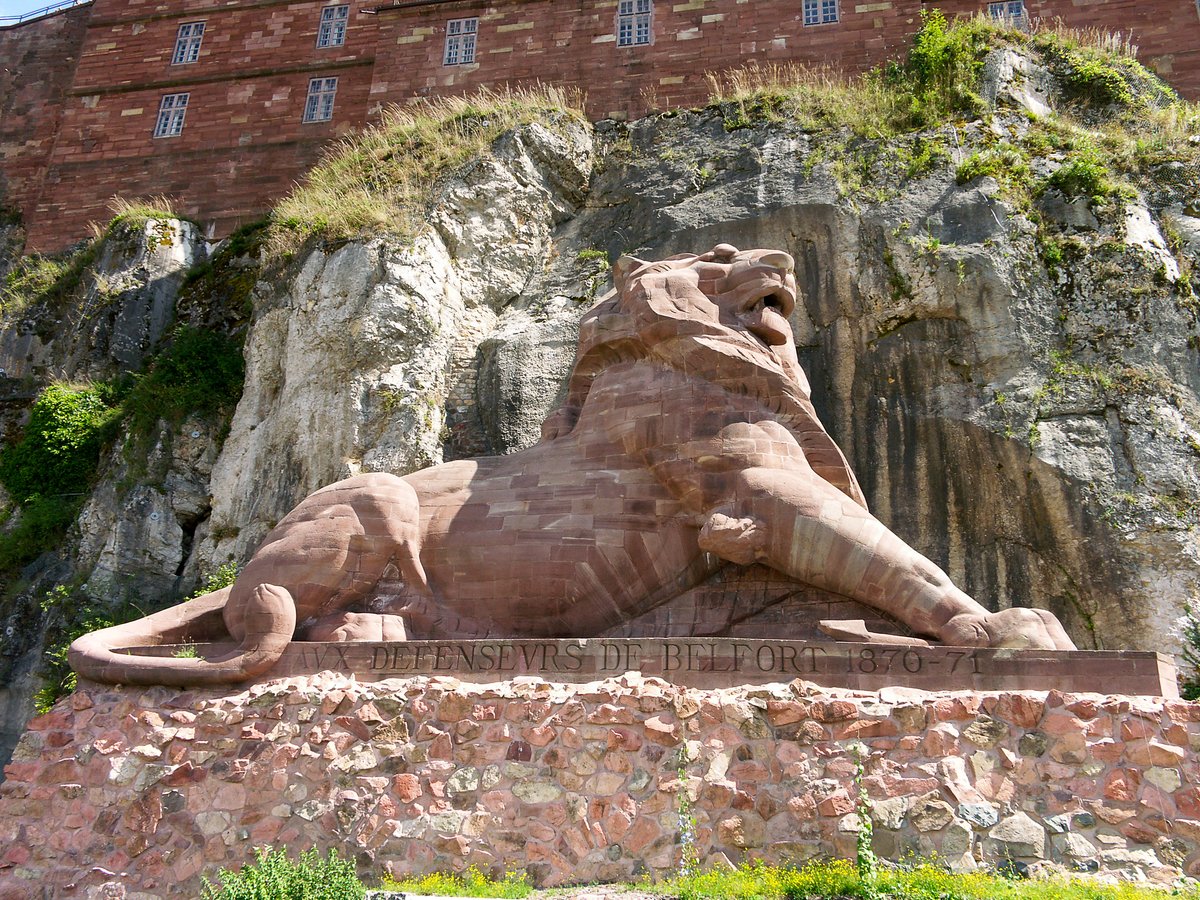

The Lion of Belfort is a massive sculpture made entirely of red sandstone. Finished in 1880 by Frédéric-Auguste Bartholdi - the sculptor of the Statue of Liberty - the colossal work measures twenty-two meters in length and 11 meters in height. The blocks were individually sculpted and then moved to the cliff below Belfort castle to be assembled, where the work dominates the local landscape.
The lion symbolizes the heroic French resistance during the Siege of Belfort, a 103-day Prussian assault from December 1870 to February 1871. The city was successfully defended against 40,000 Prussians by 17,000 men led by Colonel Denfert-Rochereau. The fortress held out until the Armistice of Versailles obligated French forces to abandon it.
Bartholdi's first preparatory model depicted the lion facing defiantly east towards Prussia, but he was then asked to calm its expression to avoid a diplomatic fallout with the German Empire. In response, he reversed the statue to face west with its rear to Prussia, but added an arrow beneath its front paw that points back towards the German border.
Smaller editions of the statue stand in the center of Place Denfert-Rochereau in Paris and also in Dorchester Square in Downtown Montreal. The sculpture remains a permanent monument to the defenders of the fortress.
Sources: Wikipedia, OpenStreetMap, Wikidata, Wikimedia Commons
Written by Nicolo Ciampini
Discuss this with the author and others
No comments yet. Be the first to start the conversation.