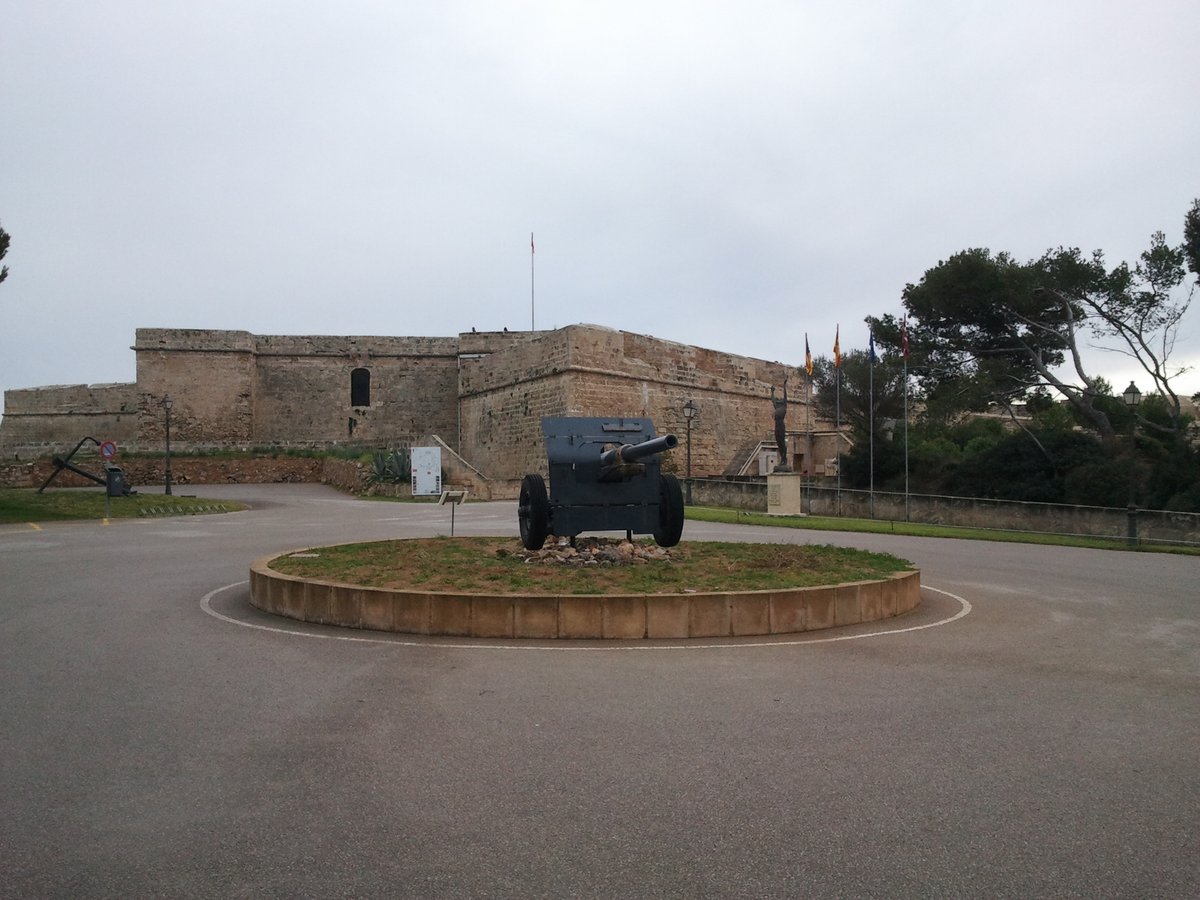

Fort San Carlos is a fortification that defends the Portopí bay, a first port since antiquity. During the Middle Ages, maritime trade was hindered by pirates and corsairs who attacked Portopí despite the five towers that defended it. The construction of Fort San Carlos, known as the castle of Portopí, began under the order of Philip III in 1610 and was completed in 1612. The funding for the construction was split between the monarchy and the College of Merchants.
Initially called the castle of Portopí, it was later dedicated to St. Charles for unknown reasons. One of the torres de Portopí was bundled into the new construction, retaining its function as a lighthouse. In 1662 to 1663, the castle was expanded from its initial rectangular core, which is still preserved.
During the War of Succession or Occupation, some defensive structures were added outside the castle near the sea. In the 19th century, the Dic de l'Oest was built next to the castle, completed in 1938.
During the Spanish Civil War, political prisoners were imprisoned inside Fort San Carlos. In 1981, Fort San Carlos became the seat of a Spanish Army museum, with a collection mainly from the 19th and 20th centuries, and a section dedicated to the Mallorcan general Valerià Weyler y Nicolau. The museum houses a notable collection of Mallorcan artillery company's spherical stone balls from the Almudí (or Armoury) of Palma. The fort is in good condition and is illuminated at night, although it does not stand out for its low profile.
It has a collection of European, African, and Asian weapons, donated in 2004 by Lieutenant Colonel Antoni Llorente Alberti. The museum includes a room dedicated to the Peninsular War (1808 - 1814), with reproductions of the Palma Stock Exchange from the end of the 19th century and a model of the Battle of Tetouan.
Sources: Wikipedia, OpenStreetMap, Wikidata, Wikimedia Commons
Written by Nik Frost
Discuss this with the author and others
No comments yet. Be the first to start the conversation.