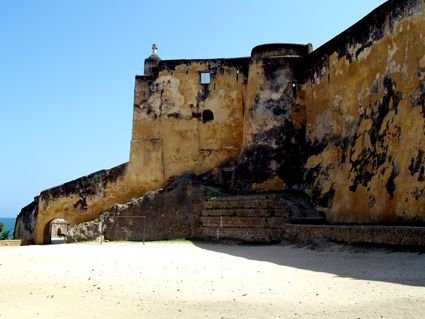

Nestled on Mombasa Island, Fort Jesus is a historic relic that marks the first successful Western influence over the Indian Ocean trade. The structure was designed by the Italian architect Giovanni Battista Cairati between 1593 and 1596 by order of King Felipe II of Spain. Today, Fort Jesus stands as a masterpiece of late Renaissance military fortification, roughly square with four bulwarks at its corners.
The fort was captured and recaptured at least nine times between 1631 and 1895. After the Portuguese recaptured it from the Sultan in 1632, they refurbished it and built more fortifications, making it harder for the fort to fall. It was subject to a two-year siege from 1696 to 1698 by the Omani Arabs led by Saif bin Sultan. The capture of the fort marked the end of Portuguese presence on the coast, although they briefly re-occupied it between 1728 and 1729.
In 1958, Fort Jesus was declared a national museum and later a UNESCO World Heritage Site in 2011. Today, it houses a museum and serves as a host for research programs, a Conservation Lab, and an Education Department, preserved as a significant example of 16th-century Portuguese military architecture.
Sources: Wikipedia, OpenStreetMap, Wikidata, Wikimedia Commons
Written by Mutabor
Discuss this with the author and others
No comments yet. Be the first to start the conversation.