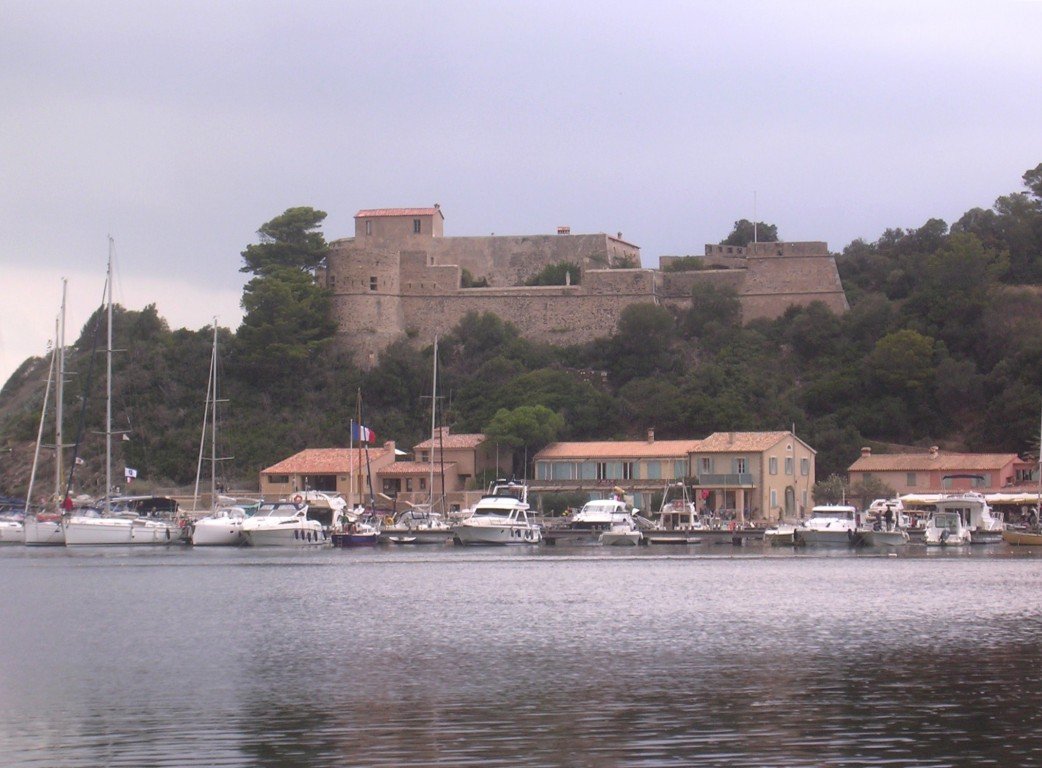

The masonry of the fort's outer walls is constructed using a technique called "schiste tranché." In this method, local schist found on the island was used like bricks. A very thick plaster was applied over the facades to cushion the impact of cannonballs, a feature common in fortifications from the 19th century.
François 1er ordered the construction of the fort to fight piracy in the Mediterranean. By 1635, Cardinal de Richelieu remodeled it for residential purposes, providing housing for the commander and soldiers, as well as a bakery for the garrison and storage for artillery and supplies. In 1710, a naval commander chose to burn his ship at the foot of the fort rather than surrender to the opposing fleet.
After the fall of the Empire in 1815, the fort fell into a period of dormancy. In 1988, it was assigned to the Parc national de Port-Cros. Between 2016 and 2021, it underwent a major restoration using stones collected from the island. Workers applied a "flush" coating to the facades to consolidate the structure while respecting traditional construction techniques.
Today, the fort remains a significant piece of military heritage. As the only building on the island classified as a historical monument, it is in part leased to a private individual and is not open to the general public.
Sources: Wikipedia, OpenStreetMap, Wikidata, Wikimedia Commons

Written by Nicolo Ciampini
Discuss this with the author and others
No comments yet. Be the first to start the conversation.