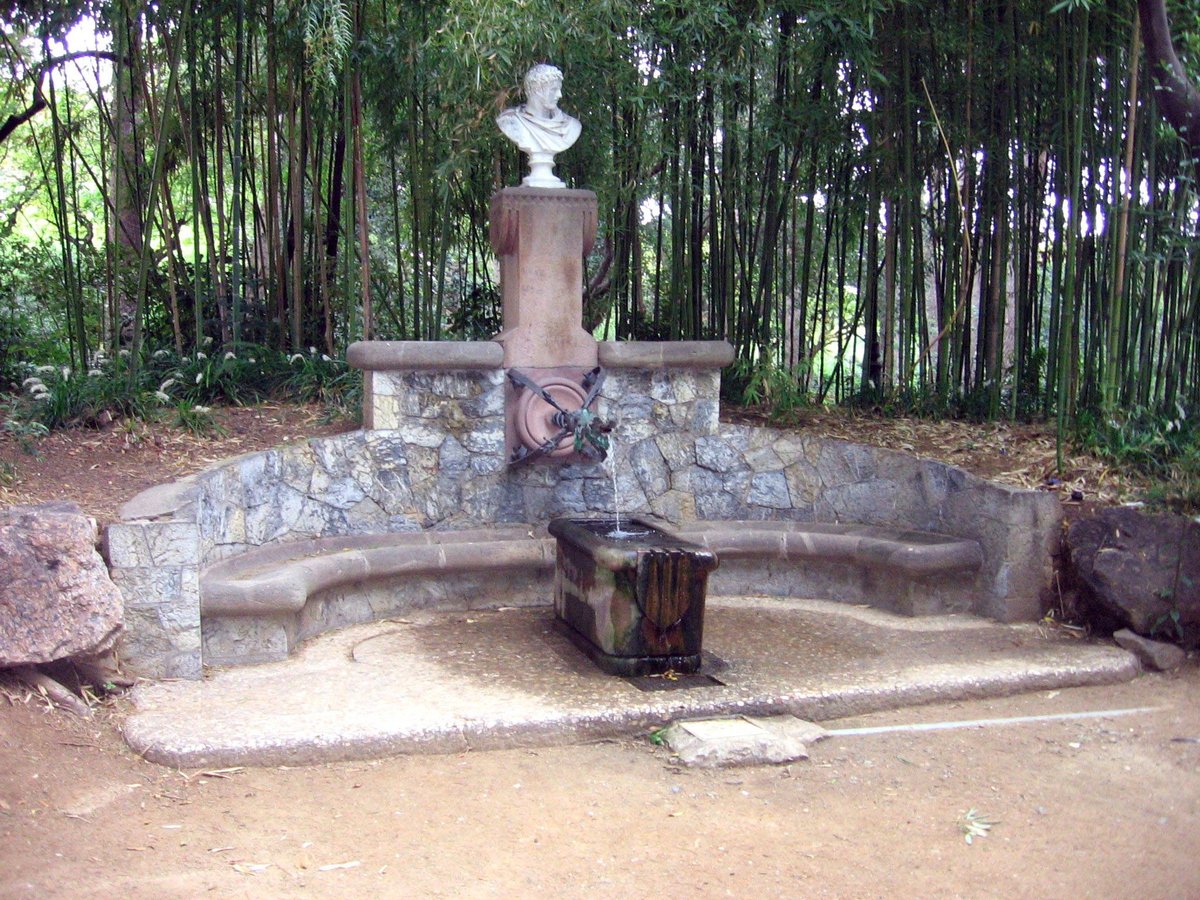

The Font d'Hèrcules sits in a quiet corner of the Palau de Pedralbes gardens, tucked away inside a bamboo grove. It was designed by Antoni Gaudí in 1884, during his Orientalist period when he was fascinated by the arts of Persia and India, as well as Hispanic Islamic art, mainly Mudéjar style. During this period, Gaudí made extensive use of ceramic tile decoration, pointed arches, exposed brickwork, and finishes in the shape of temples or domes.
The fountain was originally part of the Finca Güell, a private estate belonging to the businessman Eusebi Güell. Gaudí worked on the grounds between 1884 and 1887, designing the perimeter walls, gatehouses, and several garden elements. For years, this specific fountain remained largely unnoticed because of its secluded location, until it was rediscovered and restored in 1983.
Its design features an elliptical stone bench and a central pedestal supporting a bust of Hercules. From the base of the pedestal, a spout in the shape of a Chinese dragon pours water into a basin marked with the coat of arms of Catalonia. The set is sober but aesthetic, integrating harmoniously with the surrounding nature, which was one of Gaudí's main concerns as he considered nature to be his great master.
While the bust of Hercules currently on display was a 1983 replacement, the original work by Rossend Nobas was recovered from a municipal warehouse in 2021. Credited to the Museu Nacional d'Art de Catalunya, it is a red terracotta piece weighing 476 kg. The head of the sculpture depicts the second work of Hercules: the death of the Hydra of Lerna.
Sources: Wikipedia, OpenStreetMap, Wikidata, Wikimedia Commons

Written by Nik Frost
Discuss this with the author and others
No comments yet. Be the first to start the conversation.