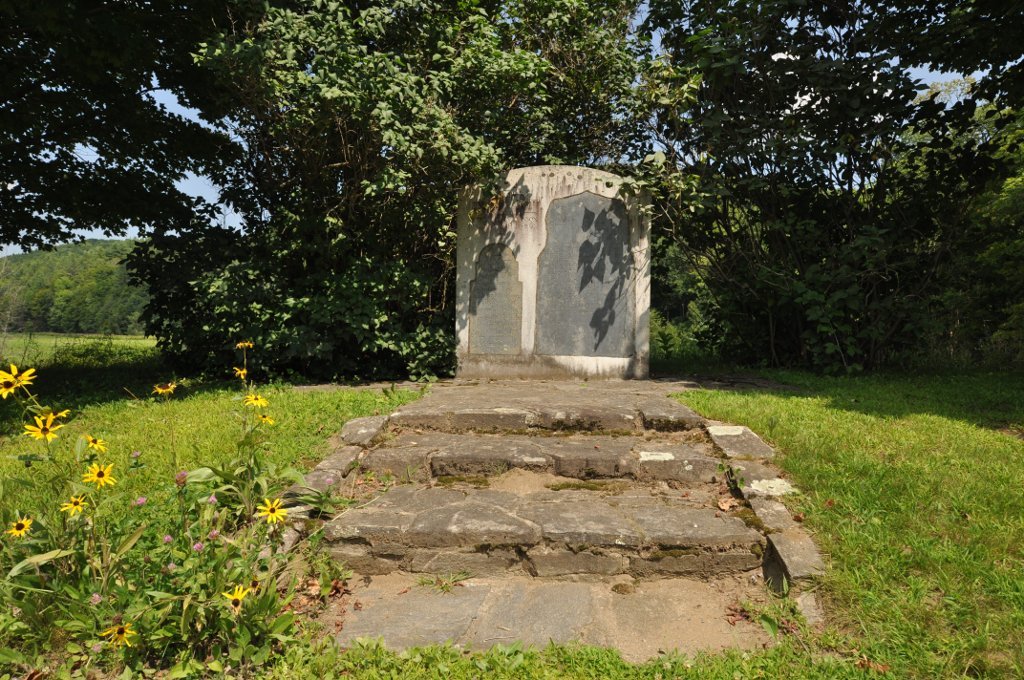

Way back in 1754, the continent was a battlefield in the French and Indian War. One fateful August 29, a surprise attack by Native Americans struck the Fort at Number 4, Charlestown, New Hampshire, taking as captives members of the Johnson and Farnsworth families. On the second day of a forced march, Susannah Willard Johnson gave birth to a daughter, who would later be known as Elizabeth Captive Johnson.
After being ransomed and returned home by 1760, Susannah returned to the site of the ordeal on several occasions. In 1799, she hired a stonecutter to create two slate markers as a memorial. While she intended for one to be placed at the birthplace and the other at the nearby Native encampment, her instructions were not followed. Instead, the two stones were placed side-by-side in a location not far from their present site.
Descendants of the Johnson family mounted the two stones in a single granite slab in 1918 and placed them at the same site. The present location is near that location, created as a result of road improvements on Route 106 that required the memorial's relocation.
Listed on the National Register of Historic Places in 1974, the Indian Stones bear witness to a piece of history, standing near a small roadside pullout in southern Reading, where the haunting yet astounding past still weighs heavy.
Sources: Wikipedia, OpenStreetMap, Wikidata, Wikimedia Commons

Written by Friendly Jane
Discuss this with the author and others
No comments yet. Be the first to start the conversation.