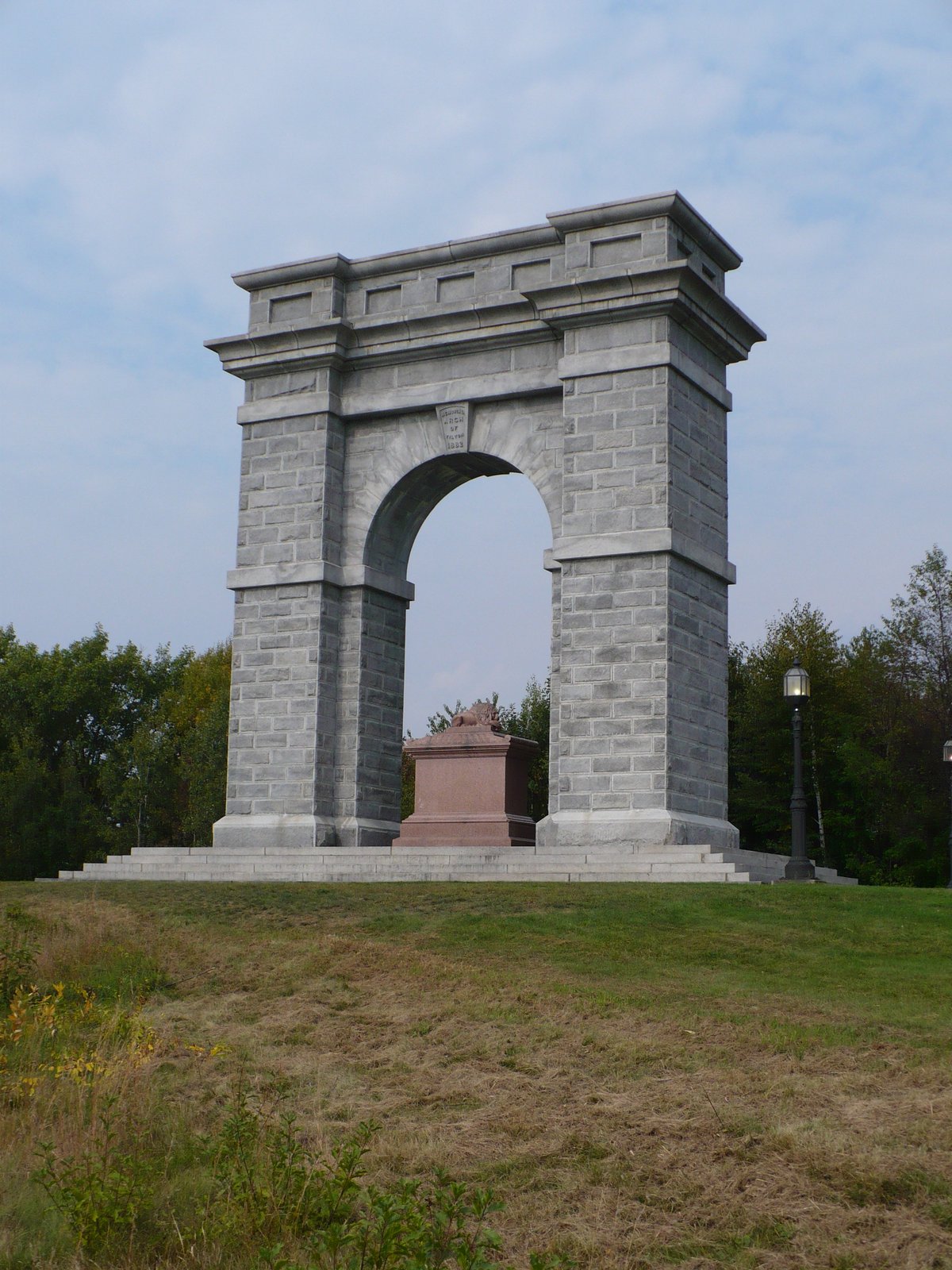

Charles E. Tilton commissioned the construction of the Memorial Arch of Tilton in 1882. Inspired by the Arch of Titus in Rome, Tilton intended for the monument to symbolize the victories of peace rather than those of war. He hired the Concord firm of Dow & Wheeler to design the structure, which features surfaces modeled in the rustication of Romanesque revival building. The arch was built on top of an old Indian fort at the apex of a local hill for a cost of 50,000 dollars.
The arch is 55 feet tall and 40 feet wide, constructed of Concord granite. It sits atop a hill 150 feet above the Winnipesaukee River with a foundation that goes 16 feet into the earth. At its base sits a 50-ton sarcophagus and a red granite "Numidian lion." While Tilton intended to be buried in this monument, he was instead buried roughly a mile west in Park Cemetery in Tilton. When it was first built, gas lamps at each corner made it the only illuminated object for miles.
The monument was added to the National Register of Historic Places in 1980. In 1984, it was repaired, cleaned, and sandblasted to remove plants growing out of cracks in the top. At this time, a park was created around the monument including the addition of picnic tables and grills. The keystone of the arch is inscribed with the name of the monument and the year 1882, and contains a lead box with historical newspapers, books, and coins from the era of its erection.
Sources: Wikipedia, OpenStreetMap, Wikidata, Wikimedia Commons



Written by Friendly Jane
Discuss this with the author and others
No comments yet. Be the first to start the conversation.