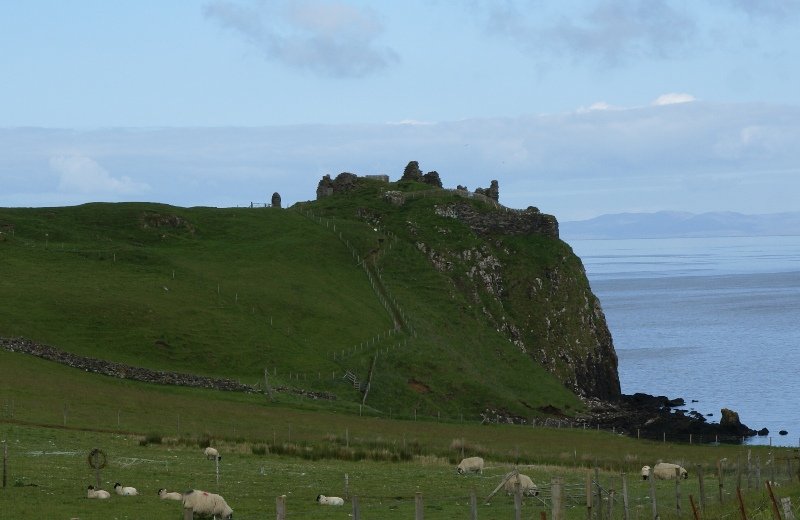

Duntulm Castle stands on a basalt promontory on the north coast of Trotternish on the Isle of Skye, near the hamlet of Duntulm. The castle was built in the 14th and 15th centuries during feuds between the rival MacLeod and Macdonald clans. By the early 17th century, the MacDonalds of Sleat had gained the upper hand in the area. In 1618, the Privy Council and Sir Donald MacDonald of Sleat signed a charter requiring him to repair Duntulm, which resulted in the addition of a second tower.
Around 1650, the castle's importance peaked with further improvements and the construction of a rectangular house within the wall. In 1732, the castle was abandoned when Sir Alexander MacDonald built a new residence, Monkstadt House, five miles to the south. He robbed much of the castle's stone as building material for the new house.
Local legend says the castle was abandoned after the infant son of the chieftain who dwelt there fell from a window and was dashed on the rocks below. As punishment, the nursemaid in charge of the child was set adrift on the North Atlantic in a small boat.
Today, the ruins are in very poor condition, with major falls of masonry recorded as recently as 1990. The main structure of the castle measures about 25 by 9 metres and is defended by a ditch along the landward side. There is no access inside because the ground is considered unsafe, but the vaults of the tower, which once stood to four storeys, remain visible from the path.
Sources: Wikipedia, OpenStreetMap, Wikidata, Wikimedia Commons
Written by Nicolo Ciampini
Discuss this with the author and others
No comments yet. Be the first to start the conversation.