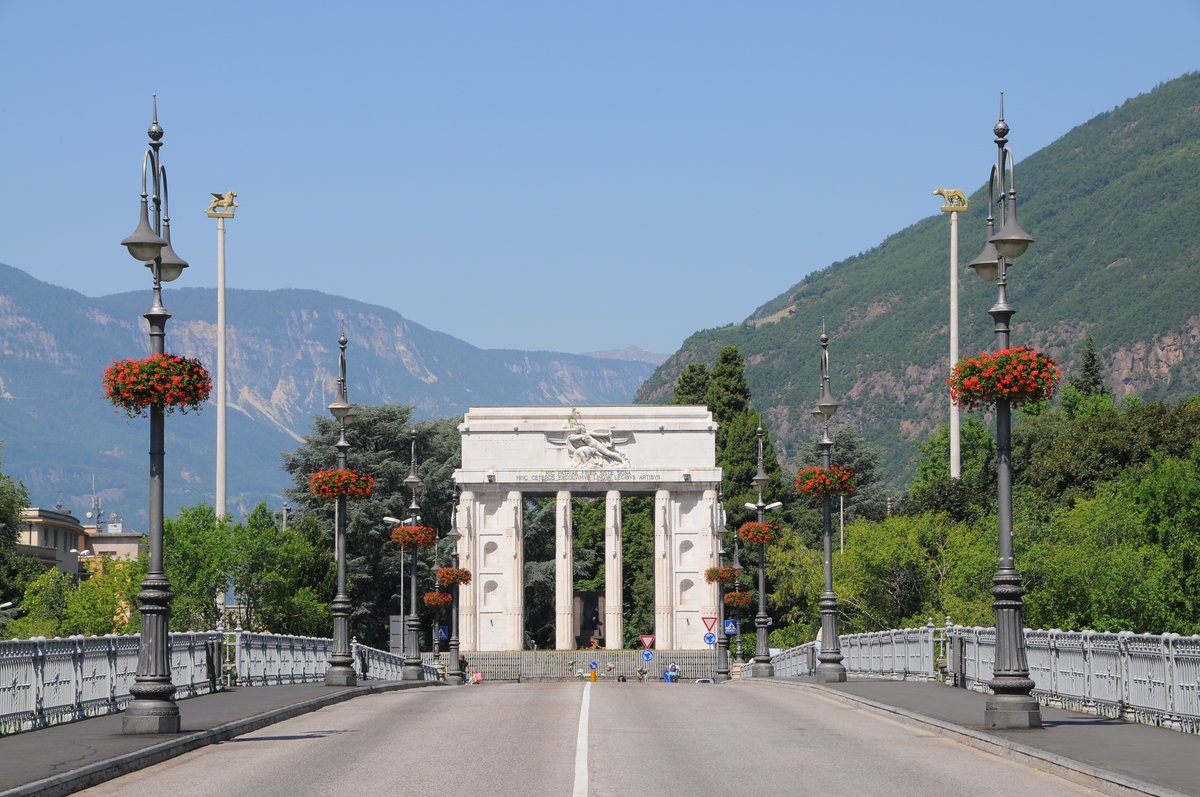

The Victory Monument in Bolzano was ordered by Benito Mussolini in South Tyrol, which had been annexed from Austria after World War I. The 19-metre-wide Victory Gate was designed by architect Marcello Piacentini and substituted the former Austrian Kaiserjäger monument, torn down in 1926–27. Built in Fascist style and displaying lictorial pillars, it was dedicated to the "Martyrs of World War I".
The main façade features a Latin inscription stating that the border of the fatherland is there and that others have been educated in language, law and culture. This script was seen as provocative by many within the German-speaking majority in the province. On the day of the inauguration on 12 July 1928, a counter-demonstration with 10,000 people took place in Innsbruck.
Since its construction, the monument has been a focal point of tensions between the Italian- and German-speaking communities in Bolzano and the surrounding region. After various attempts to blow it up by South Tyrolean separatist groups in the late 1970s, it has been fenced off to protect it from further defacement.
In 2014, by a joint decision taken by the Italian Ministry of Culture, the South Tyrolean Provincial Government and the Municipality of Bolzano, the monument was reopened to the public along with a permanent exhibition. Titled "BZ '18–'45: one monument, one city, two dictatorships", the exhibition focuses on the history of the monument within the context of Italian fascism and the Nazi occupation of 1943–45. The project aims to turn difficult heritages into democratic resources.
Sources: Wikipedia, OpenStreetMap, Wikidata, Wikimedia Commons
Written by Nicolo Ciampini
Discuss this with the author and others
No comments yet. Be the first to start the conversation.