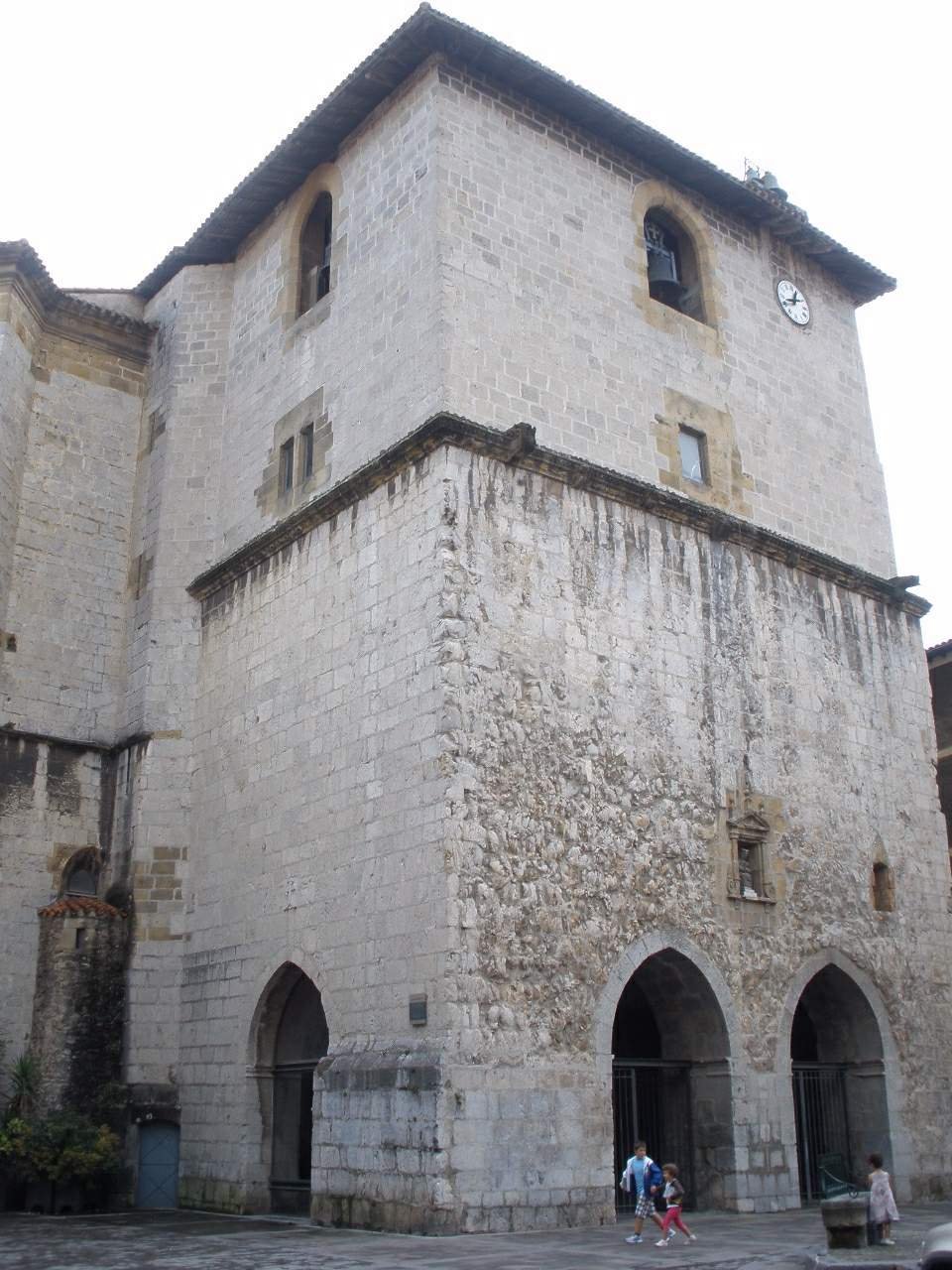
Welcome to the Church of Santa Maria in Deba, Spain. Known as Santa Maria la Real or simply Santa Maria, this Catholic temple is a masterpiece of Basque Gothic architecture and a national monument. It was built and completed in the late 15th and 17th centuries respectively, funded by the profit from the port trade, particularly the wool trade. The church is located at Plaza Zaharra 7, Deba.
The buildings dimensions are 35 meters long and 18 meters wide, and it features a magnificent polychromed Gothic portada, with five archivolts and a complete representation of the apostles and stories of the life of the virgin. The exterior is in the form of a salon and is divided into three naves of the same height, covered with Renaissance crucería vaults. The interior features the Retablo Mayor de Nuestra Señora de la Asunción, by Bernabé Cordero in 1662 and completed by Pedro de Alloitiz in 1668. The claustre has capillas, and the campanario is on the portico.
The church was declared a Bien de Interés Cultural (BIC) and was included in the Tesoro Artístico Nacional by decree on 3 June 1931. It forms part of the Camino de Santiago de la Costa.
The 17th of June 1343, the king Alfonso XI de Castilla authorizes the move of the village of Monreal de Icíar, which he had founded on the 24th of June of 1294, to a location by the sea. The new village would be named Monreal de Deva and would receive the Vitoria fuero. The old village must have had a church that provided religious service. There is a document from 1390 that decrees that the meetings of the council, which until then were held in the arenal, would be held in the church, giving documental evidence of the existence of a temple at that time. The old church (Monreal de Icíar) was moved to the new location and it is now known as the Church of San Pedro Apóstol, which has a Baroque main altar and was declared a BIC in 1986.
Sources: Wikipedia, OpenStreetMap, Wikidata, Wikimedia Commons
Written by Nicolo Ciampini
Discuss this with the author and others
No comments yet. Be the first to start the conversation.