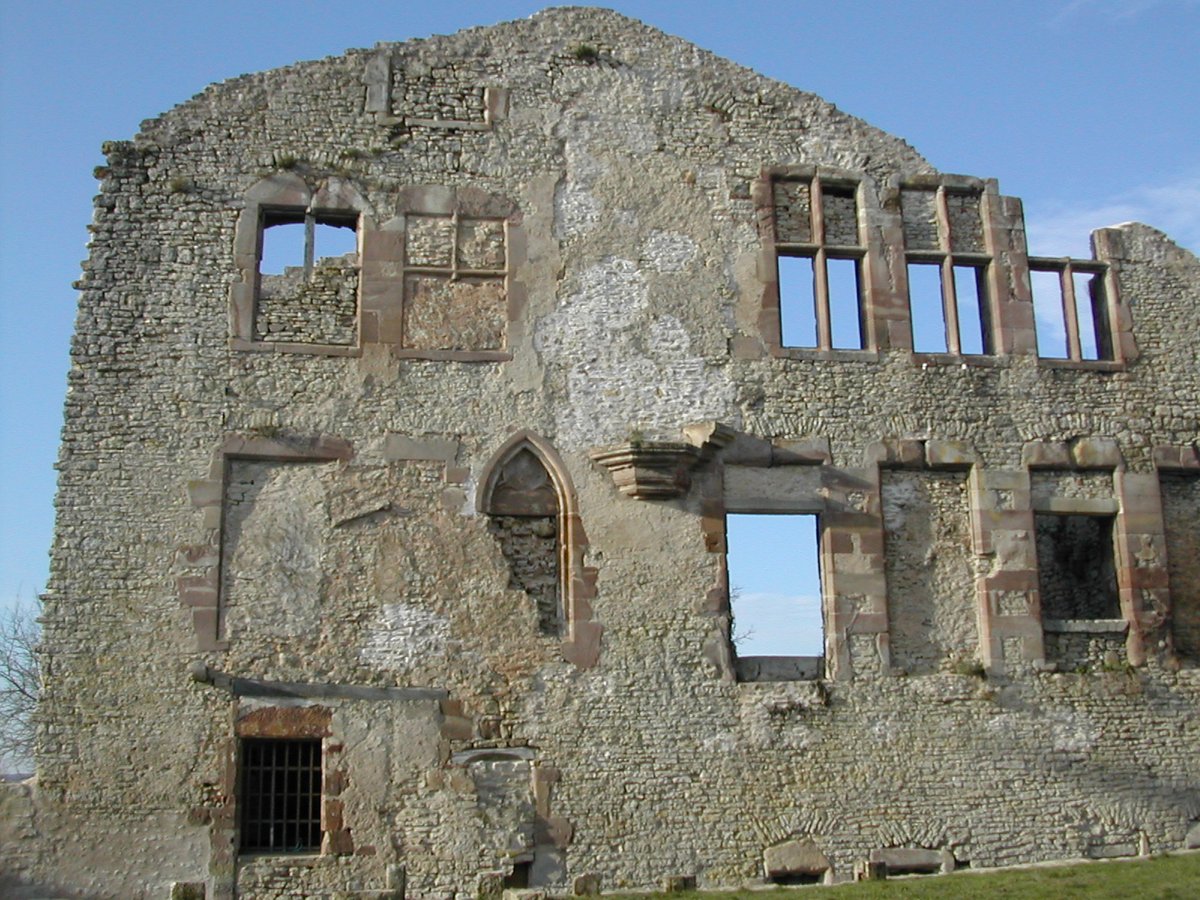

In 1444, Conrad Bayer de Boppart, the Bishop of Metz, razed an old castle to build a powerful new fortress. This reconstruction created the structure known today, adapted specifically for the use of cannons and other couleuvrines that were appearing on the arms scene at the time. The fortress was designed with a rectangular courtyard and a double enclosure. The inner wall was especially formidable, reaching sixteen meters in height and two and a half meters in thickness.
History left its mark on the site through various conflicts and interests. In 1639, Richelieu had the castle dismantled after besieging and taking it. Later, the revolution of 1789 finished the work he had started. Despite these destructions, parts of the site remain. Visitors can see the manor house with its entrance door, which shows the coats of arms of the successive lords who lived there, as well as the episcopal palace, which remains heavily degraded but offers historical insights.
The prison tower holds several historical inscriptions, including one stating that Laborde was imprisoned in 1584 for giving away his violin strings on Mardi Gras, and another mentioning that the mother Chéqui was imprisoned for making the sabas several times. Other visible features include a well currently closed by its coping stones and a beautiful vaulted cellar of 140 square meters with pillars connected by basket-handle arches.
Since 1932, the ruins have been protected as a natural site of historical nature. The castle was officially listed as a historical monument in 1927 and received full classification in 1992. This protection covers the buildings, ruins, and vestiges, including the north-east gate, the prison tower, the chapel, the south tower, the residence with the western cellar, and the manor house.
Sources: Wikipedia, OpenStreetMap, Wikidata, Wikimedia Commons
Written by Nicolo Ciampini
Discuss this with the author and others
No comments yet. Be the first to start the conversation.