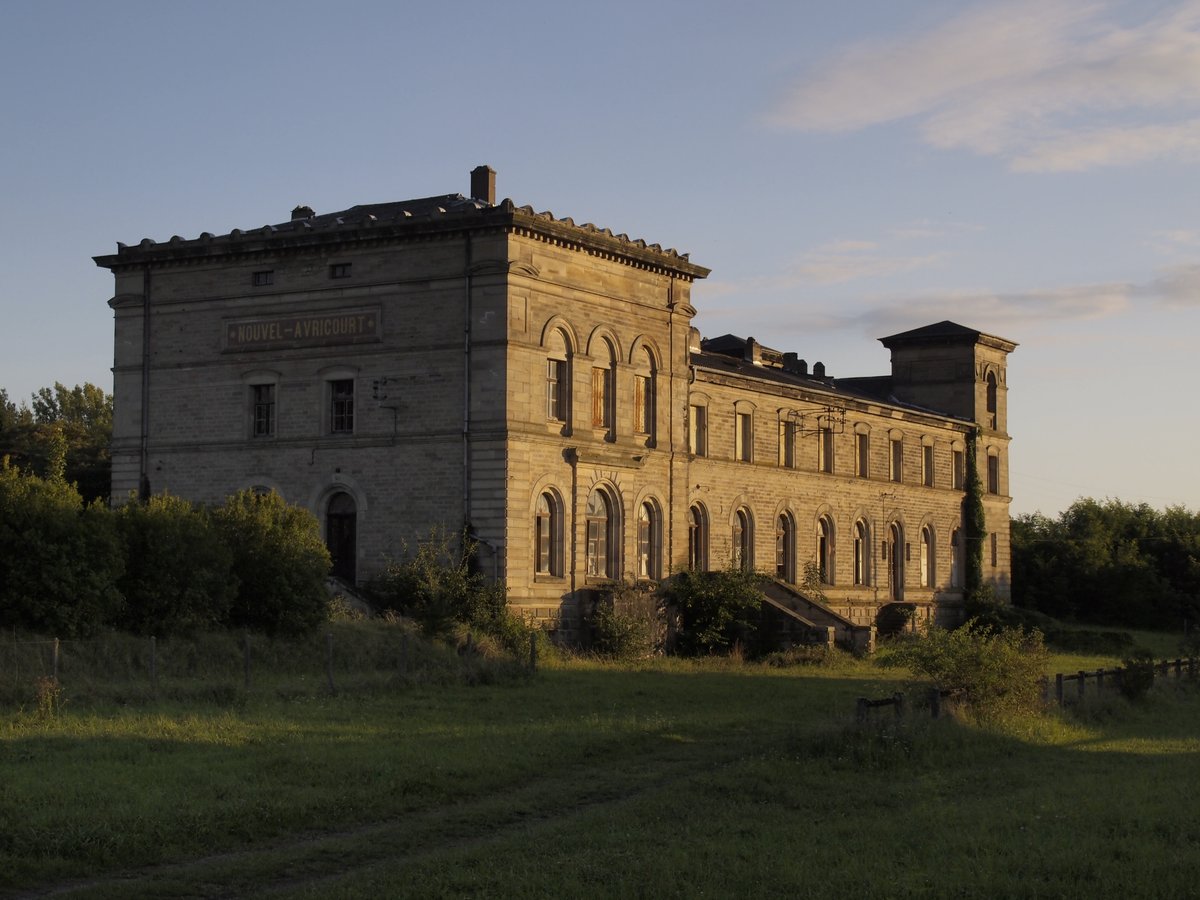

Following a convention signed in Berlin in 1871, a new border was established, leading to the construction of a border station on German territory. Completed in 1875, the station was named Deutsch-Avricourt (and Germanized as Elfringen). It featured a monumental Neo-Romanesque passenger building designed by Johann Eduard Jacobsthal. Constructed from cut stone, the building originally measured 100 meters long by 18 meters wide, featuring 57 windows, 10 doors, and four corner towers.
The site was intended to demonstrate the prestige of the German Empire at the doorstep of the neighboring territory. The station included a post office, a goods shed, and a rotunda. Its creation led to the development of a railway worker colony called the "colonie de Deutsch-Avricourt," which was organized according to a strict socio-professional hierarchy.
Trains from Lunéville and Nancy arrived at the station, where passengers were disembarked before the trains departed empty for the nearby station at Igney - Avricourt. All signage at the station was written in Gothic script. During the First World War, a portion of the passenger building, including two of the corner towers, was removed during the bombardment of Avricourt.
In 1919, when Alsace-Lorraine was returned to France, the station was renamed Nouvel-Avricourt. It entered the network of the Administration des chemins de fer d'Alsace et de Lorraine on June 19, 1919. The station eventually closed in 1969 due to the closure of the line to Bénestroff and its proximity to the neighboring station of Igney - Avricourt.
Sources: Wikipedia, OpenStreetMap, Wikidata, Wikimedia Commons
Written by Nicolo Ciampini
Discuss this with the author and others
No comments yet. Be the first to start the conversation.