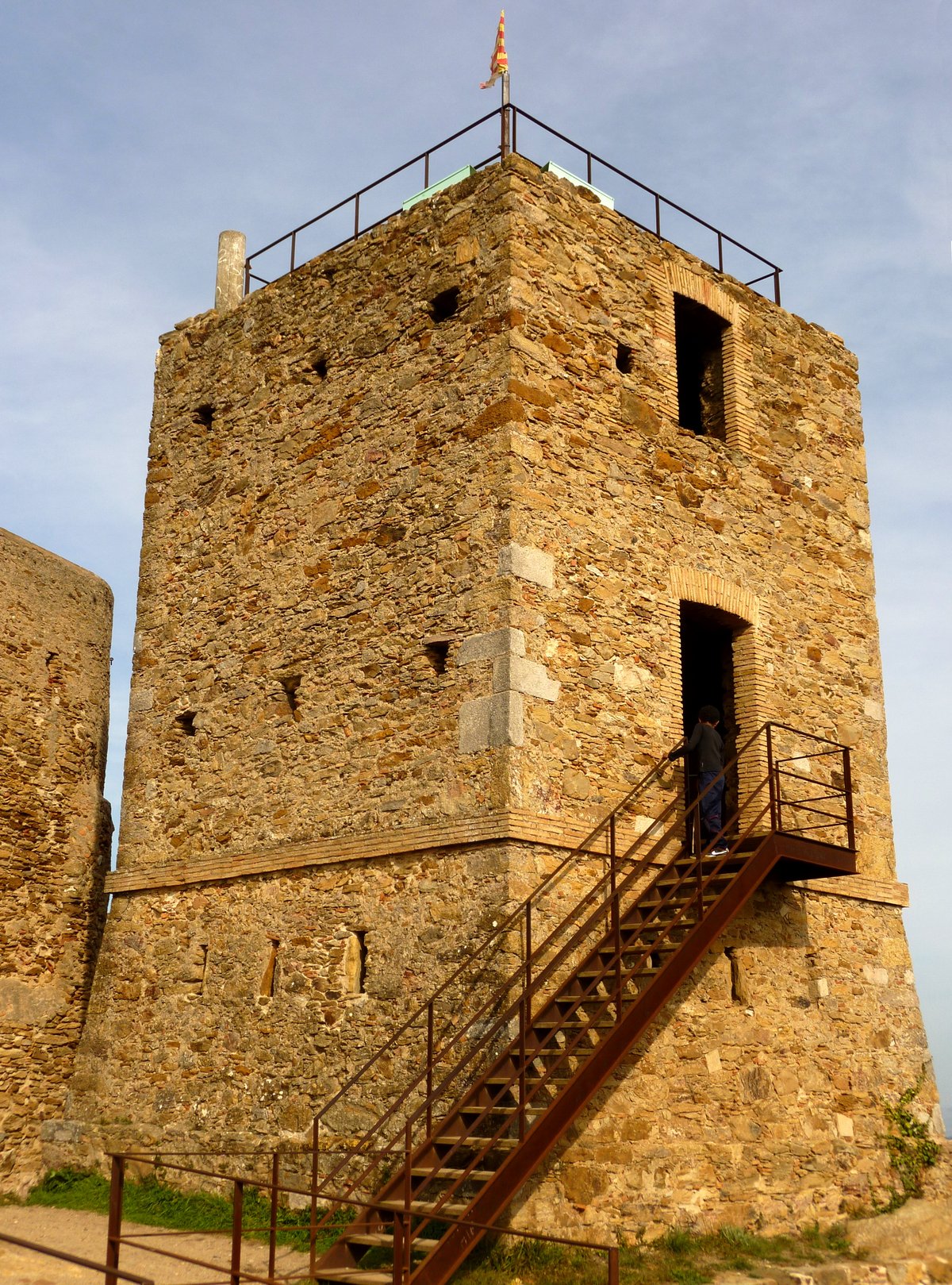

Castell de Sant Miquel sits atop Mount Sant Miquel, straddling the municipalities of Girona and Celrà in the Gironès region of Spain. Although it is more closely associated with Celrà, it was originally under the administrative jurisdiction of Girona. In the eleventh century, there may have been a fortified structure on the site, evidenced by the presence of two cisterns and a section of wall with remains of a semi-circular tower. However, the first historical records of the site date to the middle of the fifteenth century, when construction began on a chapel dedicated to Saint Michael the Archangel and Santa Maria.
The chapel has a single nave and the apse is polygonal, built on the base of a pre-existing circular tower. The nave was expanded in the eighteenth century. An outdoor bell tower was located in the middle of the nave and covered with a vault of stones, which was replaced by a stone vault later. Remains of two quadrangular cisterns and a wall associated with the potential tower are found near the chapel. It is believed that hermits inhabited the chapel between the sixteenth and eighteenth centuries.
During the Second Siege of Girona in 1808, the chapel was occupied by French troops. In August of that year, it was attacked and recaptured by forces led by Joan Clarós. The chapel was again used as a military installation during the preparations for the Siege of Girona in 1809. A troop of about 500 French soldiers fortified the chapel in May 1809 during the preparations for the siege. The remains of the chapel were used to build two towers for optical telegraphy in 1848.
One of these towers, located on the south side of the chapel, is square-based with a basalt-embracing base and several vents. The entire complex was fortified and a perimeter moat was built. The installed facilities became obsolete with the launch of the electric telegraph in 1856. The installations were put under the control of the Civil Guard. The climb to Sant Miquel's castle from Sant Daniel's Valley has been popular since 2010, particularly on weekends.
The view from the tower is 360 degrees and includes, among other things, the entire Costa Brava, the Eastern Pyrenees, the Guilleries, the Montseny, Rocacorba, the Serra de l'Albera, the Montgrí, the north of Montnegre, the Gironés plane, and the NW Gavarres with the peak of Puig Alt (Sant Martí Vell, with the Santuary of the Angels).
Sources: Wikipedia, OpenStreetMap, Wikidata, Wikimedia Commons
Written by Nik Frost
Discuss this with the author and others
No comments yet. Be the first to start the conversation.