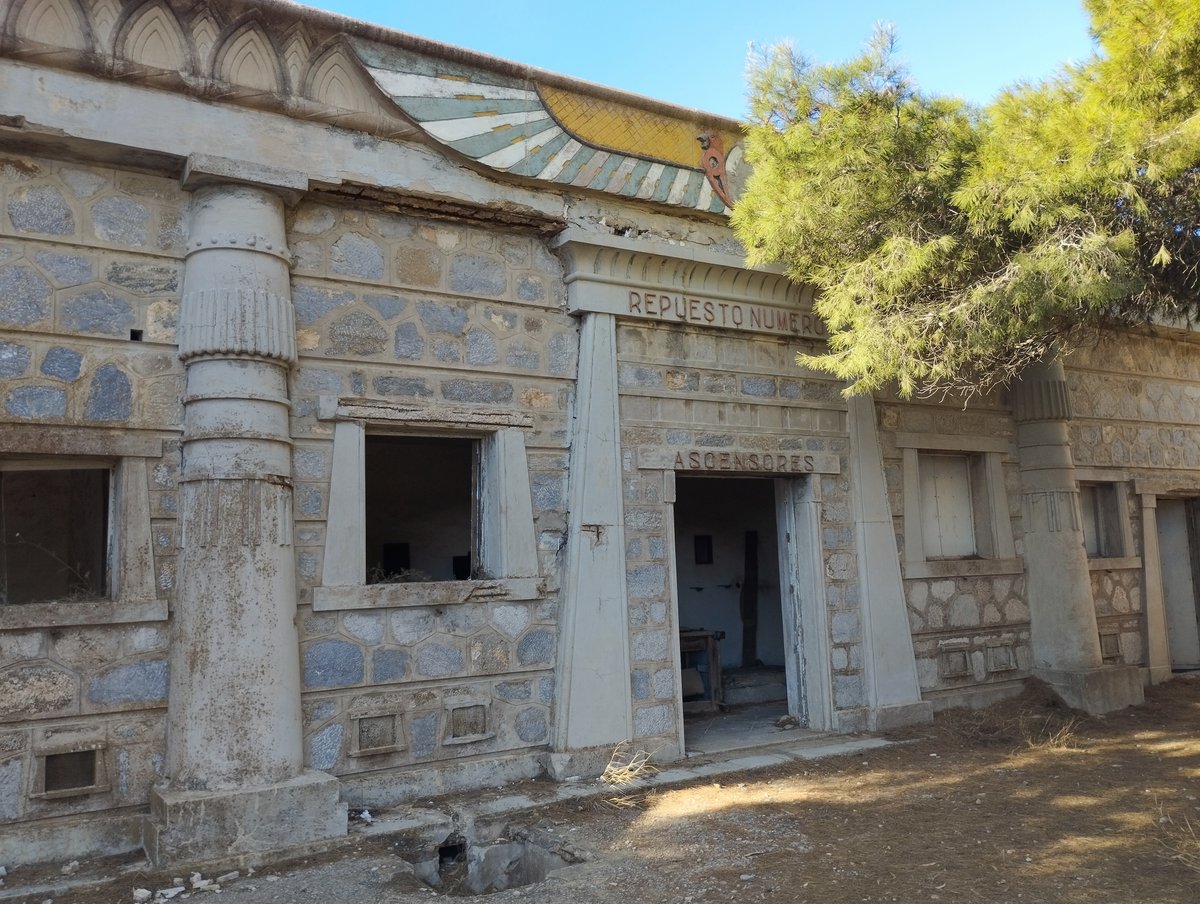

La Parajola, also known as C-3, is a Spanish coastal fortification situated on Monte de Galeras within the municipal term of Cartagena. It was built in 1926 as part of a defensive cordon for the strategic city of Cartagena during the dictatorship of Primo de Rivera. The battery was part of the La Algameca military installations and had four guns built by the Sociedad Española de Construcción Naval. These guns were based on the six-inch coastal cannon design by British company Vickers-Armstrongs. The battery was used exclusively against military targets during the Spanish Civil War. On March 7, 1939, it was used to sink the ship Castillo de Olite, causing one of the largest naval tragedies in Spanish history. The Batería de La Parajola was declared a cultural asset of interest on August 7, 1997.
The story of the Castillo de Olite begins during the Spanish Civil War when a subversion happened in Cartagena fomented by the Franco Fifth Column and pro-negotiation republican elements. The Navy of the Republic fled to Tunisia while the government of President Juan Negrín sent the 206th Mixed Brigade to retake the city and the General Franco’s staff was sending 30 ships with more than 20,000 soldiers with the intention of securing the important naval base.
The 206th Brigade was the first to arrive and quickly defeated the rebels, restoring the control of the Republic at midday on March 7. The Franco Navy retreated when they learned the news, except for the Castillo de Olite, which approached the coast not knowing the situation due to a radio outage. As it approached, it was hit by the first shot from La Parajola, under the command of Captain Antonio Martínez Pallarés. The ship attempted to maneuver, but then several shots collided with the hull, one of them hitting the magazine.
In the subsequent explosion, 1,476 men out of the 2,112 on board died, 342 were injured and 294 were made prisoners. The Castillo de Peñafiel, another ship that did not receive a timely warning, received a hit but was able to retreat to Ibiza without further incidents. The battery was disarmed in 1994 in accordance with the Plan NORTE, and although it was declared a cultural asset of interest in 1997, its access remains restricted since it is located in a military zone owned by the Ministry of Defense.
Despite this, its deteriorated state led it to be added to Hispania Nostra's Lista roja de patrimonio en peligro in June 2014.
La Parajola stands at an altitude of 165 meters and its architecture follows a historicist style, drawing influence from ancient Egyptian architecture. The depots and munition storage of La Parajola have designs reminiscent of ancient Egyptian architecture. The entrance of La Parajola features pylon structures. Modernist elements can also be found in La Parajola's architecture. A walk through this site takes you back to a time of Spanish history that was characterized by civil conflict and military maneuvers.
Sources: Wikipedia, OpenStreetMap, Wikidata, Wikimedia Commons
Written by Nik Frost
Discuss this with the author and others
No comments yet. Be the first to start the conversation.