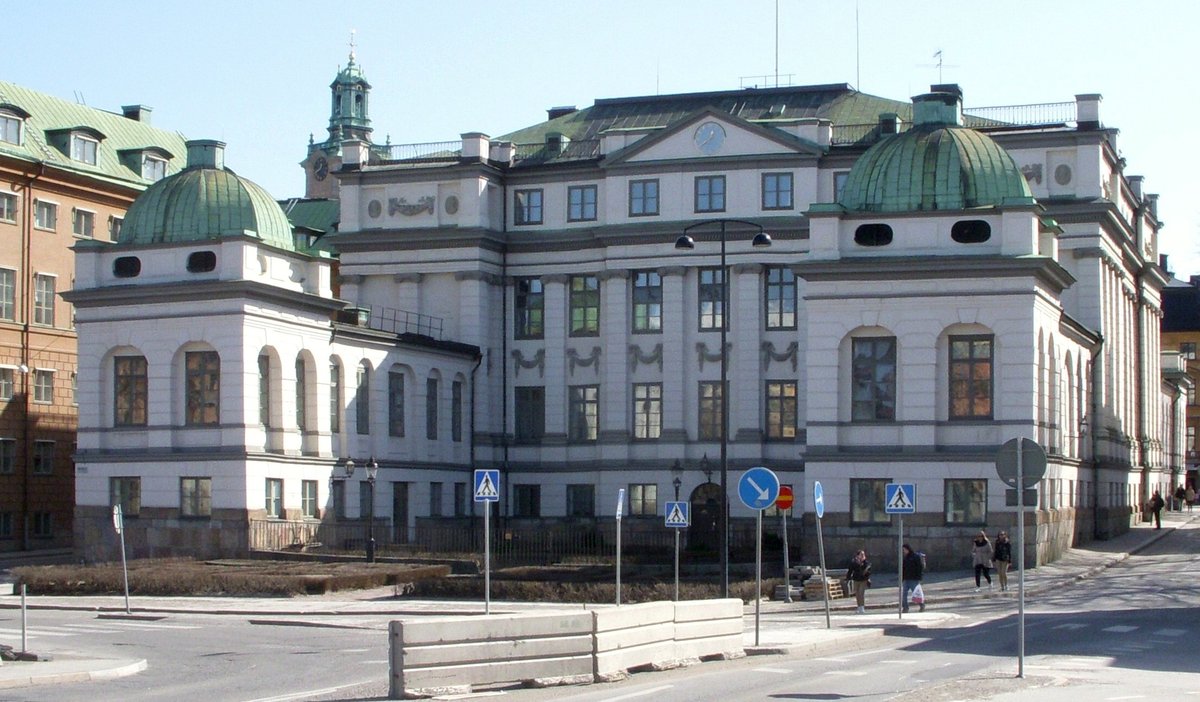

The Bonde Palace, a palace in Gamla stan, central Stockholm, Sweden, is likely the most prominent monument of the Swedish Empire (1611–1718). Designed by Nicodemus Tessin the Elder and Jean De la Vallée in 1662-1667, it was initially the private residence of Lord High Treasurer Gustaf Bonde (1620–1667).
While housing the Stockholm Court House from the 18th century and, since 1949, the Swedish Supreme Court, the palace has also served as a temporary residence for the Royal Library and the Svea Court of Appeal following the fire of the royal palace Tre Kronor in 1697. However, the palace suffered damage in two subsequent fires. The roof was destroyed in 1710, but the original cupolas, preserved on the northern wings, are still intact.
The palace was bought by the city in 1730 to serve as the City Hall, signifying the end of its years as a private residence.
The palace was thoroughly restored following a fire in 1753 by Johan Eberhard Carlberg, resulting in the construction of the southern wings to the original plans, the addition of a new top floor, and an up-to-date, low-hipped roof. Today, the interior still reflects the taste of the mid 18th century. Despite witnessing several dramatic historical events, the palace was no longer able to accommodate the court house in the 19th century, leading to the construction of a new court house on Kungsholmen in 1915.
The palace then accommodated various municipal offices before being transferred from the city to the state in 1948 for further refurbishment in 1948 and 1986.
Sources: Wikipedia, OpenStreetMap, Wikidata, Wikimedia Commons
Written by Nik Frost
Discuss this with the author and others
No comments yet. Be the first to start the conversation.