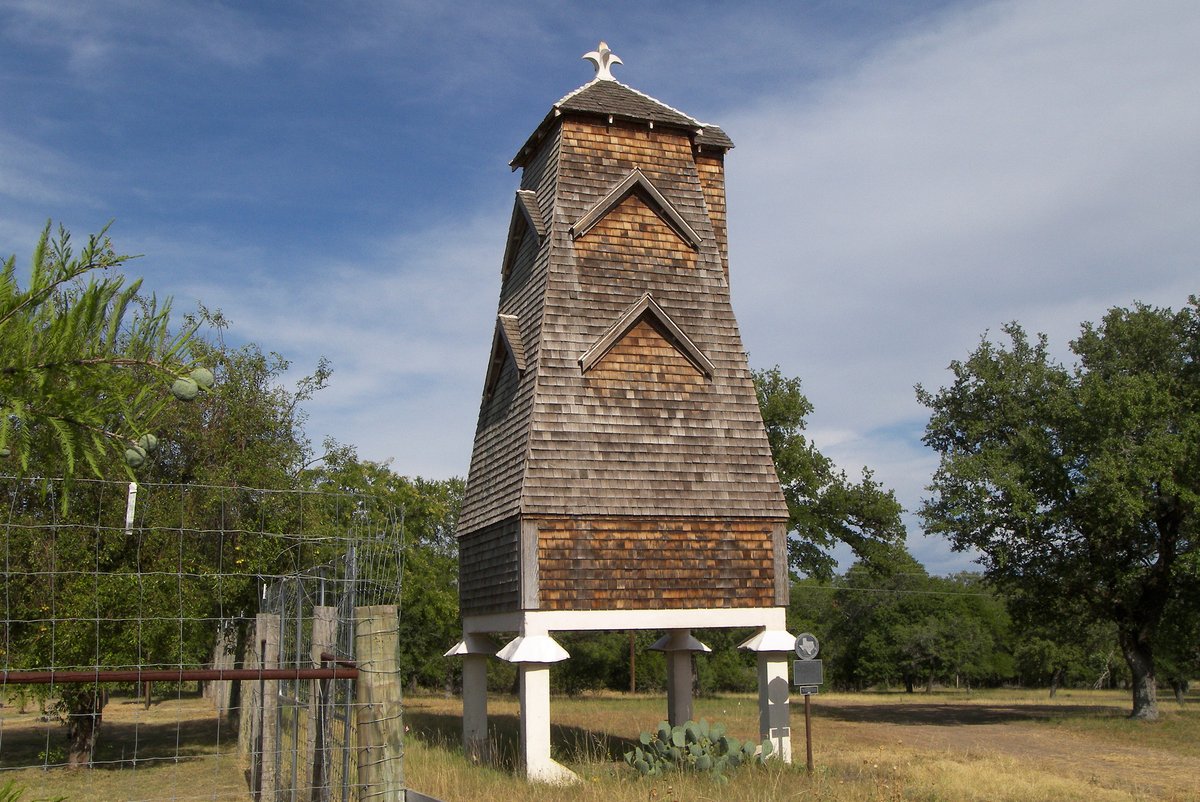

In the heart of Kendall County, Texas, on the south side of RM 473 east of Comfort, stands a peculiar structure: the Hygieostatic Bat Roost. Erected in 1918, it was commissioned by former San Antonio Mayor Pro Tem Albert Steves from San Antonio health officer Dr. Charles A. R. Campbell. Campbell had been researching a method to control the spread of mosquito-carried malaria by encouraging the insect's natural enemy, the bat. The shingled pyramid-shaped raised tower stands 30 feet high, with one dormer serving as an entrance for the bats while the other dormers are ornamental.
The lower portion of the tower allows access for humans. The concrete base of the tower is raised 7 feet off the ground, facilitating wagons being driven beneath to collect the guano. Campbell patented his bat roost design and erected several of them in the San Antonio area beginning in 1907. When the bat roost was built on his Kendall County property, Steves coined the name Hygieostatic Bat Roost based on the Greek words hygiea (health) and stasis (standing).
Today, the Hygieostatic Bat Roost is a designated Recorded Texas Historic Landmark and is listed on the National Register of Historic Places. The descendants of Albert Steves still own the property where this 20th-century structure stands.
Sources: Wikipedia, OpenStreetMap, Wikidata, Wikimedia Commons

Written by Friendly Jane
Discuss this with the author and others
No comments yet. Be the first to start the conversation.