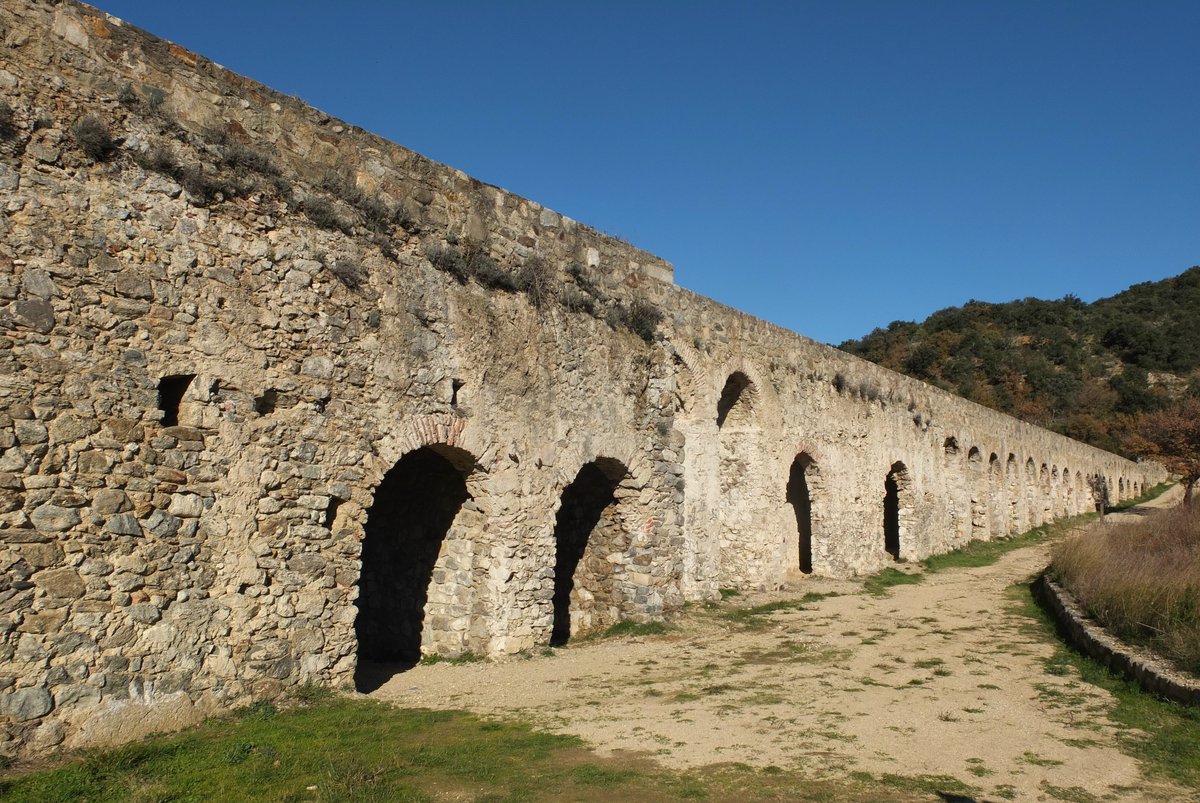

Le pont-aqueduc d'Ansignan is a 170-meter structure located in the Pyrénées-Orientales, spanning the Agly river. It serves a dual purpose: a lower level functions as a bridge for pedestrians, riders, or small carts, while the upper level is a working aqueduct that carries water to irrigate fields on the opposite bank. Because the aqueduct was built over the original road, the lower level takes on the appearance of a tunnel, lit by a few small openings in the stone.
The history of the site is complex. While the road is well-attested, the original bridge may date to before or during the Roman era, potentially built by the Volcae Tectosages. Local authorities date the masonry of the arches to between 220 and 270 AD, though others suggest the original work might have been a bridge-siphon. In the 9th century, an aqueduct was built over the initial bridge, turning the original path into a tunnel. The structure was reworked again during the 13th and 14th centuries to reach its current dimensions.
Today, the bridge-aqueduct remains in service, continuing to provide irrigation for the village. While local legends attribute its unique design to monks, Templars, or even ancient astronomical calendars, it is a recognized monument historique. Visitors can still see the base of a mill and water outlets from a 1906 hydroelectric turbine, even though the building itself was demolished in the 1970s. The structure's 29 arches increase in size as they approach the river, with the two largest spanning the main bed of the Agly.
Sources: Wikipedia, OpenStreetMap, Wikidata, Wikimedia Commons
Written by Nicolo Ciampini
Discuss this with the author and others
No comments yet. Be the first to start the conversation.