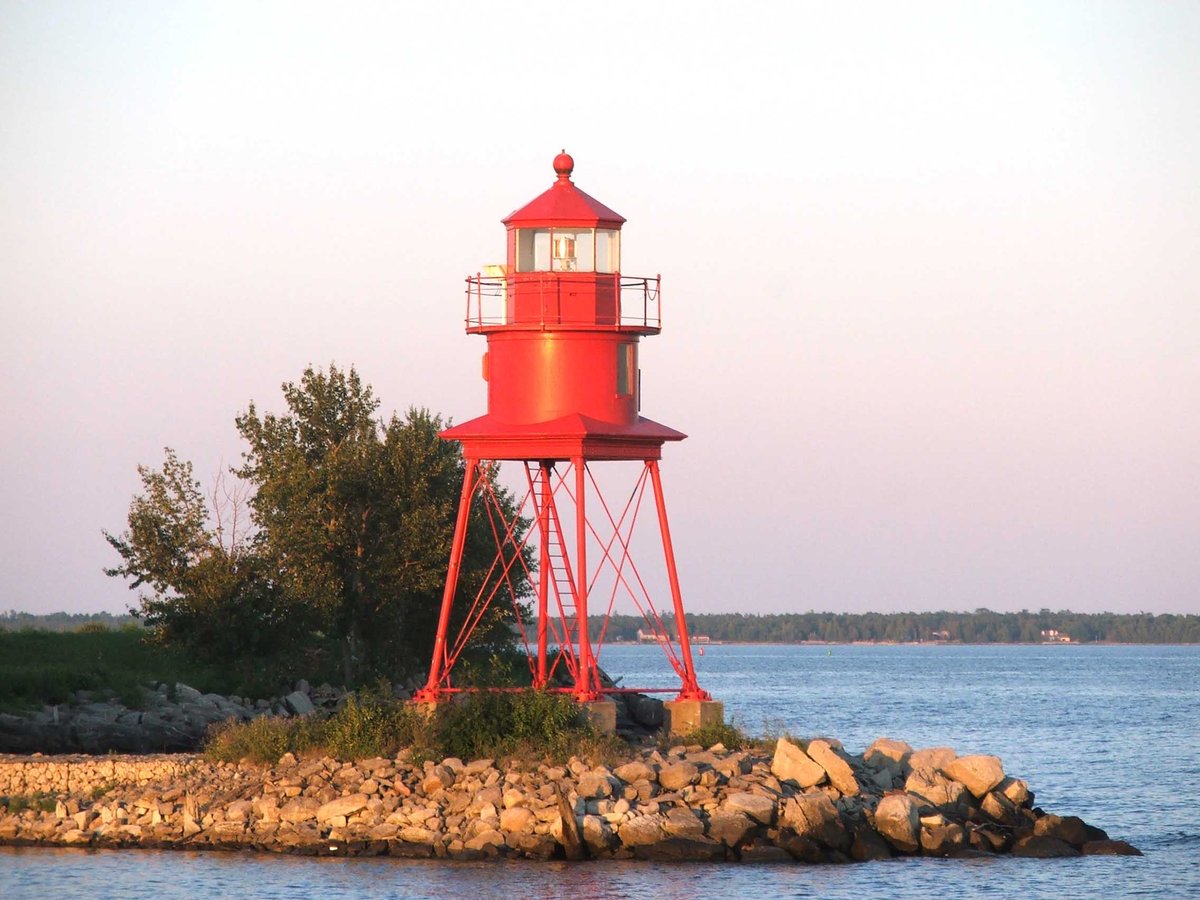

If you hang out in Alpena, you might hear people call this spot Sputnik or Little Red. Some locals might joke that it is more about work than aesthetics, but that is exactly what gives it such character. This lighthouse sits on the north breakwater of Alpena Harbor to mark the entrance to the Thunder Bay River. It is a working piece of maritime history that still does its job today.
To get the full story, you have to look at the timber industry. Back in 1857, lumbermen started asking for a light because shipping logs and newsprint were the lifeblood of the local economy. The government was slow to move, first trying to put a light at Trowbridge Point. After a lot of persistence, Congress finally agreed to move the location to the mouth of the Thunder Bay River in 1868.
The light has gone through several versions over the years. There was a temporary 25 foot pole light in 1875, followed by a wooden pyramidal tower in 1877 featuring a Sixth Order Fresnel lens. That tower burned down in 1888 along with parts of the town. A temporary pole served the area until the current structure was finished in 1914.
This third version sits on a steel frame and stands 34 feet tall. You might see 80 feet in some old records, but those are just errors in the files. It started out painted black, but they switched it to red in 1950 for better daytime visibility. It is a unique design and some say it is the only surviving example of its kind in the country.
Tech upgrades have also kept it current. It had a fog bell in 1891, an electric alarm in 1920, and it uses a modern automated fog horn now. It became automated in 1974. The onshore complex once had a brick oil storage building from 1896, but they took that away when they switched to electricity. The 1996 lens replaced the original Fresnel lens, which you can now find at the Grand Traverse Lighthouse.
Today, the light is still an active aid for ships. You get the best view of it from the transient docks at the Alpena marina. It stays busy marking the harbor for freighters coming deep into the river. It is a local icon that even appeared as a stamp in 1999 for the Great Lakes lighthouse festival. Even though it is no longer manned by a resident keeper, as there were from 1878 to 1965, it remains a red sentinel for every ship coming in with the day's haul.
Sources: Wikipedia, OpenStreetMap, Wikidata, Wikimedia Commons
Written by Friendly Jane
Discuss this with the author and others
No comments yet. Be the first to start the conversation.