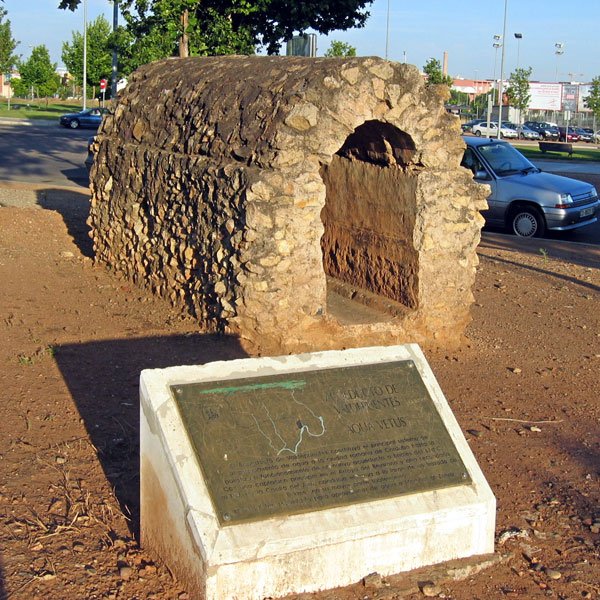

Tucked away in a park at one of Córdoba's busy intersections lies a relic of the city's past that hardly anyone even notices. The aqueduct of Valdepuentes, also known as Aqua Vetus or Aqua Augusta, was once one of three aqueducts that supplied water to the Roman city of Corduba. Today, it's a protected monument, but most people tramping past it are clueless about its history. The Romans built the aqueduct in the first century A.D, a century after Corduba was founded.
Today, after more than 2,000 years of use and misuse, all that remains are a handful of stones about 2.5 meters long, preserved by the city council in a small park near a busy roundabout. The existence of some lead conduits, gutters, drainage systems, and wells suggest its Roman origin. Evidence from inscriptions found in the last quarter of the 20th century has proven its Roman origin. The aqueduct captured water mainly from the area of Santa María de Trassierra (arroyo del Bejarano, caño de la Escarabita, and Veneros de Vallehermoso).
The conduit had a length of 18.6 km and ran subterranean almost entirely. The canal (specus) was constructed in opus caementicium with a revestimiento interior de opus signinum. The canal had a section of 90x64 cm with walls 30-40 cm thick and a diameter of 30 cm for the inner radius. More than 40 water wells (spiramina) were used to reduce the water velocity on the mountain slope. Other wells served to change direction or facilitate the cleaning of the subterranean conduit.
Sources: Wikipedia, OpenStreetMap, Wikidata, Wikimedia Commons
Written by Nik Frost
Discuss this with the author and others
No comments yet. Be the first to start the conversation.