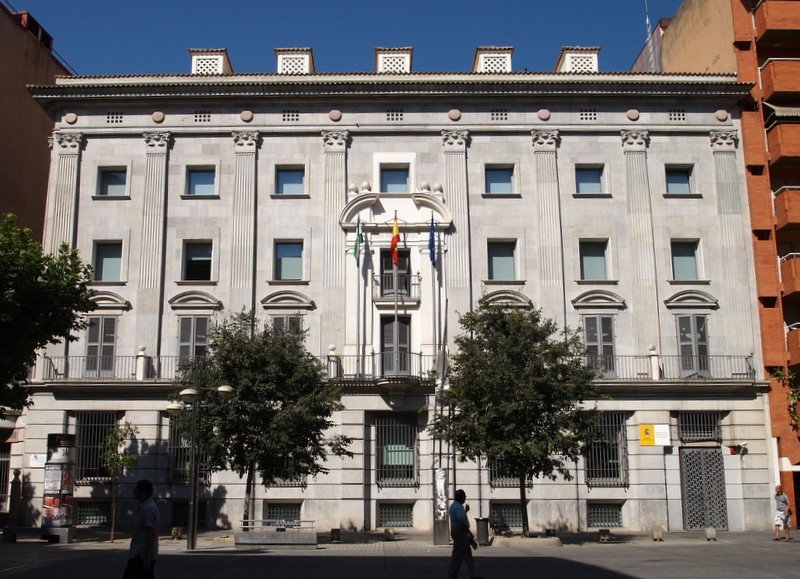

During the early 20th century, financial institutions began utilizing architecture as a strategic public face. These entities sought to project an image of unwavering wealth and stability by claiming prominent positions within the urban fabric. The Edificio del Banco de España in Córdoba serves as a prime case study of this evolution. It masterfully balances the practical requirements of a workplace with a grand, intimidating architectural presence.
Between 1935 and 1939, the architect Secundino Zuazo Ugalde envisioned a new structure on the former site of the Salón Ramírez, which had previously served as a cinema and variety theater. In a deliberate departure from mixed-use designs, Zuazo Ugalde separated the building from the surrounding public life. The interior of the building represents functionality while the exterior represents the character of capital, seeking to unite representation with a public character suitable for the service sector.
The building consists of two fundamental bodies of different heights that constitute two very differentiated parts. One body generates a representation of the building's entrance, where the large public space of the operations hall is developed; the other corresponds to the private activities of the building. This wide operations space is inspired by the old mosque of the city, picking up its formal solution. To alleviate the northwestern section of the plot, the building features a large patio and a smaller secondary patio along the southern boundary.
On the main facade, Zuazo Ugalde takes up the neorrenacentista alternative to support a new volumetric conception. This generates clean volumes of a sober planimetry, where light openings receive a schematic treatment that contrasts with the Corinthian order defining representative interests. Today, the Edificio remains a vital part of the skyline and is managed by the IAPH, reflecting a narrative of power and history through these deliberate architectural choices.
Sources: Wikipedia, OpenStreetMap, Wikidata, Wikimedia Commons
Written by Nik Frost
Discuss this with the author and others
No comments yet. Be the first to start the conversation.