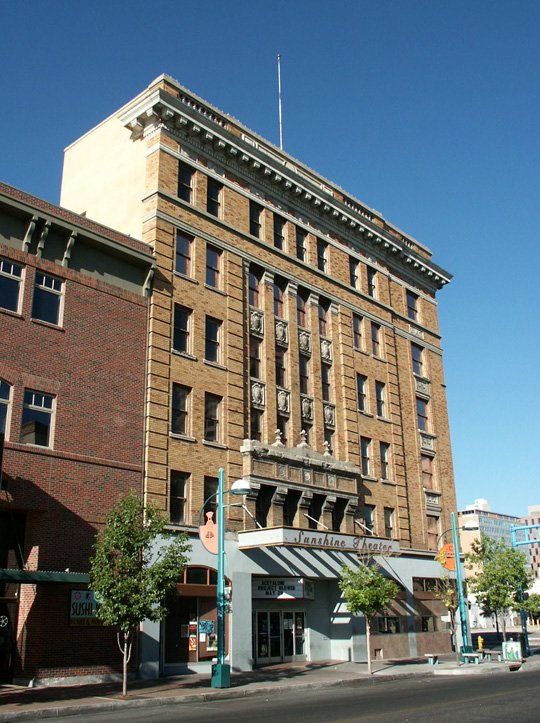
Located in downtown Albuquerque, the Sunshine Building is a six-story historic structure built in 1923-24 by Italian-American businessman Joseph Barnett. Designed by the El Paso firm Trost & Trost, the building is a Renaissance Revival structure made of reinforced concrete with a facade of yellow brick. It occupies the southeast corner of Second Street and Central Avenue Northwest, standing on the former site of the White Elephant building, a two-story adobe structure dating to 1881.
From its inception, the building was designed to house a large theater with five floors of offices. The Sunshine Theater operated primarily as a movie theater until the 1980s, though it was also equipped for Vaudeville shows and other live performances. In 1983, the building was proposed for demolition to make way for a festival marketplace development, but preservationists organized a 'Save the Sunshine' committee to protect the site. The project was eventually abandoned, and the building remains a New Mexico State Register of Cultural Properties listing and an Albuquerque City Landmark.
In 1990, the Sunshine Theater was converted into a live music venue, hosting its first act, Soundgarden, on February 14 of that year. Since then, it has become one of the most popular mid-size concert venues in the Albuquerque metro area, hosting a wide range of notable acts. The building is also notable for having what was believed to be the last manually operated elevator in New Mexico, which was staffed by operators until at least 1989.
Today, the theater accommodates about 1,000 people with an open floor, a large balcony, and a bar. While the office section maintains a separate entrance on Second Street, the theater remains a central cultural hub. The building's architecture features decorative brickwork, pilasters, a heavy cornice, and a balustraded parapet, preserving its 1920s character while serving a modern audience.
Sources: Wikipedia, OpenStreetMap, Wikidata, Wikimedia Commons
Written by No Other
Discuss this with the author and others
No comments yet. Be the first to start the conversation.