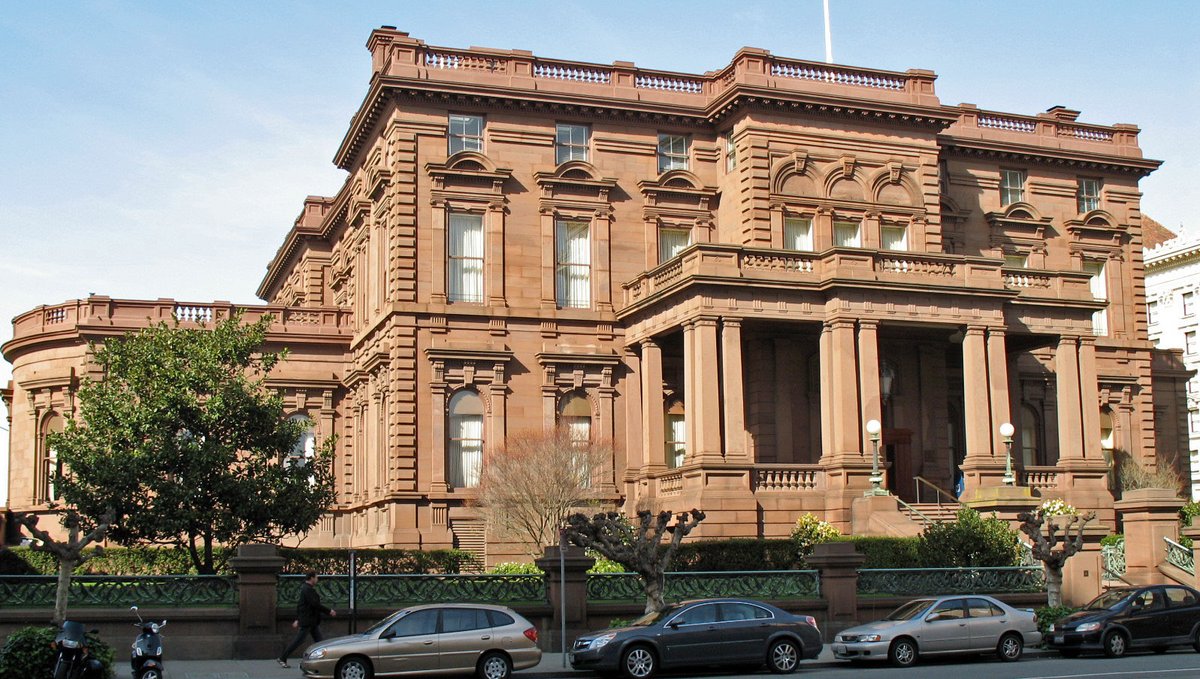
The James C. Flood Mansion is a historic building located at 1000 California Street, atop Nob Hill in San Francisco, California. Built in 1886 for silver baron James C. Flood, it served as his townhouse until his death in 1889. The mansion is notable for being the first brownstone building west of the Mississippi River and stands as the only mansion on Nob Hill to structurally survive the 1906 San Francisco earthquake and fire.
The structure occupies an entire city block bounded by California, Cushman, Mason, and Sacramento streets. It is a three-story masonry building finished in brownstone quarried in Portland, Connecticut. The exterior features Classical Revival architecture, including corner quoining, a balustraded roof edge, and windows framed by pilasters and elaborate pediments. The main entrance is sheltered by a three-bay portico supported by clustered square columns.
Flood was inspired by the Gilded Age mansions of the East Coast and commissioned architect Augustus Laver to design the home, which was completed in 1888. After Flood's death, his daughter occupied the building until it was gutted during the 1906 earthquake and fire. She sold the shell of the building to the Pacific-Union Club, which commissioned architect Willis Polk to design alterations.
The Pacific-Union Club added a third floor and a new interior, which included the use of additional brownstone from the same quarries as the original material. The mansion was declared a National Historic Landmark in 1966 and remains home to the club today.
Sources: Wikipedia, OpenStreetMap, Wikidata, Wikimedia Commons


Written by No Other
Discuss this with the author and others
No comments yet. Be the first to start the conversation.