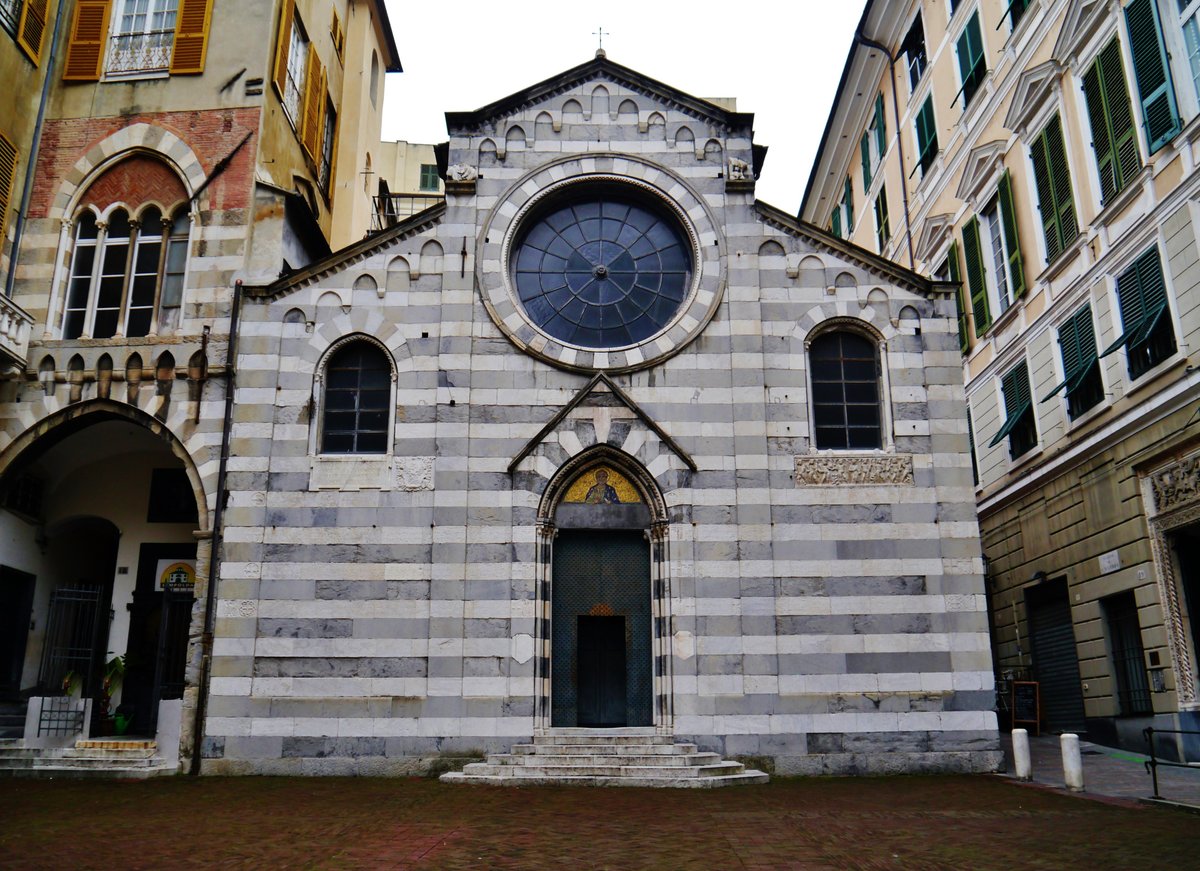

San Matteo church in Genoa, Italy, is a Roman Catholic church with a long history. The building was founded in 1125 by Martino Doria as a private family chapel. Its facade features a late Roman sarcophagus containing an Allegory of the Autumn. This sarcophagus was originally used as the tomb of Lamba Doria, who brought it to Genoa from Korčula in Dalmatia.
The exterior of the church is divided into three sections by fake columns with Lombard bands, featuring a nave, aisles, and facade with white marble and black slate stripes. On the left side is the cloister of St. Matthew, a quadrangular plan dating to 1308 with ogival arches on double small columns. At one time, large chains from the harbor of Pisa were draped across the facade until they were returned in the 19th century.
Inside, the church houses various notable artworks, including the Miracle of the Ethiopian Dragon by Luca Cambiaso and the Vocation of St. Matthew by Giovanni Battista Castello. The crypt contains the tomb of Andrea Doria, executed by Montorsoli, while the high altar holds a Holy Family with St. Anne by Bernardo Castello. According to tradition, the sword housed under the altar belonged to Andrea Doria and was donated to the church by Pope Paul III.
Sources: Wikipedia, OpenStreetMap, Wikidata, Wikimedia Commons
Written by Nicolo Ciampini
Discuss this with the author and others
No comments yet. Be the first to start the conversation.