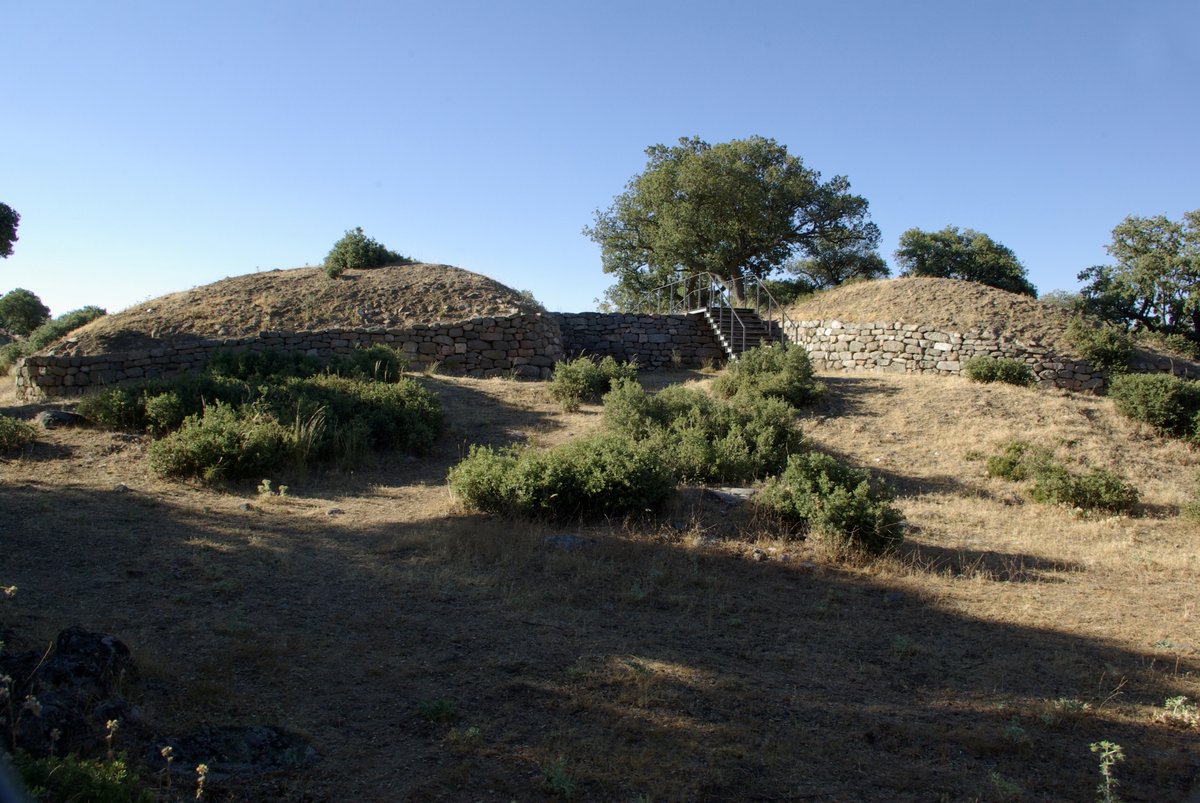

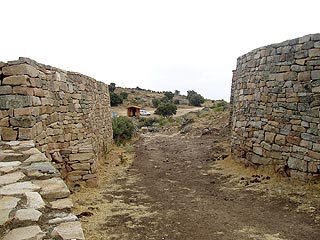
The settlement La Mesa de Miranda, located in the municipality of Chamartín in the province of Ávila in Spain, was a hill fort or oppidum where Vettones people lived between the late fifth and the first century BC. The place was strategically chosen as it is easily defended on a plateau between two rivers that, by erosion, created a cliff to the north of the fort. The castro consists of three enclosures, including the Castillo Bajero and the Castillo Cimero, which are connected by gates flanked by towers.
The oppidum was enclosed by a 2,832 m long wall and 5 meters wide on average, built from large blocks of stone, enclosing an area of circa 30 ha. According to excavations, the wall must have been built in the late 3rd or early 4th century BC. The dimensions of the third enclosure suggest it was used as a livestock pen. Based on the number of houses and cemetery findings, the estimated population of the oppidum was between 300 and 375 inhabitants, making it a noticeable settlement at that time.
South of the walls lies the necropolis named La Osera, where 2,230 graves were discovered. Different burial areas were identified by a vertical stone, or stele, with a height between 50 and 160 cm. It is believed that these steles were used for astronomic events based on Solstices and Celtic religious festivals. The necropolis dates from the 3rd century BC to the early 3rd century AD. The fortified settlement was recently restored and opened to the public in 2004.
Sources: Wikipedia, OpenStreetMap, Wikidata, Wikimedia Commons
Written by Nicolo Ciampini
Discuss this with the author and others
No comments yet. Be the first to start the conversation.