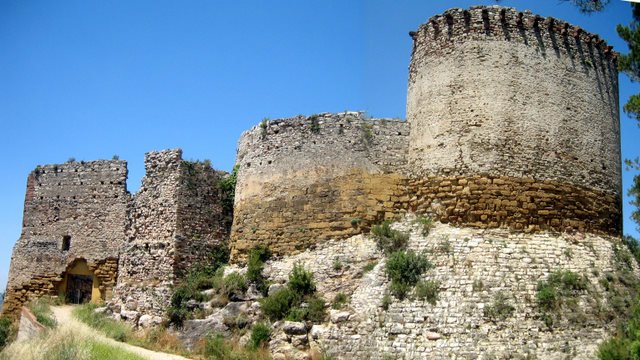

Castell de Gelida in Gelida, Catalonia, is a national heritage site. Perched atop a cliff of the serrra d'Ordal, it overlooks the town and the lower course of the river Anoia. First mentioned in 945, the fortress was built to strengthen the Monastery of Santa Cecília de Montserrat. After Almansor's raid in 985, Ènnec Bonfill acquired the fortress through exchange with the church. The fortress passed through various hands until the 13th century. In the early 12th century, the Almoravites reached the fortress walls.
In 1267, Guerau VI de Cervelló granted privileges to the university of the territory. In 1297, Guerau VII de Cervelló sold the fortress and other properties to King Jaume II. In 1309, King Jaume II exchanged the fortress with other castles with the Countess of Pallars. In 1337, the Barony of Gelida was sold to Pere III, Judge of Arborea. The lord of Gelida participated actively in the war against Joan II, and in 1465, the fortress hosted the conestable of Portugal Pere.
The Bertran family temporarily lost their domain due to their participation in the war against Joan II. In 1529, Anna Violant Bertran and Estaper got married with Joan d'Erill-Orcau and de Requesens. The 16th century saw minor works and repairs, and it is probable (though not documented) that Felip V destroyed the fortress after the War of the Spanish Succession. In the 18th century, the stone began to be used for other constructions. In 1780, the rector of Sant Pere requested permission to use it to build the campanar.
In 1815, Josep Pasqual de Marimon i Perellós, V marquès de Cerdanyola, sold the fortress of Gelida to the Leblond, soldiers. In 1909, the Altimires bought the fortress from the Genés, descendants of the Leblond. In 1965, the Association of Friends of Castell de Gelida was founded to manage and recover the heritage of the area around the fortress. In 1968, the fortress became municipal property. In the 1990s, archaeological interventions were carried out, documenting different areas and structures, and the evolution of the buildings.
Sources: Wikipedia, OpenStreetMap, Wikidata, Wikimedia Commons
Written by Nik Frost
Discuss this with the author and others
No comments yet. Be the first to start the conversation.