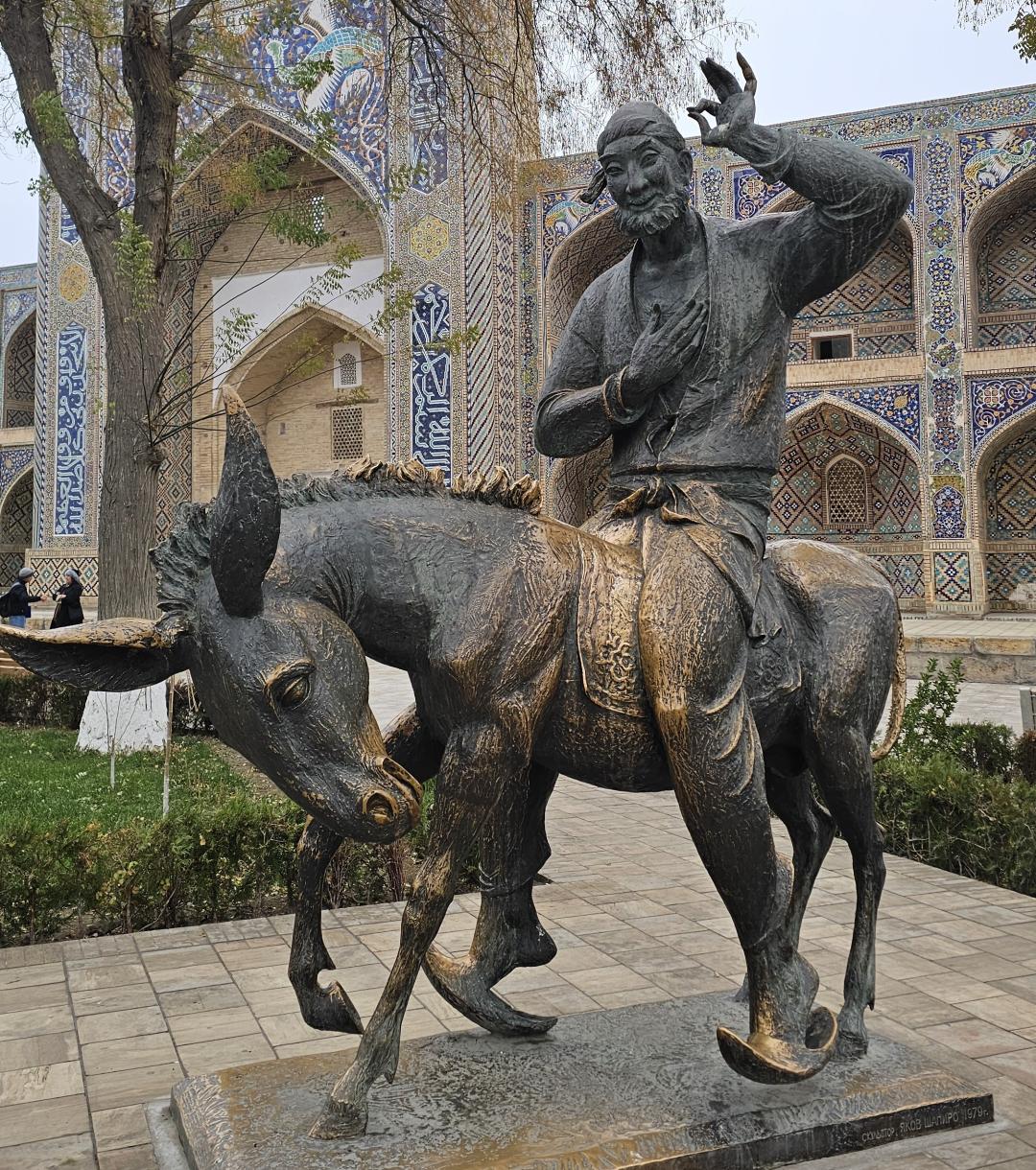

In the very heart of the historic center of Bukhara, near the famous Lyabi-Hauz square, stands a unique monument. It is like a spark of light among the serene masterpieces of ancient architecture. This is a monument to the legendary character Khoja Nasreddin Efendi. This cunning old man with a donkey is revered as a folk hero.
Many know this Eastern hero of legends, anecdotes, and fables – a sharp-witted, mischievous joker who fought against the vices of humanity. He mocks the flaws of greedy rulers and beys, hypocrisy and cowardice, bribery and litigation. Eloquent and witty, a folk sage, virtuoso, and orator—this is how Khoja Nasreddin can be described.
Why is his monument located specifically in Bukhara? Soviet writer Leonid Solovyov wrote two novels about the adventures of Khoja Nasreddin. One of these works was adapted into a film in which Khoja Nasreddin travels through Bukhara and ends up in the court of the Bukhara Emir. This character became so rooted in Bukhara that he even became a national symbol, and in 1979 a monument was erected in his honor. Every spring, a humor festival dedicated to Khoja Nasreddin is held in Bukhara. There is even a local belief that if a child is placed on Khoja Nasreddin’s donkey, their life will be filled with joy and a sea of positive emotions.
One of the best, if not the best, screen adaptations of "The Tale of Khoja Nasreddin" is "Nasreddin in Bukhara." It is clear that Leonid Solovyov himself worked on the script—the text is very close to the book. The events almost entirely, except for some episodes, correspond to the first part of the book, "The Troublemaker."
Thanks to Lev Sverdlin and Yakov Protazanov, the film was successful and remains deservedly popular to this day. Sverdlin brilliantly embodied the image of Khoja Nasreddin from "The Troublemaker" on screen: this is exactly how he appears when reading the book. Many still sincerely believe Sverdlin was Uzbek—so convincingly did the actor transform into his character.
Protazanov, who led the directing team, masterfully staged the film: nothing superfluous, minor deviations from the book were made to preserve the narrative rhythm. The hand of an experienced director is felt. It is no coincidence that Protazanov received the title of Honored Art Worker of the Uzbek SSR for this film, although at first he was reproached: "Why are you making comedies when there is a war going on?" Here is Protazanov’s famous reply: "If we always think only about the war, nothing good will come of it. A person must not forget to laugh."
Nabi Ganiev, who was part of the directing team, became the chief director of the next film about the hero of L. Solovyov, "The Adventures of Nasreddin." It is also interesting to note the cameo appearance of the famous Uzbek actor Rakhim Pirmukhamedov as a guard, who later played the role of the Baghdad thief in the sequel. The sequel to "Nasreddin in Bukhara" was released in 1946. The script was written by Leonid Solovyov with the participation of Viktor Vitkovich in 1944, and it contained the main framework for the future "Enchanted Prince." At the time of the film’s release, the writer was already in Stalin’s camps, and for understandable reasons, only Vitkovich was credited as the screenwriter.
Sources:
https://otpusk.uz/en/uzbekistan/sights/bukhara
https://nashnasreddin.ru/wordpress/media/nasreddin-v-buxare/
https://uzbekistan.travel/en/o/pamyatnik-hodzhe-nasreddinu-efendi/