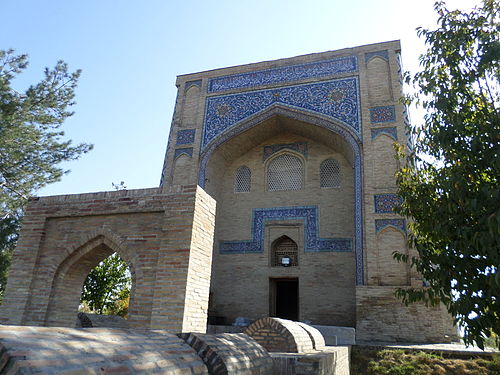

I have deprived my dwelling of carved doors.
It is open day and night for guests.
Come in, sit down, my weary traveler.
Here everything is yours: both bitterness and honey.
The wise man who shared a meal with me,
Let me pour him not sherbet, but vinegar.
He tasted the beans with grateful nobility.
As for the proud—let him not waste his strength.
Al-Kaffal ash-Shashi
The great scholar Abu Bakr ibn Ismail Al-Kaffal ash-Shoshi was born in 903 in the city of Tashkent into a family of skilled craftsmen renowned for making locks. Having inherited rich experience and secrets of craftsmanship from his father, he earned the nickname “Kaffal,” meaning “Locksmith.” It is believed that this nickname was also given to him because he managed to make an enormous lock whose key weighed more than a kilogram. He owed his vast knowledge and authority to studying at the best madrasas of the capital. Imam Al-Kaffal devoted his entire life to studying Islam, jurisprudence, as well as eloquent poetry, one of his famous works being the book “The Beauty of Dialectics.”
There is a beautiful legend that the famous Quran of Caliph Uthman (7th century) was brought to Tashkent from Baghdad by Al-Kaffal ash-Shashi himself, and that this unique handwritten sacred book was gifted to him by the Caliph of Baghdad for his outstanding merits. This legend is connected with another elegant tale that the title “Kabir” was given to Al-Kaffal ash-Shashi for a brilliant poetic response to the Byzantine emperor. In the book of Sheikh Abu Ahmad Muhammad Ghazi ash-Shashi “Silsilatu-l-Urufin,” the story described above is presented somewhat differently.
…Returning to Baghdad from another Hajj to Mecca, Kaffal ash-Shashi found the Caliph’s court in deep distress. The warlike Byzantine Emperor Nikephoros sent Caliph Mutillillah a beautiful qasida (poem) in Arabic with the note: “If you cannot respond with equally beautiful verses, then either pay tribute or prepare for war.” No one dared to take on the task. The bold Byzantine envoy pressed for an answer. Then Kaffal ash-Shashi took on composing a reply poem, but with one condition—he asked for the Mus'haf of Uthman, the oldest manuscript of the Quran, which according to legend was stained with the blood of Caliph Uthman himself. Chroniclers claim that the poem written by Kaffal amazed the Byzantine emperor, who exclaimed in admiration: “We did not know that such a skilled poet lives among the Muslims!” Thus, the caliphate was saved, and the sacred Quran of Uthman was sent to Tashkent.
Against the version involving the caliph, as sad as it is, speaks the fact that caliphs at that time were already decorative figures with no real involvement in state affairs. The only close aide to Caliph Al-Muti’ Lillah al-Fadl ibn Ja’far al-Muktafi, who is mentioned here, was a secretary, and the caliph himself lived on a meager daily allowance of 100 dirhams, which was scant for the leader of the faithful. Moreover, the most realistic version of the appearance of Uthman’s Quran is connected with the name of Tamerlane.
However, none of this diminishes the amazing poetic gift of our compatriot, whose legends have lived for more than a thousand years.
There is also a legend that Abu Bakr Kaffal ash-Shashi, who contemporaries credited with knowledge of 72 languages, translated the sacred Jewish book Torah from Hebrew into Arabic, and for this, ten thousand Muslims were freed from captivity by the Jews. When the caliph asked Kaffal: “What reward do you desire for such a great deed?” he replied: “I ask you to allocate funds to the ruler of my native Shash for the construction of irrigation canals in the city.” The caliph immediately ordered the issuance of 160,000 tangas to the governor of Shash, with which workers were hired to build a whole network of irrigation canals through the city.
There are many different legends, but they all say one thing: the people of Tashkent have always loved and continue to love the holy patron of the ancient city, remembering his good deeds done for his homeland. And it does not matter to us at all that today the Muslims of the country follow the Hanafi school of Islam, while Kaffal ash-Shashi was a scholar of the Shafi’i tradition.
Returning from travels during which he toured the entire Muslim world, visited holy places, and communicated with the most outstanding people of the Eastern Renaissance period, Al-Kaffal ash-Shashi again lived in his native Tashkent, where the fame of the great scholar and poet had reached long before Abu Bakr’s return home. Having seen the world and reached the peak of fame, the scholar and poet returned to his native city, from which he had left as a curious son of a locksmith. Several sources write that the conversion of the Karakhanid Turks to Islam was influenced by the enlightener Abu Bakr Kaffal ash-Shashi. Thus, the claims that he returned to Shash as a very old man are not entirely accurate. The contemporary historian and philosopher Ibn Miskawayh and the historian Ibn al-Athir, who lived two hundred years later, write that the Karakhanids accepted Islam in 960, when the Tashkent scholar and poet was 56 years old.
Al-Kaffal ash-Shoshi passed away in 976, and his burial place immediately gained fame as a site of holy pilgrimage. The first burial site mentioned in the 10th century has not survived to this day. In its current form, the mausoleum was built in 1542 by the Khan’s architect Gulyam Husayn. It is an asymmetrical domed portal mausoleum—a khanaka. Khanakas were intended to provide pilgrims with shelter in living cells—hujras.
Mausoleum complexes often also included a mosque and a kitchen called oshkhona.
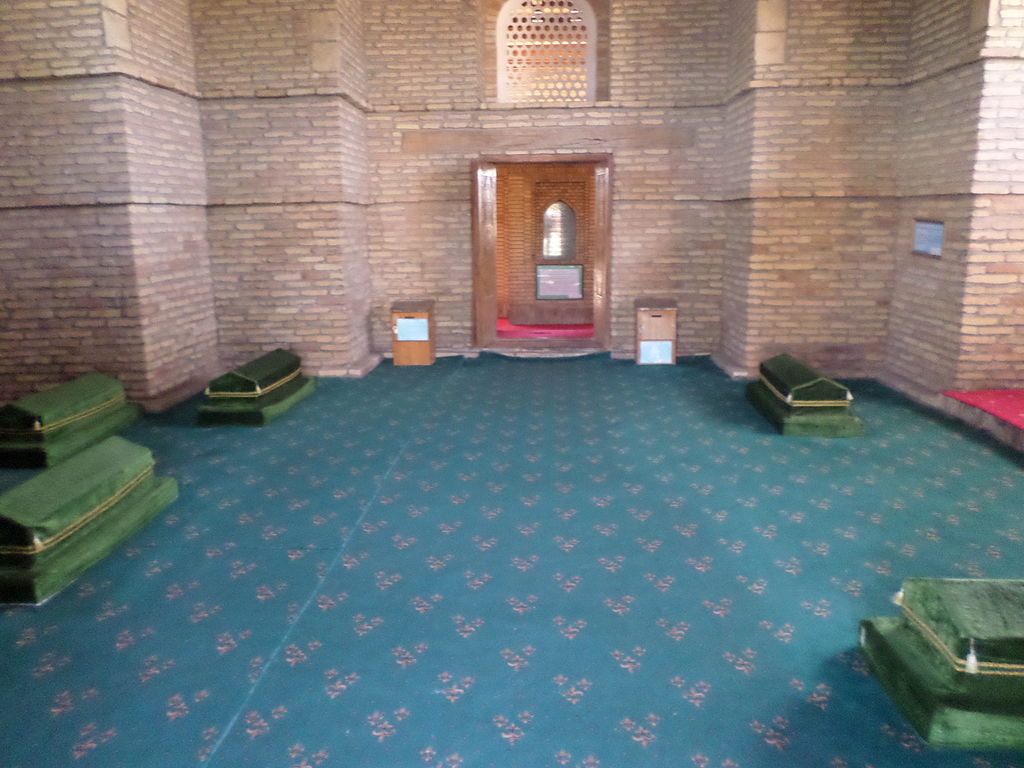
To the south of the main building, in a small courtyard, are later burial places. If you carefully examine the front facade, you can read the names of the architects who participated in its construction, as well as the date of completion.
During the Soviet period, when the authorities fought against Islam, the mausoleum of Kaffal ash-Shashi was closed. However, believers continued to visit it. On March 27, 1945, the Council of People’s Commissars of the Uzbek SSR by Resolution No. 410 transferred seven of the most visited mazars, including the mausoleum of Kaffal ash-Shashi, from the jurisdiction of the Architecture Department under the Council of People’s Commissars of the Uzbek SSR to the Spiritual Administration of Muslims of Central Asia and Kazakhstan (SADUM). Today, the burial place of Abu Bakr Kaffal ash-Shashi has become a pilgrimage site for many Muslims from around the world.
Sources:
https://legacy.uz/znakomstvo-s-mavzoleem-al-kaffal-ash-shashi/
https://ru.wikipedia.org/wiki/Мавзолей_Каффаля_Шаши
https://www.advantour.com/rus/uzbekistan/tashkent/kaffal-shashi.htm