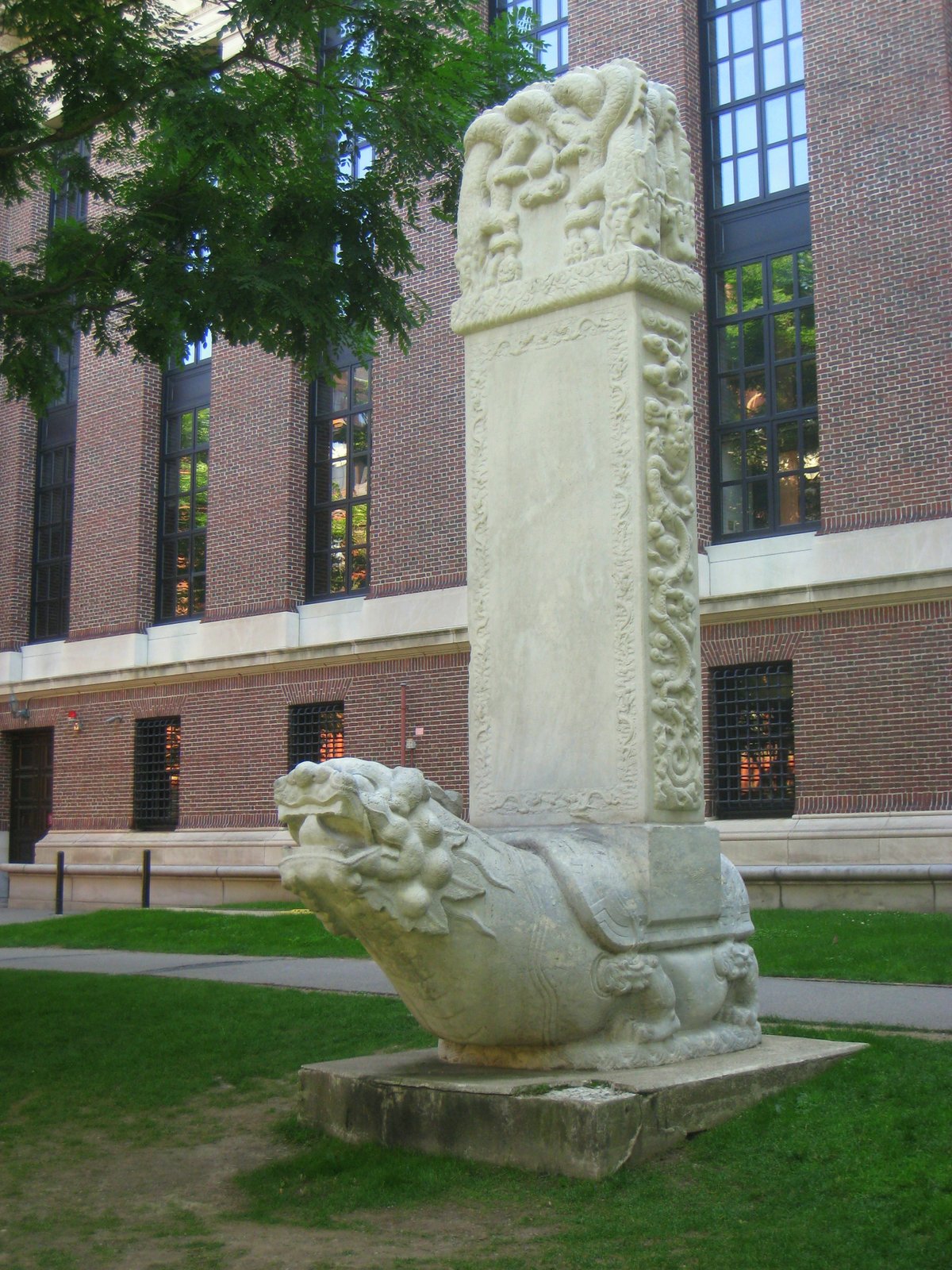
A 17-foot marble stele rests on a turtle pedestal. The Jiaqing Emperor ordered its carving in Beijing around 1820 and gave it to the governor-general of Jiangsu and Jiangxi as a gift. It survived the 1860 destruction of the Old Summer Palace during the Second Opium War. The meticulous carvings of dragons chasing pearls on the sides and top of the marble tablet are the only traces that indicate the stele's imperial past.
Chinese alumni gifted the stone to Harvard in 1936 to celebrate the university's tercentenary. New inscriptions were carved into the marble, and it was believed that Shih Hu was the calligrapher. These words praised the growth of intellectual knowledge. However, it was unclear why the official English translation provided by Dr. J. Heng Liu in 1936 did not contain a part of the inscription in which the Harvard Chinese alumni expressed hope for a brighter and more prosperous China.
Acid rain and severe weathering have made many of the inscriptions on the stele illegible. In the early 1980s, the Fogg Museum Conservation Department proposed moving the 27-ton block to the Holyoke Center Arcade, but the plan was abandoned due to financial cost. While plans were later made to relocate the stele to the Center for Government and International Studies in 2005, it remained in the Harvard Yard.
Sources: Wikipedia, OpenStreetMap, Wikidata, Wikimedia Commons


Written by Leroy
Discuss this with the author and others
No comments yet. Be the first to start the conversation.