
At the beginning of the 19th century, the Russian Empire faced the issue of relocating the most important fairs from remote areas to major cities. The idea of moving the ancient fair near the Makaryev Monastery to a location more convenient for trade arose at the very beginning of the century and was connected with the fact that the annual spring floods of the Volga destroyed the trading buildings as well as the riverbank itself, reducing the usable area, while the demand for the latter was only increasing. Nikolai Rumyantsev, Minister of Commerce from 1802 to 1810, proposed moving the fair to Nizhny Novgorod, located upstream on the Volga. Supporting this, there remains an imperial-approved city plan from 1804 featuring the fair, as well as a preserved copy of its project by the St. Petersburg architect Andreyan Zakharov.
For unclear reasons, however, the fair remained in Makaryev until 1816, when a large fire destroyed all its buildings except for one stone structure. In the same year, Nikolai Rumyantsev became the main initiator of relocating the fair to Nizhny Novgorod, and in 1816–1817 several projects for its transfer to the provincial city were developed. At the end of 1816, the issue was considered by the Committee of Ministers, and at the request of Count Alexey Arakcheev, a leading specialist in engineering and construction, the chairman of the Committee of Buildings in St. Petersburg, Augustin Betancourt, was invited to resolve it. Betancourt was eventually approved as the chief builder of the fair. In the first years, the market was held in temporary booths, while complex geodetic and hydraulic engineering works were simultaneously carried out for future capital construction.
The fair project was entrusted to architect Auguste Montferrand, who served as a draftsman in the Committee of Buildings under Betancourt’s leadership.

A graduate of the French architectural and urban planning school, Auguste Montferrand designed the Nizhny Novgorod Fair as a majestic ensemble, similar to the largest urban complexes of Paris of his time. The laying of the Spassky Cathedral took place on August 1, 1818, and by the summer of 1822, workers were finishing interior decoration. According to the decree of the Holy Synod dated July 5, the main altar in honor of the All-Merciful Savior, the origin of the Honorable Relics of the Holy Life-Giving Cross of the Lord, was consecrated by Bishop Moisey on July 25, ten days after the consecration of the main building of the fair—the Main House. The ceremony was solemn: salutes were fired from cannons on ships moored on the Volga and Oka rivers, and Governor Alexander Kryukov arranged a grand ceremonial lunch for the clergy, nobility, officials, and merchants. On August 1, the altars in the side cathedral chapels were consecrated—in honor of Alexander Nevsky on the northern side and in the name of St. Macarius, the Wonderworker of Zheltovodsk and Unzha, on the southern side. At that time, a procession was also held from the cathedral to the Oka River to bless the water.
The main concept of the architectural ensemble of the Nizhny Novgorod Fair according to the first 1804 project belonged to Andreyan Zakharov. The layout project highlighted three parts: a large square with the Main House; 48 trading buildings with a 21-meter-wide street running through the middle; and a church defining the main compositional axis of the Gostiny Dvor complex. Montferrand, taking on his own project, built upon Zakharov’s developments, repeating the general compositional axis while preserving the number and size of almost all buildings, but also introduced significant changes.
The architect paid special attention to the cathedral square, which was only outlined in Zakharov’s project. Montferrand decided to assign the cathedral the role of the sole dominant of the fair, giving the building a powerful and majestic silhouette. Numerous surviving sketches and facade variants of the fair buildings testify to the architect’s desire to impart architectural and compositional unity to the fair center, which was evident in the effort to link the facades and plans of various buildings, especially the administrative buildings and the cathedral.
In developing the overall composition, Zakharov and Montferrand were guided by the main architectural ensembles of France from the 18th to early 19th centuries. The general plan of the fair reflected the planning principles of the Tuileries Garden, the Champ de Mars, and the Place de la Concorde in Paris. The layout of the latter had much in common with the fair’s composition, especially in the approach of ending a street with a religious building. The placement of the cathedral in the ensemble reflected Montferrand’s experience in building the Madeleine Church, which served as the terminus of a street leading from the Place de la Concorde. Both temples shared a common situation on the site—the completion of a long street with a religious building; the distance from which the temple is visible in the street’s perspective; and the overall proportional scheme.
The main compositional axis of the ensemble consisted of administrative buildings, the Spassky Cathedral, and three squares of different character. This axis began with flagpoles on the bank of the Oka and ended with the cathedral, with a distance of about 800 meters between them. The cathedral, 39 meters high, served as the main vertical dominant. The entire fair composition ended with a square in front of the Spassky Cathedral. The main street, designed as a kind of wide boulevard 29 meters wide and stretching 445 meters, led to the square. The street was closed off by the Main House and the cathedral, respectively. The cathedral square, measuring 61 by 73 meters, was flanked by the cathedral building and the four Chinese Rows. All three squares on the main axis of the fair were united by Montferrand into a single compositional whole with the dominant volume of the cathedral, clearly demonstrated in the perspectives created by the architect in 1822.
The design of the cathedral, as well as the entire fair, took place throughout 1818. In the project drawings, the church was called the Church of St. Macarius. The execution of the Spassky Cathedral project coincided with Montferrand’s design of St. Isaac’s Cathedral in St. Petersburg, which may have contributed to some similarity in their appearance. While working on the St. Isaac’s Cathedral project, the architect had to consider the plan of an already existing building, but in the fair project, he was able to realize a completely different concept: the cathedral was a building with a regular cruciform plan and a pyramidal silhouette. The cathedrals had similar compositional constructions, only the capital temple was somewhat elongated along the main axis. Comparing Montferrand’s 1820 perspective drawing of St. Isaac’s Cathedral with a similar drawing of the Spassky Cathedral, it is noticeable that they are similar in viewpoint and silhouette. When designing the Spassky Cathedral, the architect first used techniques such as compositional centrism and pyramidal silhouette, which later became requirements for him when designing St. Isaac’s Cathedral. Nevertheless, Montferrand was able to achieve a fully centric composition only in the fair cathedral project.

In numerous sketches, Montferrand worked out the most concise solution for the cathedral’s composition, starting from general volumetric-spatial characteristics and ending with architectural details of the interior and facades. The search for the overall composition was evident already in the initial plan variant, according to which the church was a centric building with a large under-dome space and four chapels. The facade drawing of the first variant has not survived, but based on the plan, the building was supposed to be crowned with a large dome raised above the main volume, with semicircular niches in the corners of the central square, and the entrance from the trading part marked by a six-column portico.
Another drawing showing a different facade variant contained a note in French made by the architect himself: “General Betancourt found it significantly more beautiful than sketch No. 2.” Thus, the relationship between the chief builder of the fair, Augustin Betancourt, and architect Montferrand was correct and tactful. The architect took into account the opinion of the experienced builder Betancourt and listened to his advice. Betancourt, in turn, gave design advice: in the initial sketch of the fair cathedral, the central dome seemed too large to him. Montferrand reworked the facade, on the sketch of which he personally wrote: “Since General Betancourt found it too significant, I made sketch No. 2. De Montferrand.”
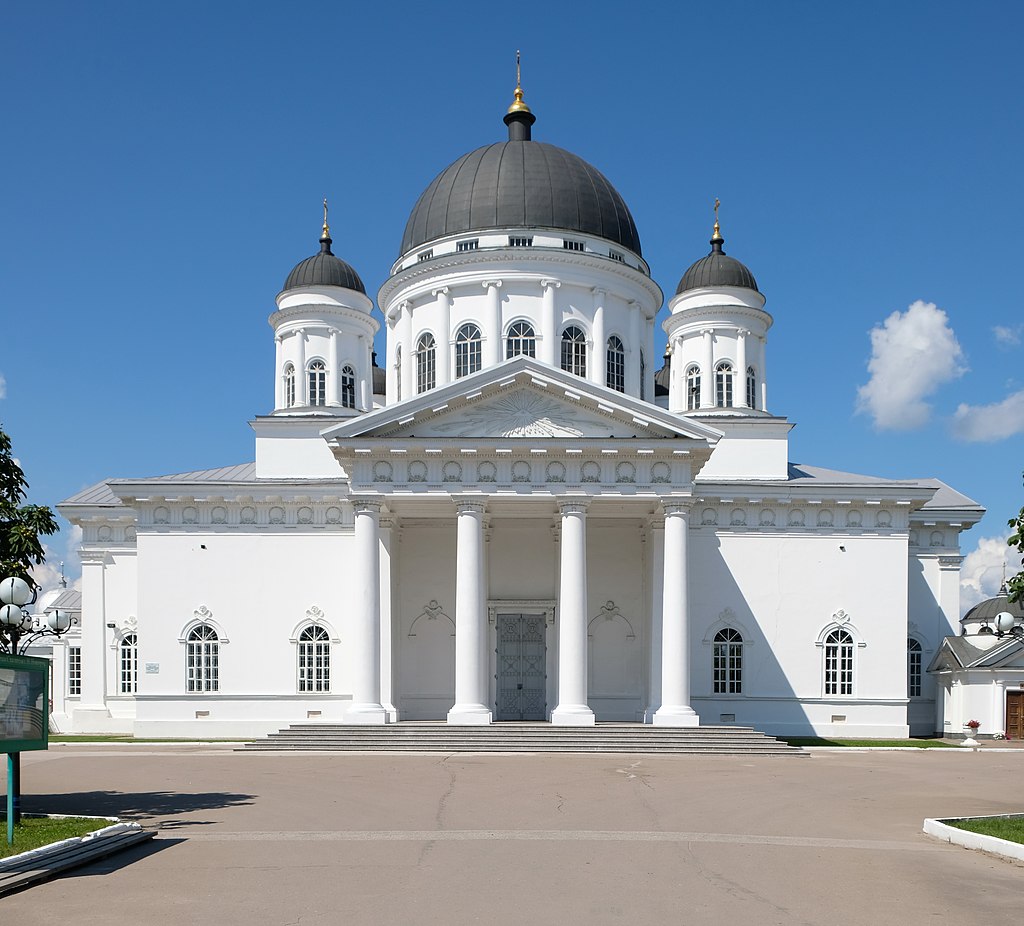
According to the second drawing, the cathedral plan became more compact: the volumes of the side vestibules were significantly reduced, the church received five domes, with the central one becoming a dominant rotunda, and Ionic order columns appeared in the piers of the tall drum windows. The architect chose for the domes not the shape of hemispheres but elongated ellipses, taking into account perspective natural foreshortening. The walls of the first floor in this variant were treated with rustication, against which the six-column Ionic portico looked impressive. A similar order was applied to the drum of the central dome.

Another facade drawing of the church, close to the final cathedral variant, has been preserved, distinguished by a more contrasting combination of masses of the central and side dome drums, with all drums decorated with Ionic columns. The walls of the lower tier no longer had rustication. The main volume was crowned with an entablature with triglyphs, and the six-column portico was replaced by a four-column one. Overall, the cathedral in this variant acquired a more monumental architectural structure.
The centric composition of the Spassky Cathedral was based on a square plan of 25 by 25 meters with three vestibules and an altar. The cathedral plan was cruciform: rectangular volumes executed in an individual manner were attached to the main square base on the four cardinal points. The main altar was located in the eastern volume, the western one housed a covered entrance with two windows and a porch, and the northern and southern sides were decorated with porticos with additional entrances.
The church is characteristic of Russian Empire style architecture and is distinguished by the purity and harmony of its compositional structure. The centric composition with a clear cruciform plan places the building among the most significant constructions of Russian architecture of the high classicism period.
The 1822 perspective of the Spassky Cathedral showed the overall unity of the composition, the harmonious combination of the small and central domes, as well as the role of the portico in the overall facade design. The portico highlighted not the main western facade but the southern one, which faced the trading part (the main street of the fair). The architect took into account all the features of the cathedral’s location in the ensemble and positioned the building so that it would be most harmoniously perceived from the trading area.
When compared with Montferrand’s design of St. Isaac’s Cathedral, a common striving for a traditional classicist pyramidal silhouette can be found in both buildings, significantly enriched by the completion with five hemispherical domes. Montferrand designed the central dome to be more massive than the smaller ones, making it dominant in the entire composition. Such a composition, based on the combination of a cruciform volume and a centrally located rotunda, belongs to one of the types of rotunda churches that became widespread in Russian architecture in the late 17th to early 18th centuries. The surge in the construction of such buildings occurred in the 1810s–1830s and was primarily related to the fact that in 1808 the Russian Empire purchased the right to repair the dome of the Church of the Holy Sepulchre, which had collapsed due to fire. The nationwide fundraising attracted great attention to rotundas and subsequently to their widespread use in construction.
The type of rotunda church applied in the architecture of the Spassky Cathedral represents an example of a pure classicist rotunda raised on a kind of podium. The rotunda volume in this form may not be clearly read in the building’s exterior, but since the interior space, connected with non-central interior elements (naves or conches), is arranged around the vertical axis of rotation, the visual perception follows a centrifugal model. In this case, the center of spatial perception becomes the main under-dome part, emphasized by the second light. A similar structural-compositional construction in Nizhny Novgorod architecture was found in the Arzamas Resurrection Cathedral, built according to the project of architect Mikhail Korinfsky.
Montferrand created the proportional construction of the cathedral facades using techniques such as inscribed squares and inscribed equilateral triangles. The facades of the vestibules fit into squares, and the main volume of the cathedral along the facade was formed by two squares. Again, the square was the basis for the relationship between the quadrangular main volume and the central dome. The proportions of the small domes along the facade also corresponded to square proportions. As a result, the facades gave the church a clear pyramidal structure based on the geometry of the square and the equilateral triangle.
The Spassky Cathedral became the first five-domed building in the classicist style in Nizhny Novgorod architecture. Auguste Montferrand, in his theoretical works, spoke positively about the traditional five-domed composition of Russian churches, considering the scheme of one large dome and four equally sized smaller domes the most preferable. In the architect’s five-domed churches, he was attracted by the “picturesqueness of the silhouette, the variety of artistic features based on contrasting combinations of heights and volumes.” After the completion of the Spassky Cathedral, several similar buildings were soon constructed in the city: the Cathedral of the Exaltation of the Cross Monastery (1823), the Assumption Military Cathedral (1827), the Alexey Church of the Annunciation Monastery (1834), and others. The image of the Spassky Cathedral, as a perfectly constructed classical building of capital level, influenced not only the fair ensemble but also became a model for imitation in the architecture of Nizhny Novgorod.
The cathedral’s exterior was decorated with details characteristic of the Empire style in the spirit of ancient Roman architecture. The central dome of the church is adorned with sixteen half-columns with Ionic capitals, installed between sixteen large and sixteen small windows; the small domes have eight half-columns of the same order between eight windows. Small cupolas with apples and gilded crosses rest on the domes.
Directly from the quadrangle, triangular pediments extend on all four sides of the cathedral. The volumes of the altar and vestibules are decorated with pilasters. The building is adorned with porticos on the north and south sides. Originally, the southern ceremonial vestibule facing the trading buildings had not only a four-column portico but also two separate Roman Doric columns behind it in the center. The northern vestibule had only a four-column Doric portico. The eastern altar part and the western vestibule were decorated only with pilasters, giving the cathedral a distinctly individual architectural and artistic solution.
The cathedral walls are covered with cement plaster and whitewash. Ornaments and plaster figures, also whitewashed, are located in the pediments, on cornices, and in other places.
During the design work on the Spassky Cathedral, Auguste Montferrand revealed himself in a new light as a mature master of interior design. Judging by the architect’s surviving theoretical works, the ideological content of religious architecture was of great importance to him, as was the question of filling the church with religious meaning without contradicting its functional essence. Montferrand saw the solution in the organic combination of architecture and fine arts, believing that “an architect must develop an understanding of painting and sculpture: then he will better perceive the imperishable idea embedded in the building’s architecture.”
The cathedral’s interior space was imbued with the “spirit of pure and solemn forms of classicism,” and the abundance of architectural forms and stucco ornament harmoniously combined with painting and culminated in a powerful dome with rich decorative design. Large windows of the powerful dome drums allowed maximum use of upper light, which is why special attention was paid to the elaboration of stucco decoration: the vault of the central nave, decorated with coffers with rosettes and abundant stucco, rested on a wide projecting entablature belt, which visually rested on attached columns. The festive appearance of the interior was enhanced by the pastel color scheme of the walls and narrative painting of the pendentives of the crossing and pilasters. Finely detailed Corinthian capitals of pilasters and other decorative interior elements are a vivid example of the strict architecture of the 1820s. All models of stucco products and ornaments for the cathedral were specially made by the St. Petersburg sculptor and decorator Fridolino Torichelli.
The composition of the interior space was based on the building’s structural scheme: the central under-dome space was organized by four massive pentagonal pillars connected by four large arches. The pillars were connected to the walls by eight smaller semicircular vaults. Inside, the light drums of the domes and the cathedral walls were lined with attached half-columns and pilasters with Corinthian capitals. All arches, vaults, and cornices were covered with geometric and vegetal stucco ornaments.
The organization of the cathedral’s interior space had its peculiarities during construction. According to the recollections of the first cathedral psalmist Ivan Sokolov, Betancourt and Montferrand, as non-Orthodox, believed that the divine liturgy could be performed multiple times on the same altar during the day, which is why the main altar and holy altar space received an elevated, elongated space to the east. In turn, no separate space was provided for the side altars. On the sides, under the small domes, special rooms were planned, lowered relative to the main altar solea by three steps: on the north—for the tabernacle; on the south—for the sacristy.
Deficiencies in the organization of the interior space became apparent during the cathedral’s construction, and to satisfy the need to conduct at least two liturgies daily due to the large number of parishioners during the fair, the rooms under the small domes were converted into side altars. The rooms under the roof of the northern pediment were adapted for the sacristy and church utensils. As a result, the side altars were separated from the main one by partitions; their space was dark and cramped, and there were no choirs, so the singing of the clergy and chanters took place in front of the soleas among the worshippers. After construction, the provincial authorities managing the cathedral could no longer correct these shortcomings.
Since the Strelka area was sparsely populated at the time, the cathedral could not have its own parish, but the state scale of the Nizhny Novgorod Fair forced the diocesan leadership to pay special attention to the spiritual needs of visiting merchants. A government decree stipulated: “The fair church, having no and unable to have any special parish, cannot be an ordinary parish church, and therefore constitutes the second, cathedral, fair cathedral of provincial Nizhny Novgorod.” The first city cathedral was the Transfiguration Cathedral in the Kremlin.
The Spassky Cathedral became the first five-domed building in the classicist style in Nizhny Novgorod architecture. Auguste Montferrand, in his theoretical works, spoke positively about the traditional five-domed composition of Russian churches, considering the scheme of one large dome and four equally sized smaller domes the most preferable. In the architect’s five-domed churches, he was attracted by the “picturesqueness of the silhouette, the variety of artistic features based on contrasting combinations of heights and volumes.” After the completion of the Spassky Cathedral, several similar buildings were soon constructed in the city: the Cathedral of the Exaltation of the Cross Monastery (1823), the Assumption Military Cathedral (1827), the Alexey Church of the Annunciation Monastery (1834), and others. The image of the Spassky Cathedral, as a perfectly constructed classical building of capital level, influenced not only the fair ensemble but also became a model for imitation in the architecture of Nizhny Novgorod.

In 1882, the clergy began correspondence with the authorities about a major repair of the cathedral, but the following year a fire occurred in the Kazan-Bogoroditskaya Church and the cathedral house. The buildings were repaired by March 1884 under the supervision of the fair architect Nikolai Ivanov. After fixing the cathedral buildings, the clergy returned to the issue of repairing the cathedral itself. In 1885, Governor Nikolai Baranov personally invited architecture professor Ernest Giber to Nizhny Novgorod to inspect the cathedral, who left the following review of the building’s condition: “Although the cathedral is very close to collapse, it will stand through this summer, as the recent flood of the Volga and Oka rivers was very mild and did not flood its foundation part, but most likely, at the first major spring flood, the cathedral building will collapse.”
The governor proposed closing the cathedral to visitors and prohibiting worship services. On August 18, 1885, Bishop Modest wrote to the governor that he “fully agreed with the opinion of the technicians, expressed in two protocols and the act of a special commission on the urgent need for a fundamental reconstruction of the old fair cathedral, with its complete dismantling.” At that time, the issue of preserving the ensemble of the Russian classicism period was not raised. The chairman of the Moscow Architectural Society, Nikolai Nikitin, expressed the opinion that the cathedral should be demolished because its architecture did not correspond to the tastes of the time: “The cathedral building is foreign, in the so-called pseudo-classical style, which prevailed then due to contempt for Russian and complete ignorance of it. …Foreign forms of the temple must be replaced by Russian ones.” However, the merchant class, especially Moscow merchants trading in the fair’s center, in the Gostiny Dvor, opposed the demolition of the Spassky Cathedral. For this reason, the merchants found an architect capable of correcting its defects without dismantling the old building. This architect was the famous Nizhny Novgorod civil engineer Robert Kilevain.
In September, Kilevain began studying the cathedral’s foundation through excavations and boreholes. At the same time, fundraising for repairs began. The first to donate a large sum of 75,000 rubles to the cathedral was Alexander Kuznetsov, heir to the city mayor Gubin. In February, it was reported that Robert Kilevain had found a way to save the cathedral from destruction: with the help of reverse arches under the main load-bearing points and laying the entire foundation with similar arches. Construction work continued until September 30, 1886, under the supervision of Peter Boytsov.
Between 1886 and 1888, a new foundation was created from ironstone bricks, bonded during masonry and plastered on the walls with Portland cement; the cathedral’s basement was rebuilt; a new floor of Tarusa marble was raised higher; the walls were overlaid with large white stones; the porticos were rebuilt. A steam fire pump was installed for pumping out spring waters. At Kilevain’s suggestion, the side chapels were rebuilt. The thoroughly repaired cathedral was reconsecrated on July 20, 1888. On July 24, the Alexander Nevsky chapel was consecrated, and on July 31, the Makaryev chapel.
In 1899, there was a threat of destruction and collapse of the nearby bell tower church. During construction work, a restoration project was made, but the fact that it was an interesting monument in the classicist style was not taken into account. It was decided to dismantle the bell tower and rebuild it in a new location, which was chosen not on the cathedral’s planning axis but in front of its western facade, destroying the symmetry of the entire ensemble. Nevertheless, the proximity of the Spassky Cathedral required architects Pavel Malinovsky and Ermigeld Michurin to create a new building stylistically similar to the cathedral’s architecture. The new bell tower was completed by 1906.
After the October Revolution, the Soviet government pursued an atheist policy. Churches were confiscated from believers, cult objects were destroyed, and clergy were often repressed. Many churches were demolished, but some with cultural and historical value were transferred to museum authorities. The Spassky Cathedral was classified as a first-category protected monument, but its iconostasis and church utensils were destroyed.
Between 1922 and 1929, the Nizhny Novgorod Fair was still held, had fairly large trade turnover, acquired an all-Union character, and became the central market for handicrafts trade. In 1928, the Spassky Cathedral building was leased to the military department for use as a food warehouse. The cathedral bell tower was demolished, and the remaining buildings of the temple complex were allocated for apartments. On February 6, 1930, a government decree was adopted to liquidate the fair, becoming one of the last steps in ending the NEP policy.
In the 1920s–1930s, most of the former fair buildings were converted into housing, and soon a slum district formed there. Of the religious buildings, only the Spassky and Alexander Nevsky cathedrals survived. In the 1940s–1950s, the fair served as a kind of “quarry” for newly constructed residential buildings. Since the 1970s, its district became a zone of major urban redevelopment due to plans to move the city center from the historic upper part of the city to the left bank of the Oka. Over time, the area around the cathedral was built up with typical five-story buildings, and the church found itself on the periphery of the new urban composition.
In 1977, Metropolitan Nikolai was appointed to the Gorky diocese. At that time, there were only three Orthodox churches in the city—the Transfiguration Church in Starye Pechyory, the Trinity Cathedral in Vysokovo, and the Transfiguration Church on Karpovka—which could not accommodate all believers, and attempts to open a new parish were unsuccessful. Only during the “perestroika” period did the authorities meet the metropolitan halfway. The Regional Council of People’s Deputies, in a decision dated November 16, 1988, resolved to transfer the vacant church to the believers. The cathedral was returned to the diocese on April 24, 1989.
The cathedral was handed over to the church in very poor condition: according to eyewitnesses, the building was in a semi-ruined state, the interior screeds were cut, the main dome was collapsing, and large cracks gaped in the walls. The diocese immediately began restoration work. In an interview with the newspaper “Gorky Worker,” Archbishop Nikolai noted: “Our cathedral is very similar to St. Isaac’s Cathedral in Leningrad; unfortunately, over the past half-century, it has lost its former beauty and presents a rather shabby sight… We intend to restore it to its original form, in accordance with all historical documents.” In 1989, the archbishop established a special “church-restoration” council, whose members searched for information about churches listed for restoration, primarily the Spassky Cathedral. The main restoration work was planned to be completed that same year. According to archival photographs, interior repairs had already begun, and a large church icon of the Savior Not Made by Hands was discovered. In April, the cathedral received cathedral status, and despite the repair work, services immediately resumed on Saturdays and Sundays.
Construction and restoration work on the cathedral’s restoration continued for a long time, throughout the 1990s and 2000s. The cathedral’s iconostasis was lost during the Soviet era. Its restoration began in the 1990s by the method of recreation. The work was completed in November 2005.
On September 12, 2009, the Spassky Cathedral ceded its cathedral status to the second fair church—the Alexander Nevsky New Fair Cathedral, which by then better corresponded to the title of the main church of the diocese: the latter, being the third tallest cathedral in Russia, was the main architectural dominant of the Strelka and accommodated more parishioners.
Sources:
https://ru.wikipedia.org/wiki/Спасский_Староярмарочный_собор


Written by Jermaine
Discuss this with the author and others
No comments yet. Be the first to start the conversation.