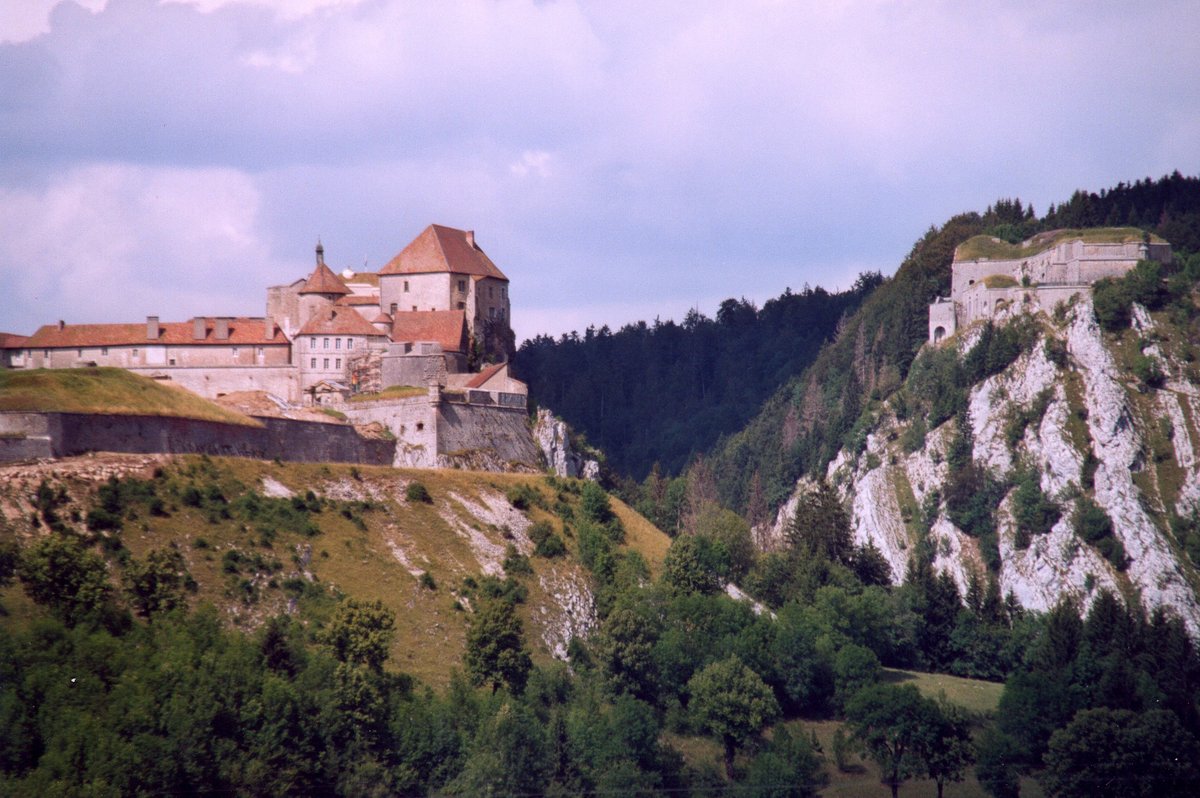

The Fort de Joux, located in La Cluse-et-Mijoux, Doubs department, France, has been built, rebuilt and modernized over a thousand years. It was initially planned as a wood castle by the lords of Joux in the 11th century, before being transformed into a stone castle in the 12th century. In 1454, Philip the Good, Duke of Burgundy, bought the château and turned it into a border fort, adding new buildings and a moat. The château was later renovated by several other rulers, including Charles the Bold, Louis XIV, and most famously, Vauban during the 17th century as part of the Maginot Line.
Over the centuries, the Fort de Joux was used as a prison for several famous figures, including Toussaint Louverture (leader of the Haitian Revolution), Mirabeau and Heinrich von Kleist. Today, the château is a monument historique and contains one of the deepest wells in France, which is covered and is now the third deepest at about 100 metres (approximately 330 feet).
Sources: Wikipedia, OpenStreetMap, Wikidata, Wikimedia Commons
Written by Nicolo Ciampini
Discuss this with the author and others
No comments yet. Be the first to start the conversation.