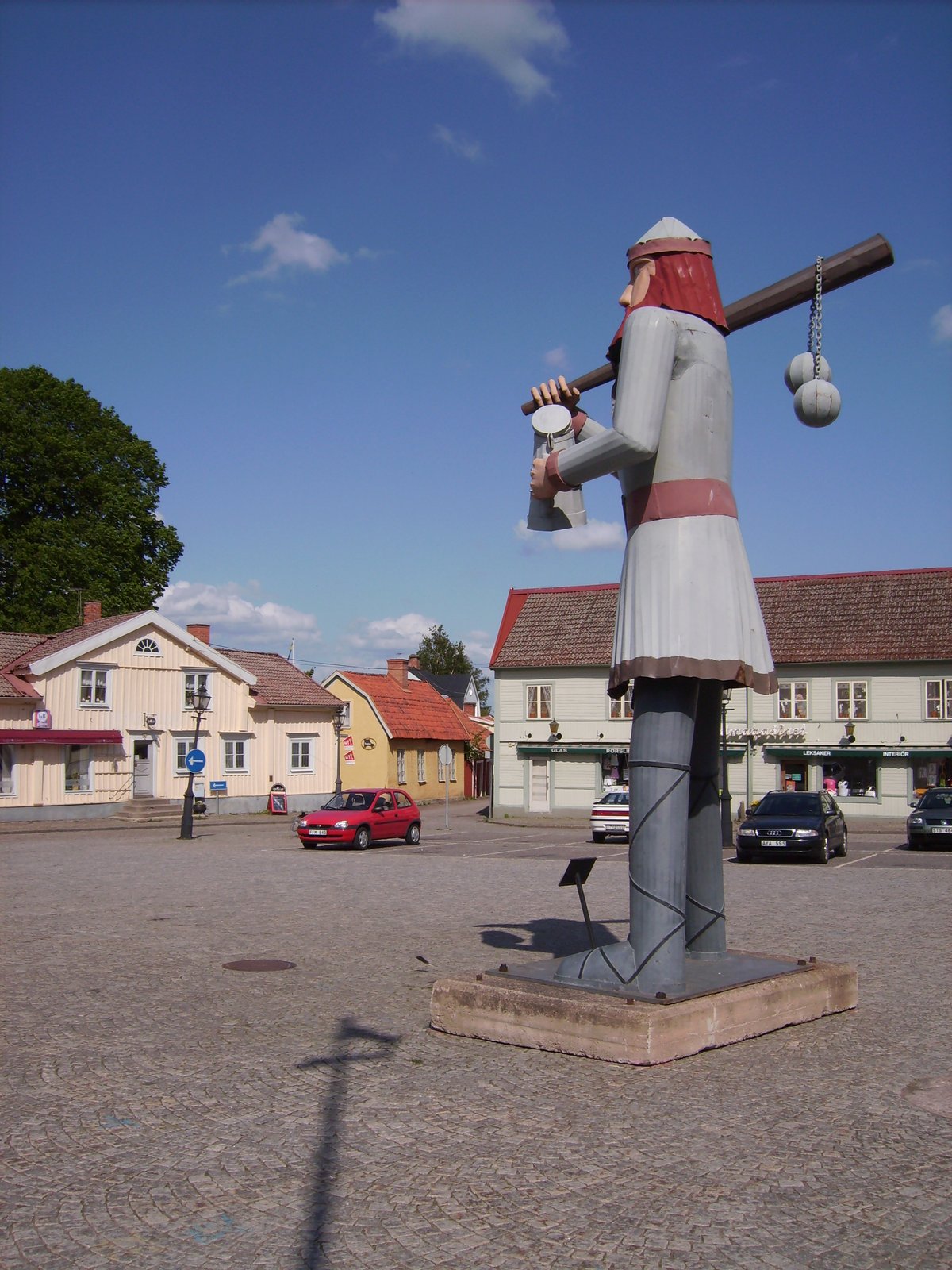

Ture Lång is the counterpart of continental Rolandsstatyer associating Hanseatic cities, including Skänninge. During the Middle Ages, Skänninge had lively connections with these cities. The statue was likely brought there by German immigrants who settled in Skänninge. The statue tradition was created after several hundred years of fighting between feudal power, imperial power, and city dwellers in Germany. The immigrants also erected a similar statue in Visby and a revision of it in Stockholm, where the Stortorget's kopparmatte depicted a man with a stick.
Club-bearing statues exist, e.g. in Münster. In the Tyrol, Hall, a statue alternates between bearing sword and club. Club-bearing statues also exist in the former German colonies in Siebenbürgen (Transylvania, now in Romania). The tall statue of Ture Lång on Ture Lång in Skänninge was erected on a place of general interest to honor the deeds of famous men. Olaus Magnus (1490-1557) wrote about the giant statue of Ture Lång on Ture Lång in Skänninge in his historical work on the Nordic peoples.
Another source about the statue in Skänninge is Johannes Bureus' work Sumlen, which refers to Per Bältare, who allegedly saw the statue: 'Ty war Ture lång (a large wooden statue standing there to commemorate it in the middle of the large square) was sitting there. The tall statue over the Pillory in Stockholm was not as imposing, standing at 45 centimeters. There is no information about Visby's Roland statue, but its existence is confirmed by a map from the 1700s, where a small square bears the name 'Roland'.
Professor of archaeology Oscar Almgren wrote about Ture Lång: 'If we know a Roland in Visby only through the name, we are confronted with a similar giant statue of Ture Lång on Ture Lång in Skänninge, which through its gigantic size, its placement and its attributes invites us, like Olaus Magnus 400 years ago, to make comparisons with the North German Roland statues. Almgren notes that the name in Skänninge is Swedish, but that the entire arrangement is German-influenced and that the prototype of the statue is likely to have been taken from Germany, where club-carrying Roland statues have existed since the 1200s.
Almgren also suggests that if the prototype had been a Swedish Tors statue, as suggested by some, Ture would have carried a hammer or ax instead of a club. Debate remains over the stop that Ture Lång holds in his hand, with opinions divided: some think it was a fixed measurement for the city, while others question whether it played a role in games. Ture Lång has a history of being associated with 'striking the cat out of the tunnel', a game often played during Rolandsstoderna festivities.
It is likely that Ture Lång has stood at approximately the same location as the current replica, as indicated on a map from 1795. There was supposedly a depiction of Ture Lång inside Vårfrukyrkan (Church of the Virgin) as per Johan Engdahls handskrift om Skänninge from 1753. The current Ture Lång statue was placed on the location in 1990 and was made by local blacksmiths Bo and Stefan Asp from Asp & Karlsson in Skänninge. Following a 2006 referendum, the statue was decided to remain on the square.
Sources: Wikipedia, OpenStreetMap, Wikidata, Wikimedia Commons
Written by Nik Frost
Discuss this with the author and others
No comments yet. Be the first to start the conversation.