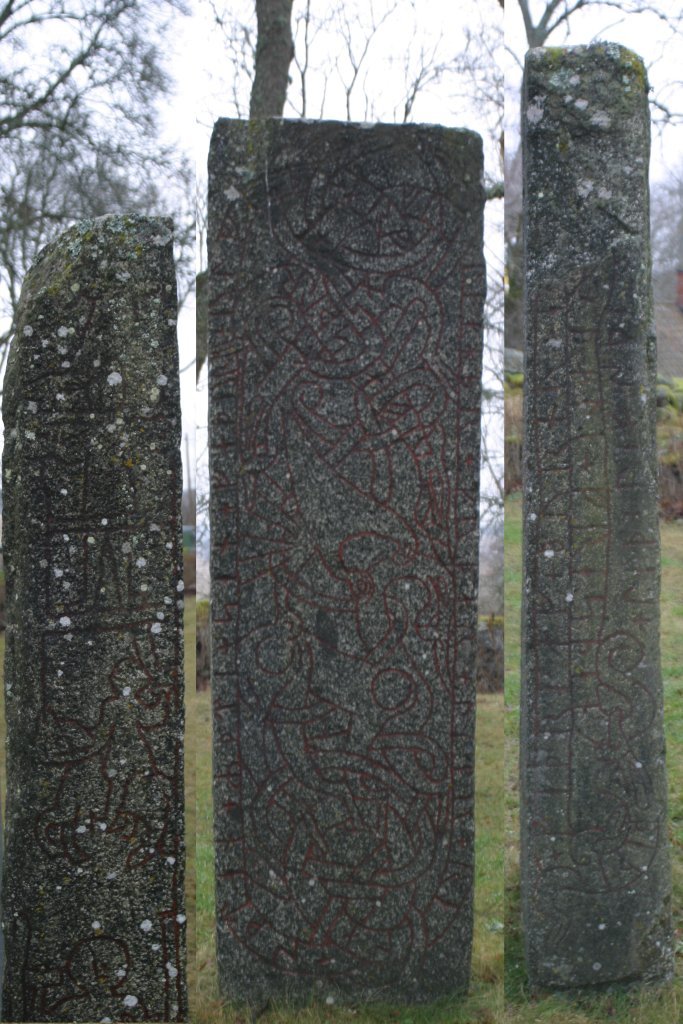

The Altuna Runestone (*Altunastenen*), listed as **U 1161** in the [Rundata](https://folkway.org/wiki/Rundata) catalog, is a [Viking Age](https://folkway.org/wiki/Viking_Age) [memorial](https://folkway.org/wiki/Memorial) [runestone](https://folkway.org/wiki/Runestone) with images from [Norse mythology](https://folkway.org/wiki/Norse_mythology) that is located in Altuna, [Uppland](https://folkway.org/wiki/Uppland), [Sweden](https://folkway.org/wiki/Sweden).
The Altuna Runestone is a granite stone 1.95 meters in height that was discovered in 1918 by a local historian in the wall of a chapel located near its current location. Before the historical significance of runestones was recognized, they were often used as materials in the construction of roads, bridges, walls, and buildings. It is one of few surviving runestones with exclusively [pagan](https://folkway.org/wiki/Norse_paganism) illustrations from Norse mythology.
Most surviving runestones were raised during the 11th century after the [Christianization of Sweden](https://folkway.org/wiki/Christianization_of_Scandinavia), and they were raised by people who wanted to show that they too adhered to the new faith, at least outwardly so, because at least half of the runestones have inscriptions related to Christianity. One side of the Altuna Runestone, however, illustrates a legend recorded in the *[Hymiskviða](https://folkway.org/wiki/Hymiskviða)* of the *[Poetic Edda](https://folkway.org/wiki/Poetic_Edda)*, in which the Norse god [Thor](https://folkway.org/wiki/Thor) fishes for [Jörmungandr](https://folkway.org/wiki/J%C3%B6rmungandr), the Midgard serpent.
Thor goes fishing with the [jötunn](https://folkway.org/wiki/J%C3%B6tunn) [Hymir](https://folkway.org/wiki/Hymir) using an ox head for bait, and catches Jörmungandr, who then either breaks loose or, as told in the *[Gylfaginning](https://folkway.org/wiki/Gylfaginning)* of the *[Prose Edda](https://folkway.org/wiki/Prose_Edda)*, the line is cut loose by Hymir. The *Prose Edda* provides the additional detail that while Thor was pulling on the line with Jörmungandr on the hook, his feet went through the bottom of the boat.
The image on the Altuna Runestone does not show Hymir, which may be due to the narrow shape of the stone, but it shows Thor, his line and tackle and the serpent, and notably, Thor's foot which has been pushed through the hull of the boat. This encounter between Thor and Jörmungandr seems to have been one of the most popular [motifs](<https://folkway.org/w/index.php?title=Motif_(visual_arts)&action=edit&redlink=1>) in Norse art. Three other [picture stones](https://folkway.org/wiki/Picture_stone) that have been linked with the myth are the [Ardre VIII image stone](https://folkway.org/w/index.php?title=Ardre_image_stones&action=edit&redlink=1), the [Hørdum stone](https://folkway.org/w/index.php?title=H%C3%B8rdum_stone&action=edit&redlink=1), and the [Gosforth Cross](https://folkway.org/w/index.php?title=Gosforth_Cross&action=edit&redlink=1).
Sources: Wikipedia, OpenStreetMap, Wikidata, Wikimedia Commons
Written by Nik Frost
Discuss this with the author and others
No comments yet. Be the first to start the conversation.