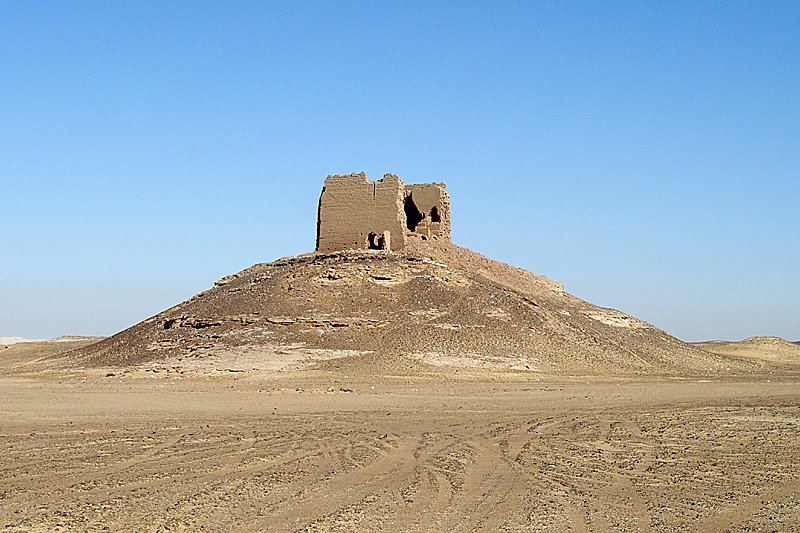

Located in the northern part of the Kharga Oasis in the Western Desert, Qasr El Gibb is an ancient Roman fort. It sits on a high hill about 45 km north of the city of Kharga and is situated just 2 km from Qasr Al-Semyiah, which is a replica of the fort and visible from the main road. As the largest Roman fort in the oasis, it served as the last water source during the Roman era. It was used as a watchtower and lighthouse to guide travelers entering and leaving the oasis, providing a view of the desert between the eastern and western slopes.
The fort was built from mud brick with exterior walls measuring 2.5 meters in thickness. It features round towers supported at the corners, connected to a barrier along the upper part of the walls. While the entrances on the east and south sides have collapsed, and most of the eastern wall has crumbled, the rest of the building remains in good condition. The southern wall still preserves its arched entrance. Originally, the building consisted of three floors, and a staircase remains on the southern side leading up to the barrier.
The interior of the fort contained many narrow, close-packed rooms. Six vaulted rooms for the garrison remain on the eastern and western sides of the courtyard. Beneath the fort is a system of water channels, which is part of a very complex and sophisticated hydraulic system connected to the oasis. Qasr El Gibb and Qasr Al-Semyiah were likely built together during the fifth century AD as part of a series of Roman forts in the Western Desert, and the Turkish army reused them during the Ottoman period.
Sources: Wikipedia, OpenStreetMap, Wikidata, Wikimedia Commons
Written by Mutabor
Discuss this with the author and others
No comments yet. Be the first to start the conversation.