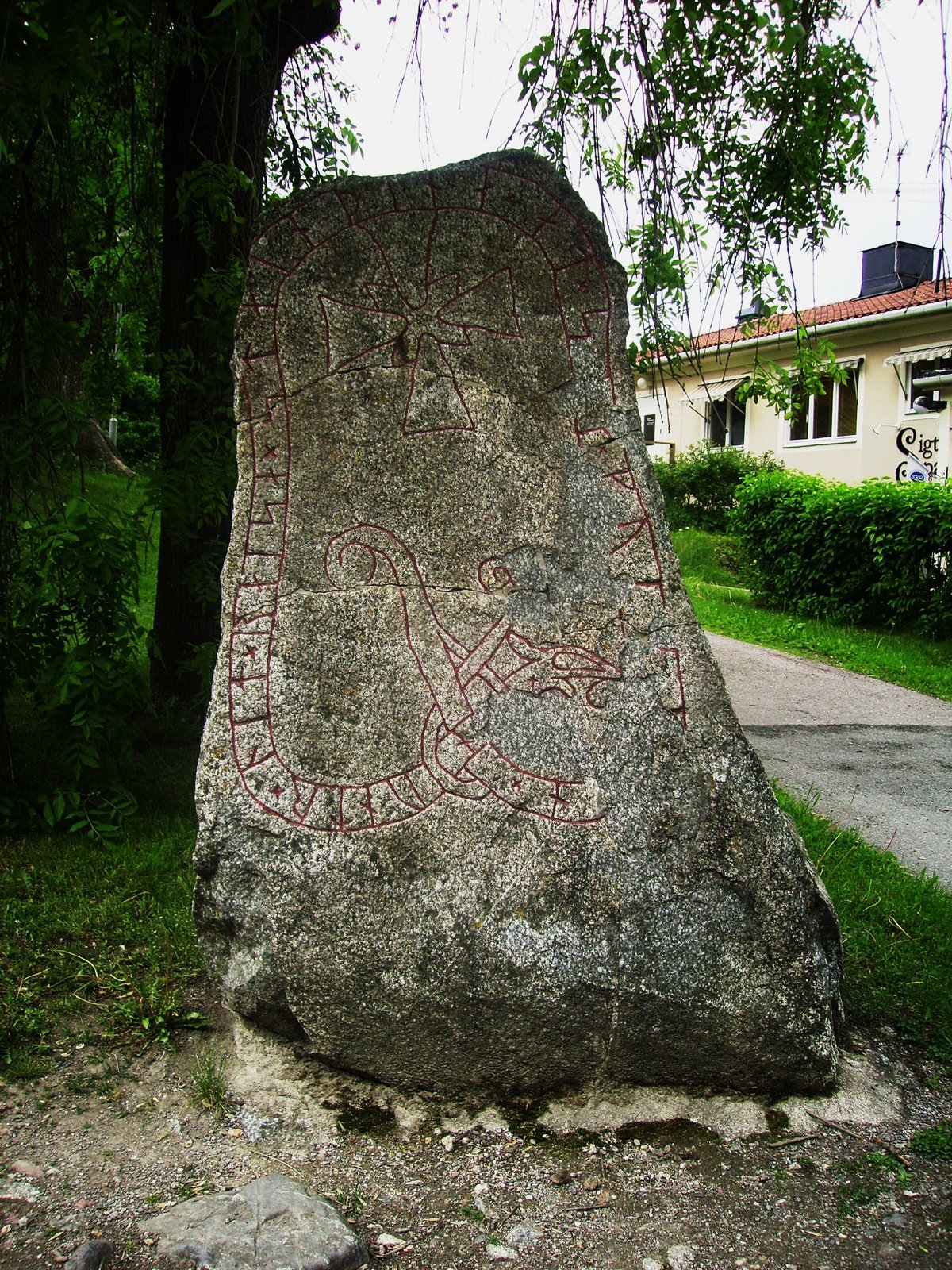

Standing tall in the heart of Sigtuna is a Viking-era runestone, measuring 230 cm in height and up to 55 cm thick. This granite monolith, carved in the heart of the 10th century, once served as a foundation stone in the northern wall of St. Lars church, a now-ruined structure. The runestone was unearthed in 1956 during excavation works in Stadsparken, Sigtuna's central park. The stone, which was once three times smaller due to pressure, has since been repaired and moved to its present location.
Today, it stands 192 cm above ground, with a breadth that varies from 123 cm at its base to 80 cm at its narrowest point at the top. Each of its runes measures between 7 cm to 10 cm. A layer of red paint, preserved as lead paint, can still be seen on the runestone, hinting at its installation in the church ground just a few decades after it was carved, providing an approximate dating for the church's construction. The carving on the stone is the work of a skilled and artistically competent carver, sharing similarities with other renowned carvers like U 255, U 267, U 269, and U 674, lending credence to the belief that the runestone was crafted by Fot.
In the inscription, it is written, 'Anundr let ræisa stæin þenna at sik kvik[va]n,' which translates to 'Anund allowed the erection of this stone after himself, while he was alive.'
Sources: Wikipedia, OpenStreetMap, Wikidata, Wikimedia Commons
Written by Nik Frost
Discuss this with the author and others
No comments yet. Be the first to start the conversation.