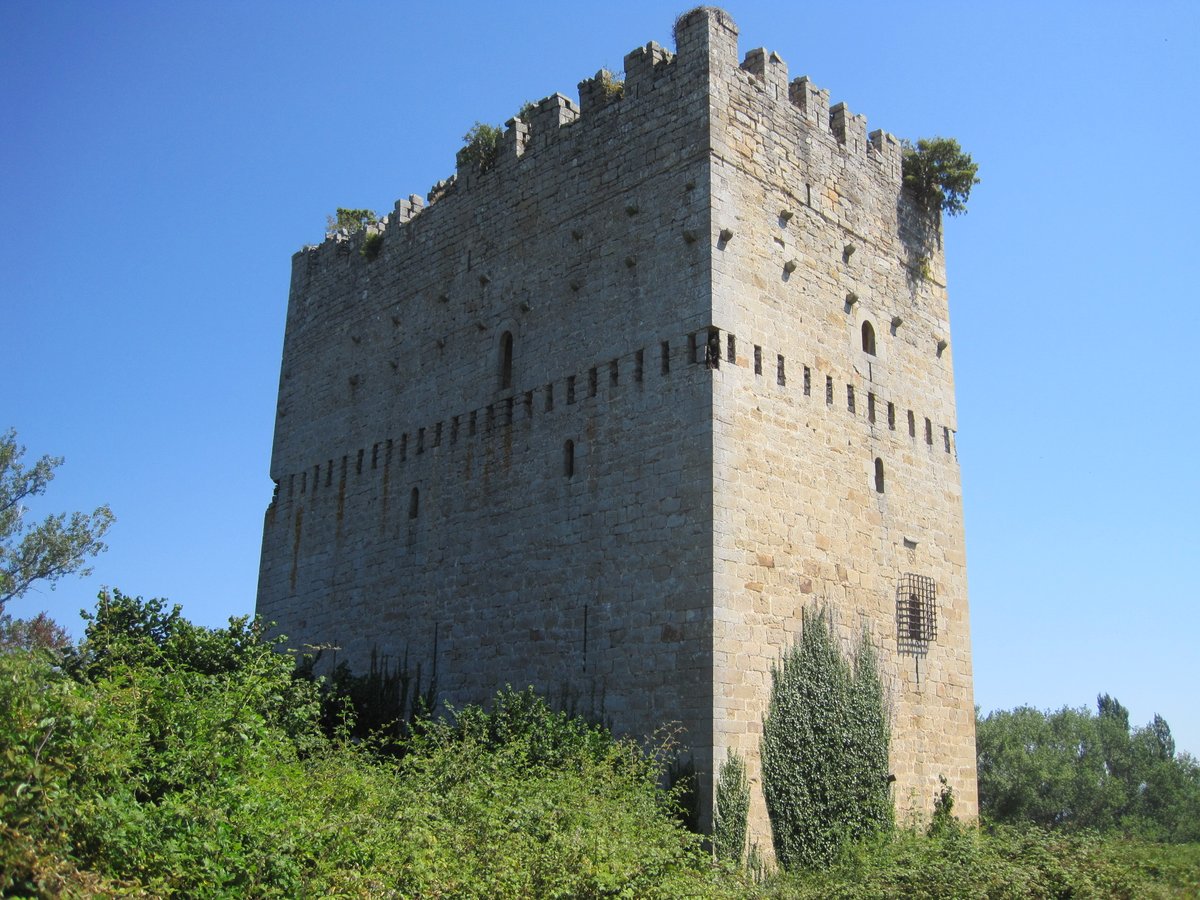

The Velasco's Tower, or Torre de la Riba, once stood as the stronghold of a powerful noble family in Espinosa de los Monteros, Spain. Built in the 15th century, it was the property of Juan de Velasco, who acquired it in ruins. The tower, with its distinctive ruffles and crenelated roof, had belonged to the Velasco family for centuries. But times change, fortunes shift, and the tower that once guarded the frontier fell into neglect. Only a few years ago, it was restored and protected as a monument, its story secured for future generations to explore.
The tower, or Torre de la Riba as it was known, is nestled in a sleepy Spanish village in Burgos, Castilla y León. It perched proudly on a hillside overlooking the town, its tall, slender form a stark contrast against the rolling hills of the surrounding countryside. Its red, unmortared bricks, aged and weathered, gave the tower the appearance of a crumbling ancient ruin, its walls adorned with battlements, arrow slits, and embrasures. The tower's original purpose was both defensive and residential – a fortress and a home, a seat of power for the Velasco family.
By the 15th century, the tower and its grounds had fallen into disrepair. Juan de Velasco, a member of the powerful and influential Velasco family, set about restoring the tower and turning it back into a residence. However, his plans were never fulfilled, and the tower remained a ruin – a picture of bygone splendor and power, a symbol of the past.
Over the centuries, the tower underwent many changes. At the beginning of the 20th century, it was used as a prison, and later, it was used as a workshop and storage facility. By the 1930s, the tower was in a state of disrepair, its walls crumbling and its roof collapsing. It was only in the 1940s, under the protection of the Spanish government, that the tower was saved from complete destruction.
On April 22, 1949, the generic decree protecting Spanish castles was signed by Generalissimo Francisco Franco and then Minister of Education José Ibáñez Martín. The decree made the tower, along with many others, a monument of national heritage, protected and preserved for future generations. Today, the Velasco's Tower stands as a protected monument, a testament to the power and grandeur of a bygone era. It is a rare example of a well-preserved medieval fortification, one that invites visitors to imagine the lives of the families who once lived and ruled within its walls.
The tower is significant not only for its historic value, but also for its literary connections. María del Carmen Arribas Magro, a local historian, wrote about the tower in her book 'Espinosa de los Monteros Los Montes de Somo y de Pas.' The book provides an interesting insight into the tower's history, the local people, and the surrounding area.
Visitors to the tower can explore the well-preserved ruins, step into the musty-smelling prison cells, and imagine the life of a noble family living within its walls. The tower, with its crumbling walls and battlements, stands as a powerful reminder of a bygone era, a time of power, intrigue, and cold, hard steel. The Velasco's Tower, once the seat of power for a noble family, now stands as a monument to the past, a testament to a time long gone, and a reminder of the eternal cycle of power and decline.
Sources: Wikipedia, OpenStreetMap, Wikidata, Wikimedia Commons
Written by Nik Frost
Discuss this with the author and others
No comments yet. Be the first to start the conversation.