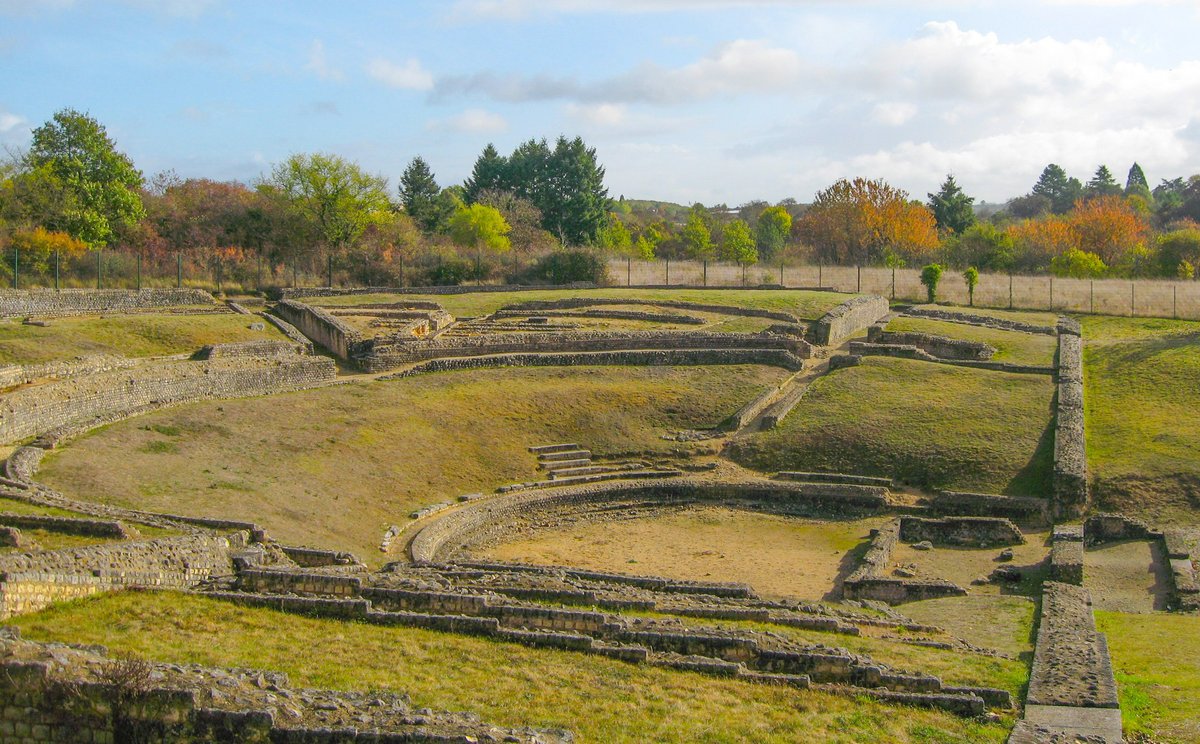

Argentomagus was a Roman city located in the Mersans plateau of central France, situated at a strategic point on the north bank of the river Creuse. It sat at the crossing of two major roads - one connecting Cenabum (Orléans) to Augustoritum (Limoges), and another from Limonum (Poitiers) to Avaricum (Bourges). The Latin name of the city meant "Silver Market," and the modern town of Argenton takes its name from this ancient site.
In pre-Roman and early-Roman times, the site was home to the Bituriges tribe. Following the Roman conquest circa 50 BCE, the city reached its peak during the Gallo-Roman period in the 2nd and 3rd century CE. During the late Empire, the Notitia Dignitatum recorded a government arms factory in the city. The inhabitants were active in metal smelting and bronze-smithing and practiced the cult of Mercury, along with the cults of the Earth Mother, Venus, and various warrior heroes.
The archaeological site is of prime interest because it shows how the settlement evolved from a Gaulish site into a Roman town. Substantial areas of the ruins have been excavated, revealing an amphitheatre, a Roman villa, a cemetery, and a thermal spring. Unique finds, such as a circular altar pedestal, have also been recovered. A local museum related to the site exists in Mersans.
Sources: Wikipedia, OpenStreetMap, Wikidata, Wikimedia Commons
Written by Nicolo Ciampini
Discuss this with the author and others
No comments yet. Be the first to start the conversation.