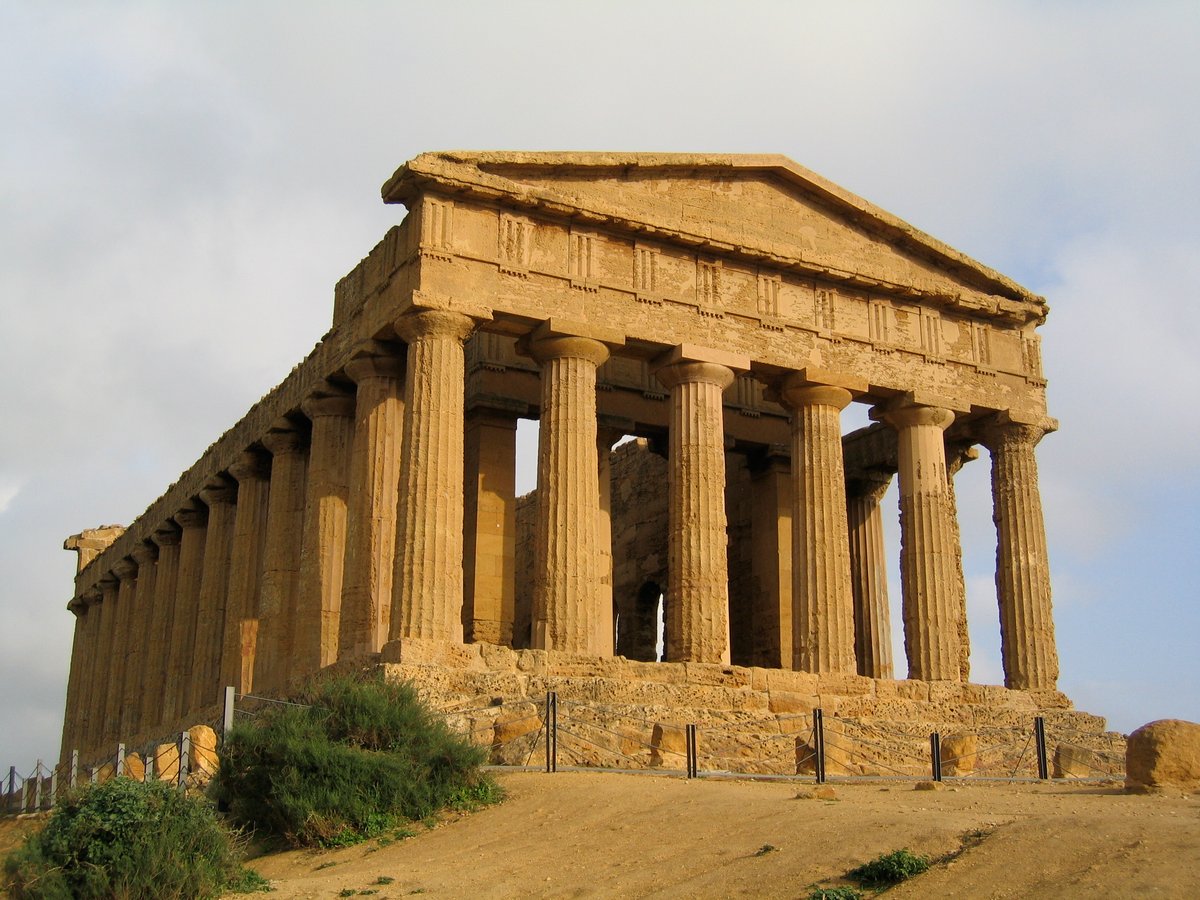

The Temple of Concordia, located in the Valley of the Temples in Agrigento, Italy, was built around 440-430 BC. It is one of the best-preserved Greek temples, particularly of the Doric order, but it breaks with the usual Doric symmetry. Instead of the typical eight columns, it sports a peristasis of six by thirteen columns and deviates from Doric precision. The cella measures 28.36 m × 9.4 m, and the columns are 6 m tall and decorated with twenty flutes and harmonious entasis. The temple was built on a firm base designed to overcome the unevenness of the rocky terrain. In the 6th century, it was converted into a Christian basilica, but the Christian alterations were removed during the 1785 restoration. Even though named after Concordia, the Roman goddess of harmony, the inscription found nearby holds no such connection.
Sources: Wikipedia, OpenStreetMap, Wikidata, Wikimedia Commons
Written by Nicolo Ciampini
Discuss this with the author and others
No comments yet. Be the first to start the conversation.