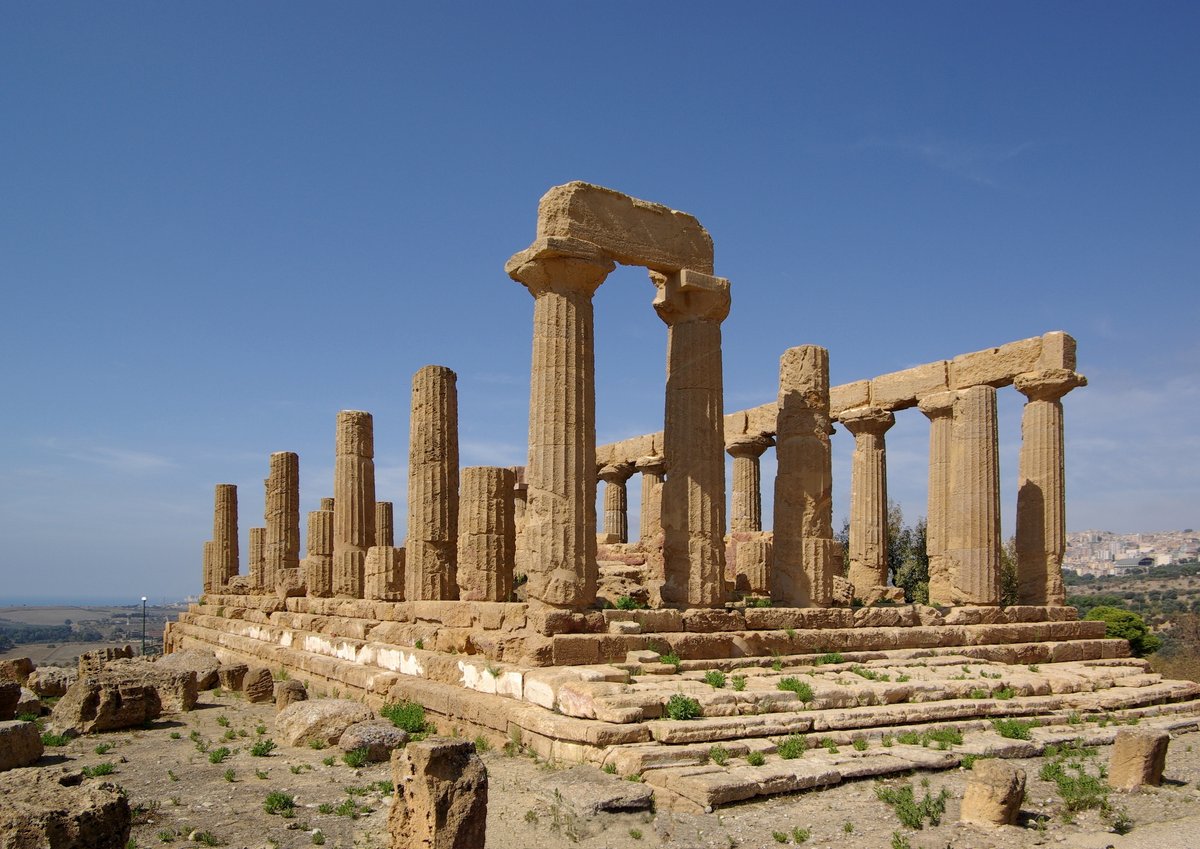

In Sicily's Valle dei Templi, a Greek Doric masterpiece hide – the Temple of Juno, or Temple D. Despite a misinterpretation by the Roman writer Pliny the Elder, who referred to another temple when he named this one 'Hera', it was built around 450 BC and is part of the Archaic Doric period. The temple shows signs of a fire that followed a massive battle and the sack of Akragas, the ancient name of the city, in 406 BC. It was later restored during the Roman era, and its original terracotta roof replaced with one of marble, with a steeper slope on the eastern side. The temple is a peripterotic Doric temple, with six columns on the short sides and thirteen on the long sides, a design influenced by Greek models and shared with its ‘twin’, the Temple of Concordia.
The interior of the temple is composed of a cella, with no internal colonnade. It is of the double antis type, with its pronaos mirrored by the opisthodomos, both framed by two ranks of columns. Two stairs for the inspection of the roof or perhaps for religious purposes were built into the wall separating the naos from the pronaos.
Sources: Wikipedia, OpenStreetMap, Wikidata, Wikimedia Commons
Written by Nicolo Ciampini
Discuss this with the author and others
No comments yet. Be the first to start the conversation.