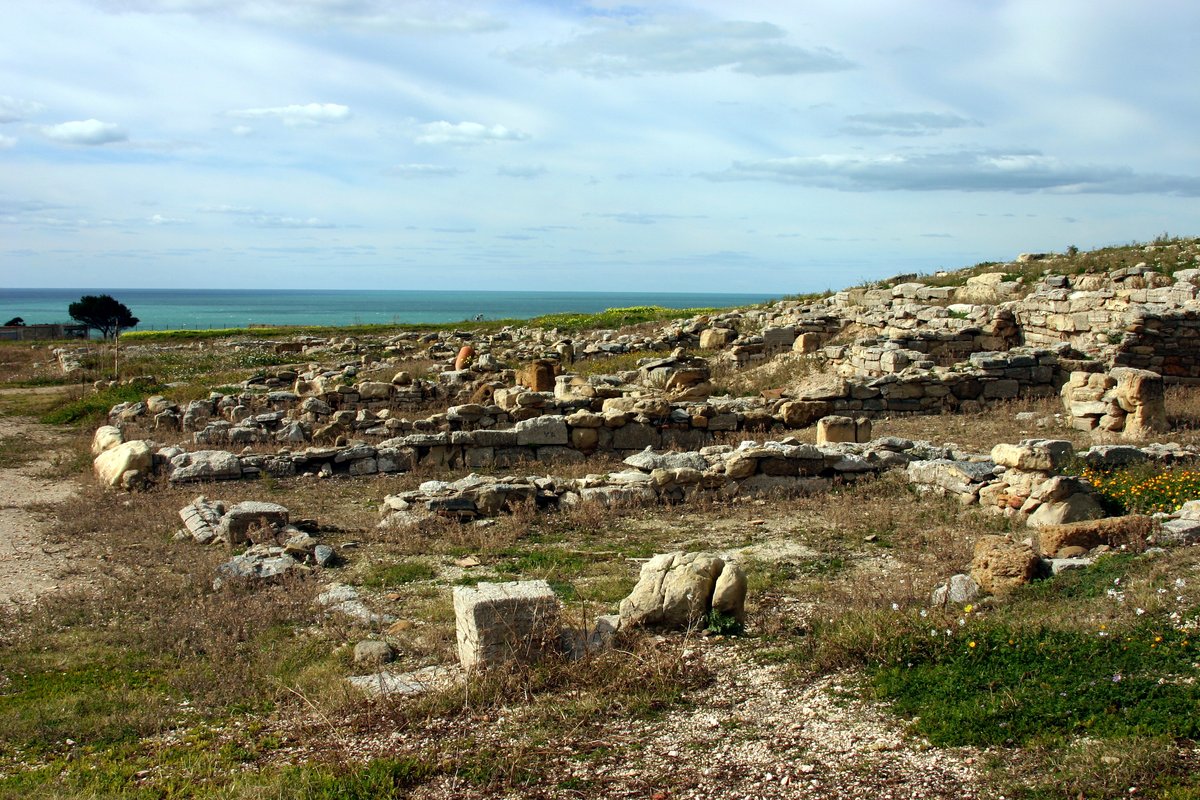

Heraclea Minoa was an ancient Greek city of Magna Graecia situated on the southern coast of Sicily near the mouth of the river Platani. It was founded in the middle of the 6th century BC as an outpost of the Greek colony of Selinus. The city was situated on a defendable promontory now called Capo Bianco, featuring sheer white cliffs to the ocean on its south side. It was eventually abandoned around the beginning of the 1st century AD.
The city's name is connected to two separate myths. One says Heracles obtained the right to the western portion of Sicily after vanquishing the local hero Eryx. Another says King Minos of Crete landed at the mouth of the river Halycus and founded a city called Minoa. Historically, the site was in contention between Selinus and Akragas for control of the Platani valley. Around 510 BC, Dorieus the Spartan attempted to reclaim the territory but was defeated and slain by the Carthaginians and Segestans. Following this, Euryleon made himself master of the city, which likely obtained the name Heraclea.
During the 5th century BC, the city was under Akragan control and became prosperous before being destroyed by the Carthaginians around 406 BC. It was won back by Dionysius in 397 BC but lost again in 383 BC. By 314 BC, it reappeared in history as an important city, though it was soon recovered by Agathocles of Syracuse. In 256 BC, during the First Punic War, the Carthaginian fleet of 350 ships was posted there as a naval station to prevent the passage of the Roman fleet, where it sustained a great defeat by the Roman consuls Regulus and Manlius.
Sources: Wikipedia, OpenStreetMap, Wikidata, Wikimedia Commons
Written by Nicolo Ciampini
Discuss this with the author and others
No comments yet. Be the first to start the conversation.