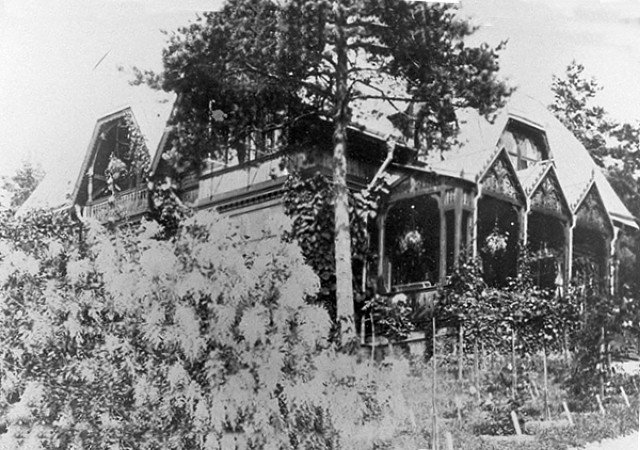

Kappsta was a summer villa built in Lidingo, Sweden in 1882. It was originally part of Skärsätra farm and was later owned by the Wallenberg family, where Raoul Wallenberg, a known humanitarian, was born in August 1912. Kappsta was located between Lilla Värtan, Skärsätra båtklubb, Villa Ekbacken, Nysätravägen, and Törnrosavägen. The area is approximately 12 hectares, similar to Kappsta naturreservat. Remains of a stone setting from the Iron Age are found on a nearby hill near Lilla Värtan (fornlämning RAÄ-nummer: Lidingo 5:1).
In 1881, a law change allowed for 1/5 parceling of the farm’s area, leading to a cottage-like settlement of summer homes on Lidingo land. Erling Ribbing, then-owner of Skärsätra, started to sell land for summer homes, including Rastaborg, Tykö, Oakhill, Solbacken, Fredriksberg, Nysätra, and Kappsta. Wisingska villan was built in 1882. The villa was built in the Swiss style with extensive wood paneling. The house was 300 m² and two stories high with a wide view over Lilla Värtan.
The villa was placed 12 meters above sea level near the edge of a cliff. A stone retaining wall was built around the house to support the land. A cellar is still preserved next to the house. The entrance steps were made of concrete. The facades were clad with standing and lying panels painted like other summer homes in the neighborhood, likely yellow with white trim or light green with dark green trim. The roof was tiled. The house was intended for summer use but could be heated with fireplaces and the kitchen’s hearth.
In 1883, Wising bought additional land and built a servant’s cottage, a barn, and Sjövillan which served as a guest house. Sjövillan was 100 m² smaller than the main building and similarly designed in the Swiss style.
In June 1917, Maj Wallenberg wrote: ‘Raoul Wallenberg was born at Kappsta in August 1912. Raoul Wallenberg spent many summers at Wisingska villan during his upbringing. Wisingska villan was used as a summer home by the family until the end of the 1920s. The main building of Kappsta burned down in 1931 after a lightning strike. Kappsta remained in the Wallenberg family’s possession until 1947. In the 1950s, Kappsta and other buildings burned down.
In 1960, the Kappsta area was owned by Östlunds Bygg AB. In 1974, the municipality of Lidingö prepared a general plan for a high-rise housing development for about 500 residents. The plans for Kappsta’s development were met with protests and demands to protect and preserve Kappsta as a green area. Lidingö municipality purchased Kappsta from Österlunds bygg in 1986 to prevent development. Kappsta Nature Reserve was established in February 1996. Today, the foundation of Wisingska villan remains, approximately 20x20 meters with two cast entrance stairs and a well-built cellar.
A memorial portfolio of Raoul Wallenberg, in bronze, was placed on the site in 2002. Minnesmärket Attachéväska R.W. was donated by Marcus Storch and was designed by sculptors Ulla Kraitz and Gustav Kraitz. Only Solbacken (Nysätravägen 19) and Fredriksberg (Nysätravägen 3) are preserved among the neighboring villas. Fredriksberg was built in 1883 for the Norwegian merchant David Dietrichsson. Villa Nidaros, which was Trondheims’ official exhibition pavilion at the Stockholmsutställningen 1897, was located on the Kappsta area. Villa Nidaros burned down after a lightning strike in July 1960, leaving only the foundation.
Sources: Wikipedia, OpenStreetMap, Wikidata, Wikimedia Commons
Written by Nik Frost
Discuss this with the author and others
No comments yet. Be the first to start the conversation.