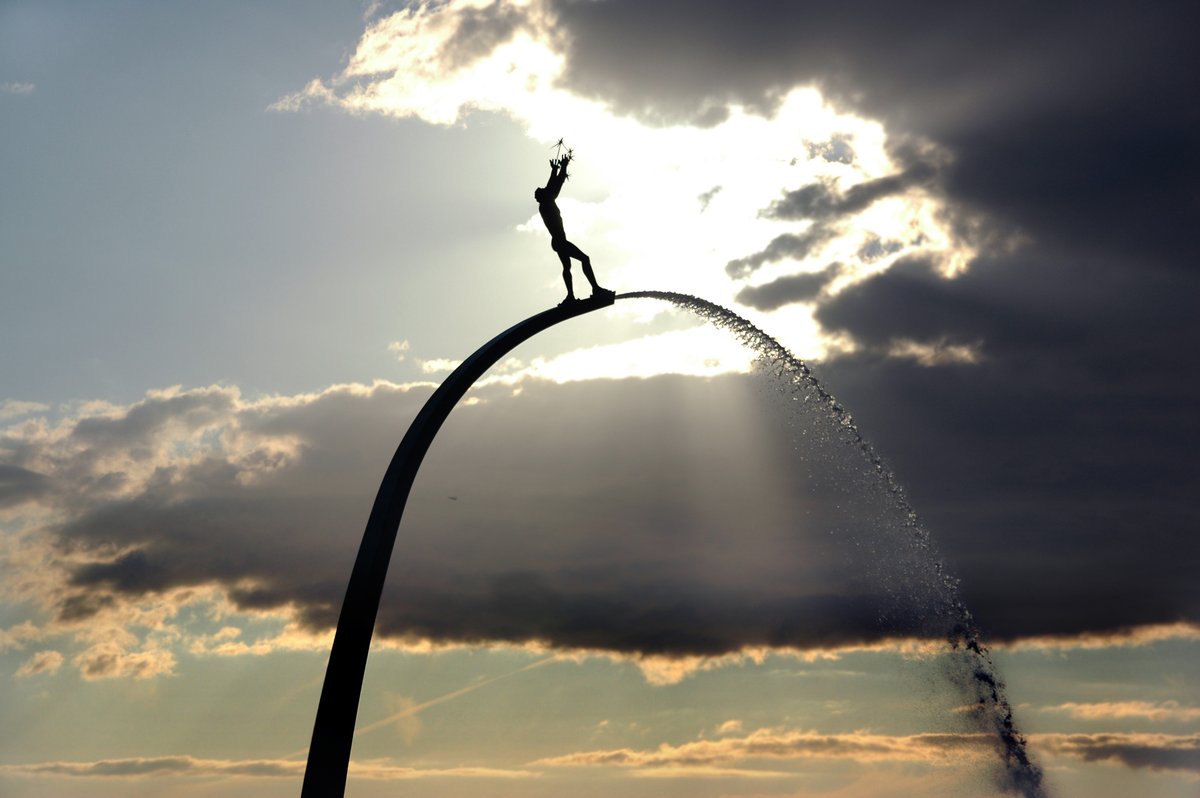

In 1946, Carl Milles began sketching Gud Fader på himmelsbågen as a profound symbol of global harmony. His original vision placed this masterpiece in Manhattan to mark the establishment of the United Nations. Despite this intent, the UN chose to prioritize different investments, causing the project to remain in a state of suspended animation for many years.
Realizing such a massive structure required a leap into modern engineering. The final result stands 23 meters tall and features a stainless steel arch measuring 18 meters to represent the heavens. This design captures the moment God reaches out while an angel offers him stars to scatter across the firmament. A water spray further extends the curve of the arch into the surrounding waves.
While Milles provided the core concept, his former student Marshall Fredericks completed the full-scale modeling in Detroit at the age of 84. The work moved to the Herman Bergmans foundry in Stockholm for casting. In 1995, King Carl XVI Gustaf and Queen Silvia inaugurated the work, where it remains a point of interest today in Nacka Strand.
Sources: Wikipedia, OpenStreetMap, Wikidata, Wikimedia Commons





Written by Nik Frost
Discuss this with the author and others
No comments yet. Be the first to start the conversation.